

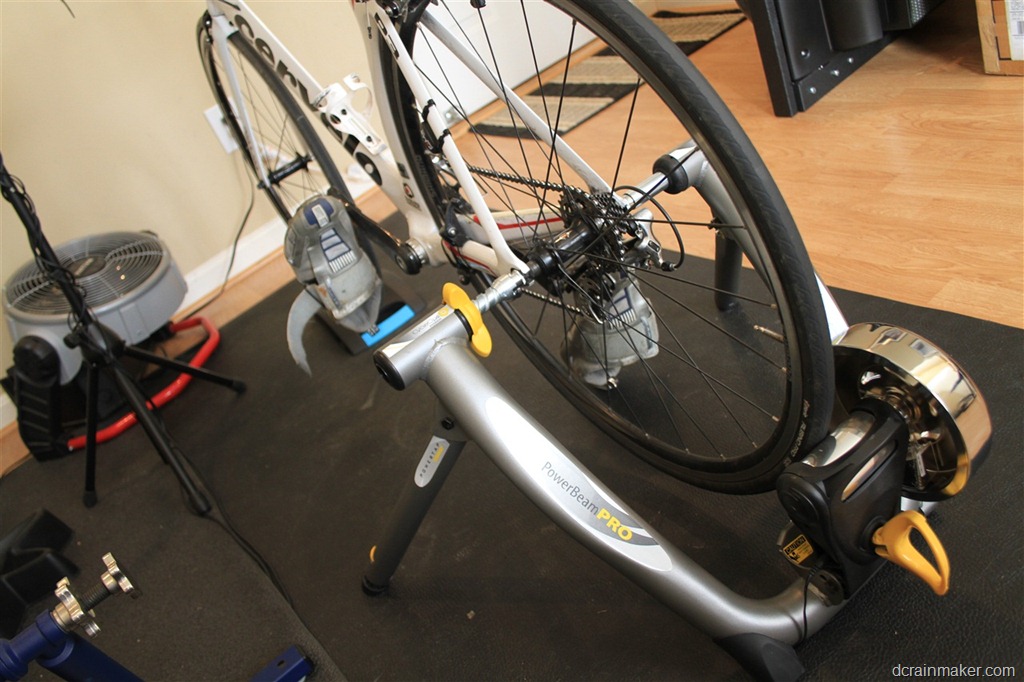
While the CycleOps PowerBeam Pro may be two years old, it’s one of the very few trainers on the market that allows specific wattage resistance control. Meaning, you can set it for a given wattage – i.e. 200w, and it’ll hold it. As such, it puts itself in the same class of units as the CompuTrainer and TACX platforms. And from a price standpoint, the unit is in the same range as those as well – about half-way in between the CompuTrainer and the Tacx Bushido. But what about features and functionality? And perhaps even more importantly considering the ‘history’ of most of the competitors in this class: How stable is the hardware and software?
Well, I set out to find out. Back in November the folks at CycleOps sent me out a unit to try out. However, there was a bit of a twist. This unit would actually serve two reviews and test cycles. The first is as you can buy it today – a trainer and a head unit to control resistance. The second though, is for testing and trying out their up and coming software suite, due to release later this fall. Ultimately, the unit will go back – like virtually everything else I test.
Speaking of which, like all my reviews, they tend to be pretty in depth (perhaps overly so) – but that’s just my trademark DC Rainmaker way of doing things. Think of them more like reference guides than quick and easy summaries. I try and cover every conceivable thing you might do with the device and then poke at it a bit more. My goal is to leave no stone unturned – both the good and the bad.
Lastly, at the end of the day keep in mind I’m just like any other regular athlete out there. I write these reviews because I’m inherently a curious person with a technology background, and thus I try and be as complete as I can. But, if I’ve missed something or if you spot something that doesn’t quite jive – just let me know and I’ll be happy to get it all sorted out. Also, because the technology world constantly changes, I try and go back and update these reviews as new features and functionality are added – or if bugs are fixed.
So – with that intro, let’s get into things.
Unboxing:
I’ve unboxed a lot of trainers lately, and without question – the PowerBeam Pro was the cleanest and easiest when it comes to unboxing and setup. Here’s where you start:
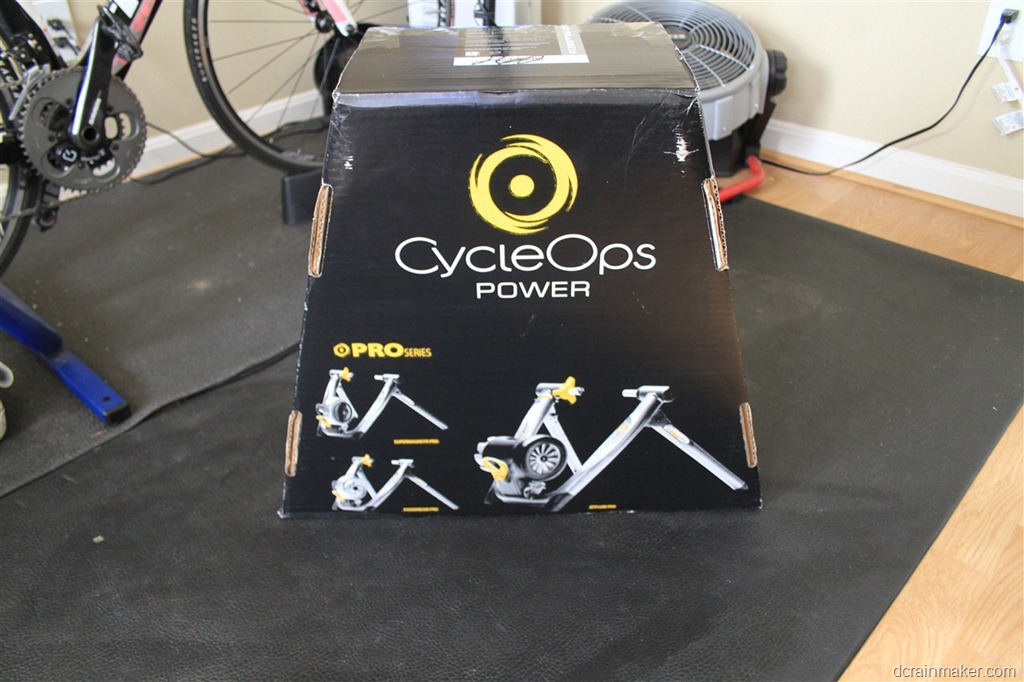
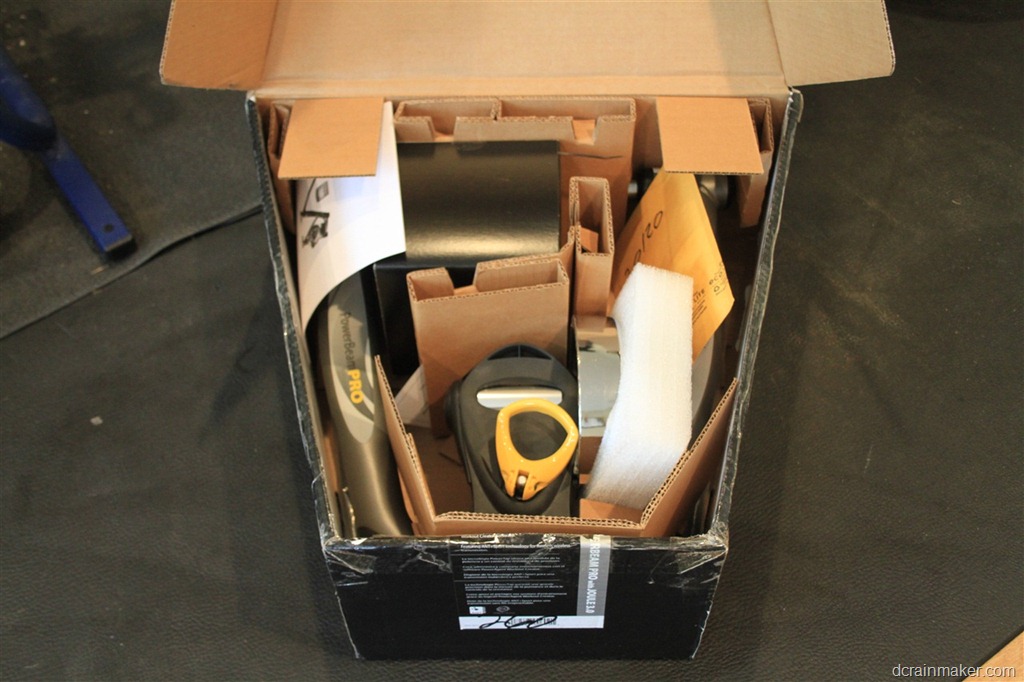
Inside the main box you’ll find the trainer itself, along with a smaller black box. This smaller black box contains the Joule 3.0 head unit and some mounts. Here’s the main parts though coming straight out of the bigger box:
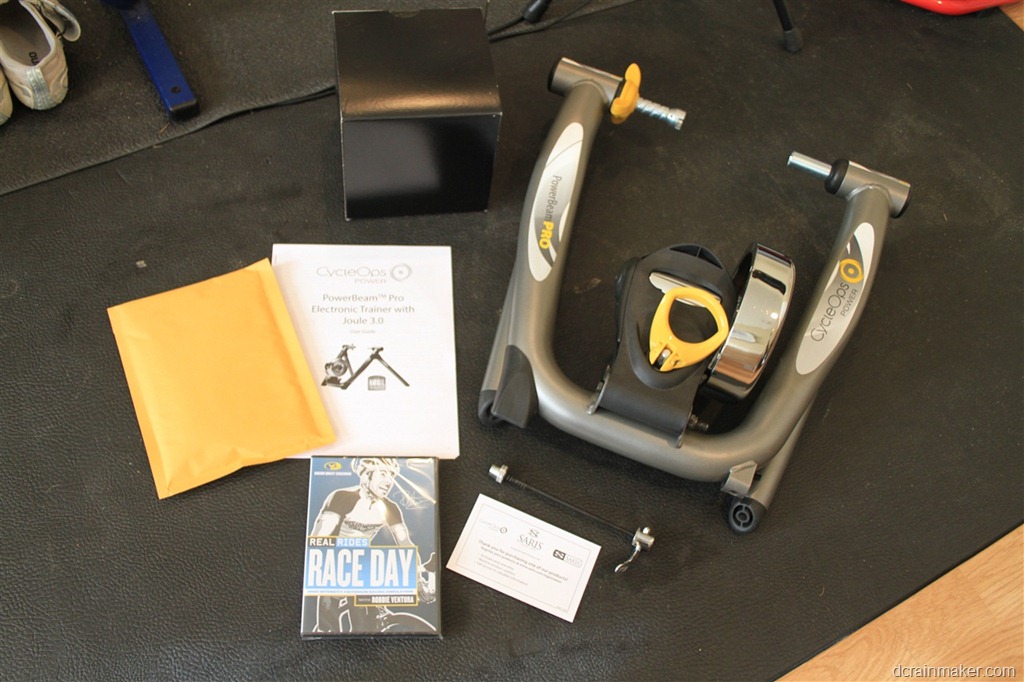
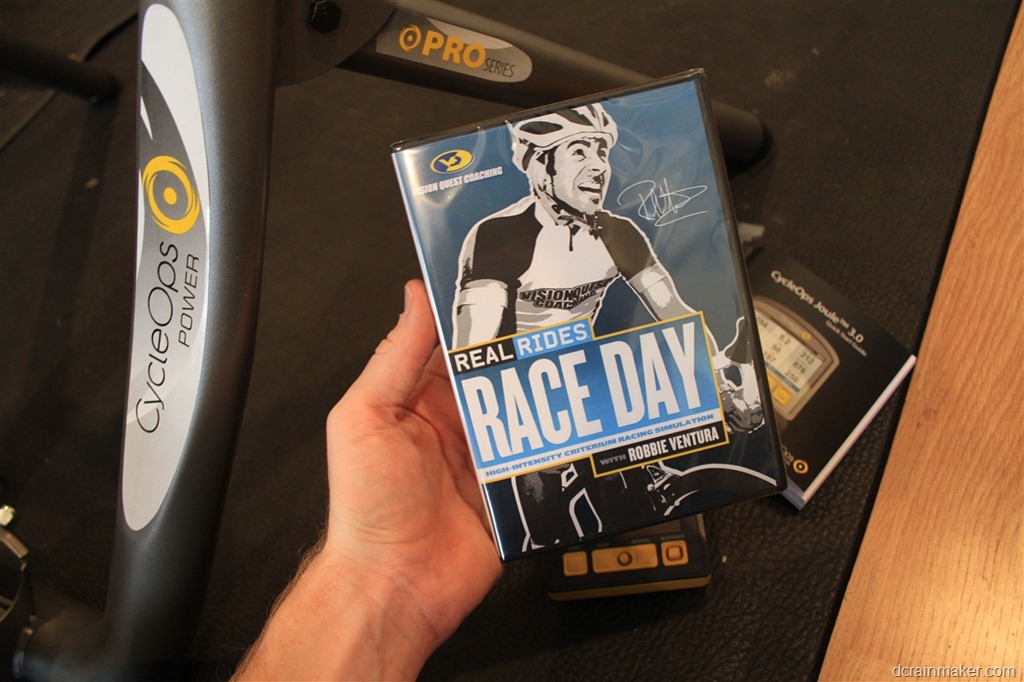
There’s a DVD in there – though, it’s not interactive in nature. It’s more along the lines of a simple movie:
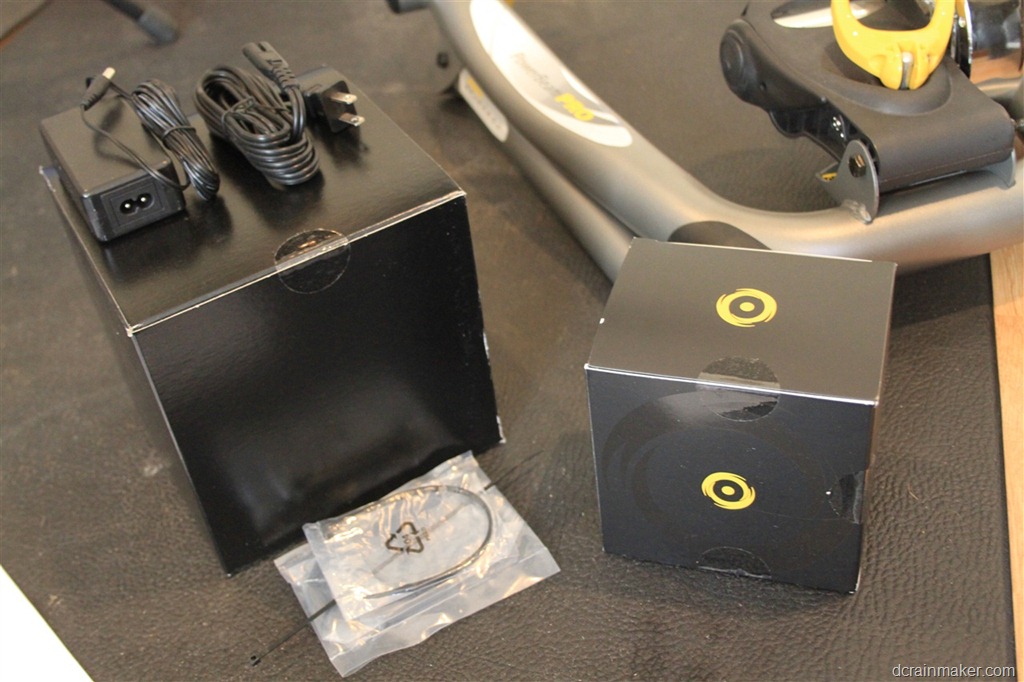
Inside that black box actually contains another box – this one being the Joule itself, as well as the power cable for the trainer.
Moving down into the smallest box (the Joule box), you’ve got the following assortment of goods. You’ll find mounts for the Joule, an ANT+ cadence sensor, a standard mini-USB cable, a heart rate strap, and the manual.

Oh, and of course the Joule itself.
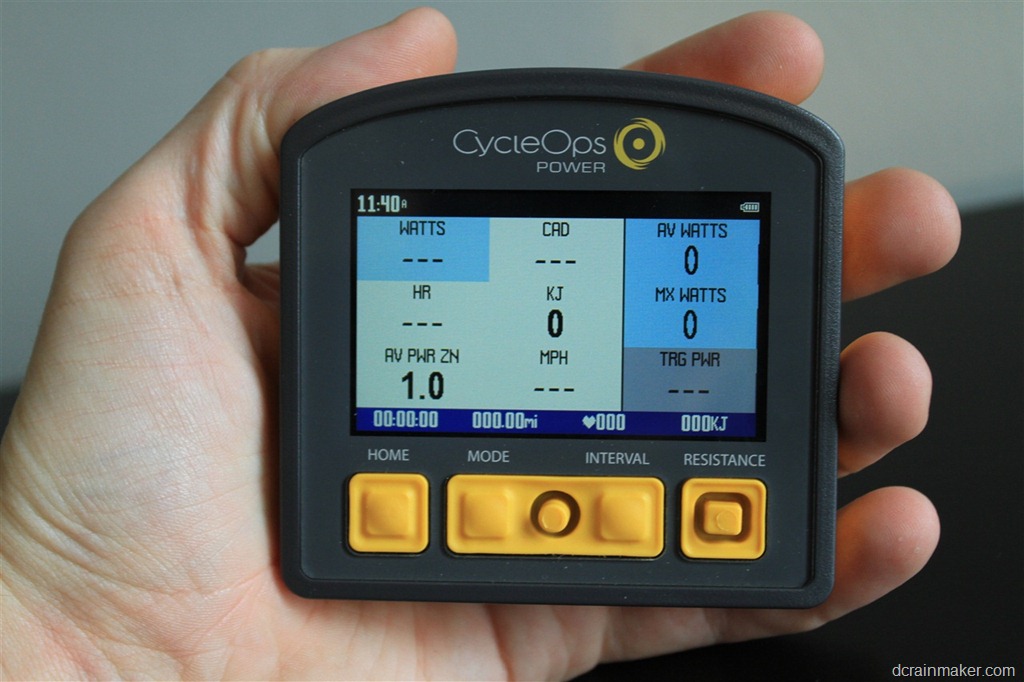

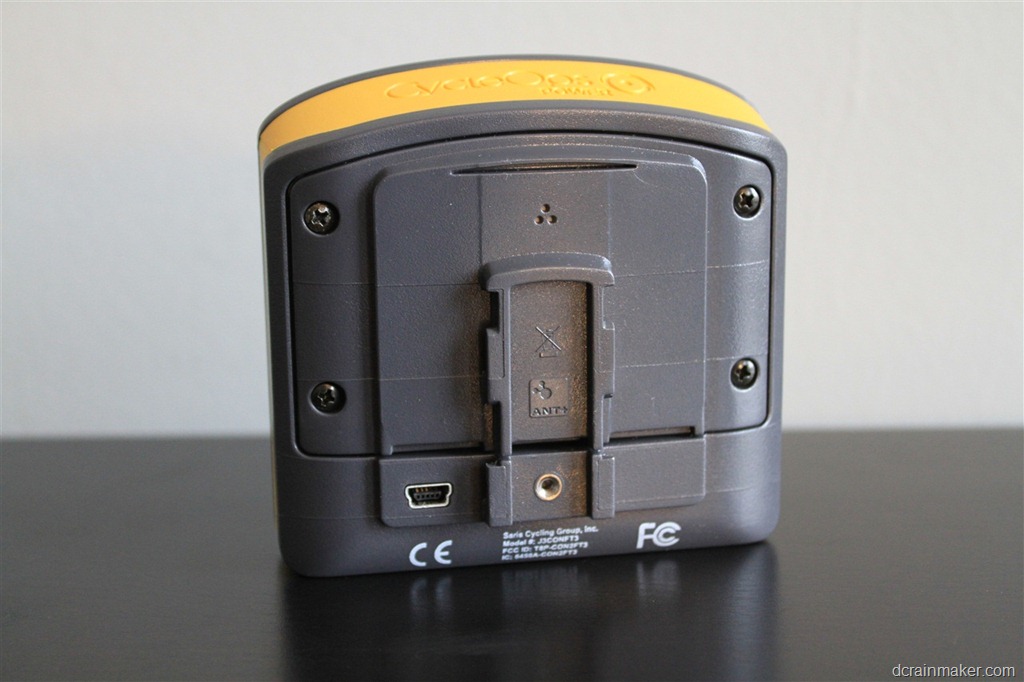
Looking at the Joule, here’s a handy reference with respect to size. I’ve got the Joule 2.0 (common for outdoor riding), the Garmin Edge 800, and the Joule 3.0:
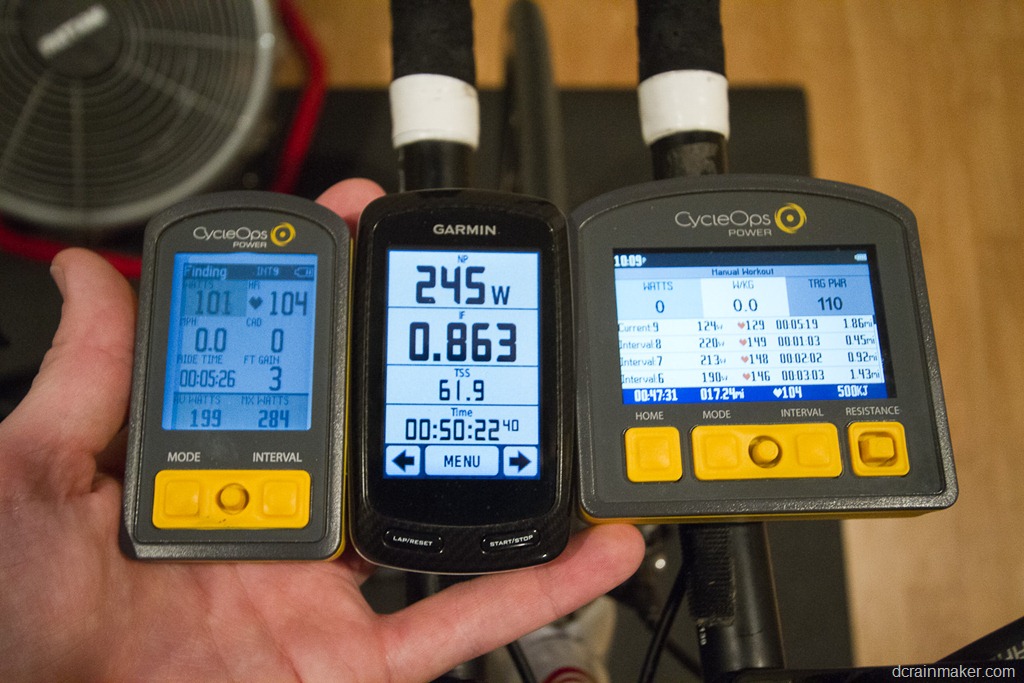
And finally – with all the presents unwrapped, here’s the fully meal deal:
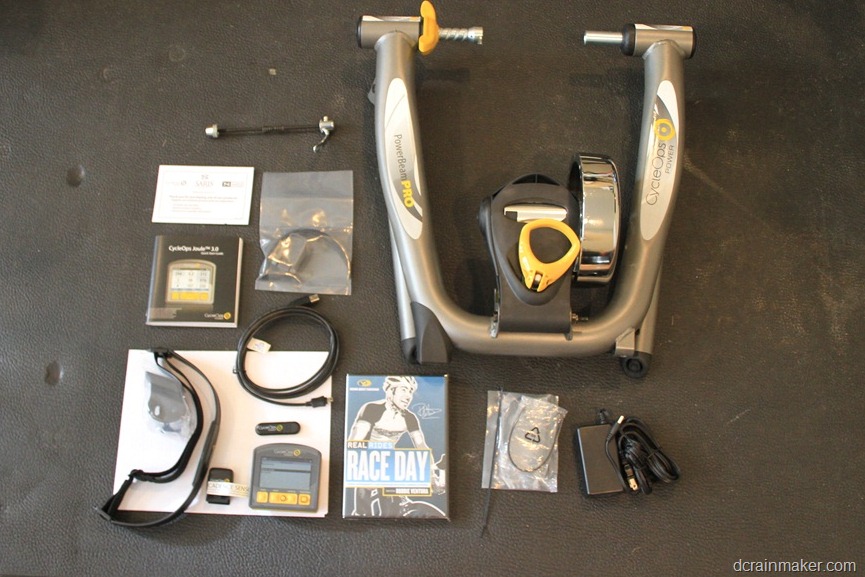
With everything unboxed, let’s get it all setup.
Setup of physical trainer:
Setup of the physical trainer itself is pretty straight forward. Sure, it’s plausible that one could mess this part up…but would be really difficult. Take earlier said power cable…and plug in said power cable.
Ok, you’re done.
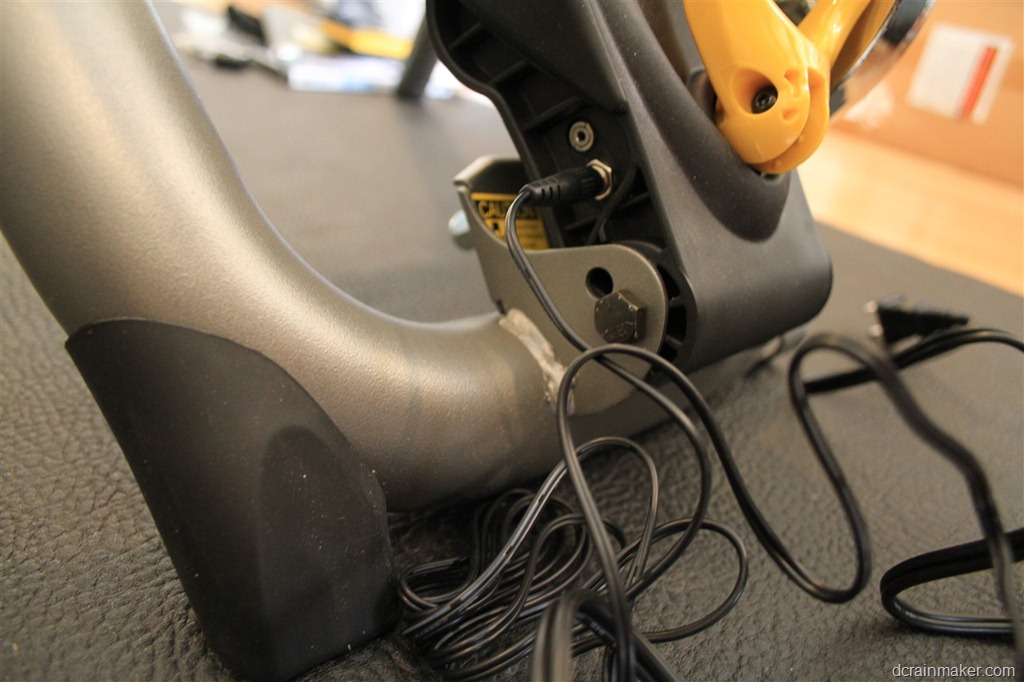
Well, ok…because we’re not a bunch of sloppy cyclists, we’ll take the able and wrap it under the mat to make it look pretty:
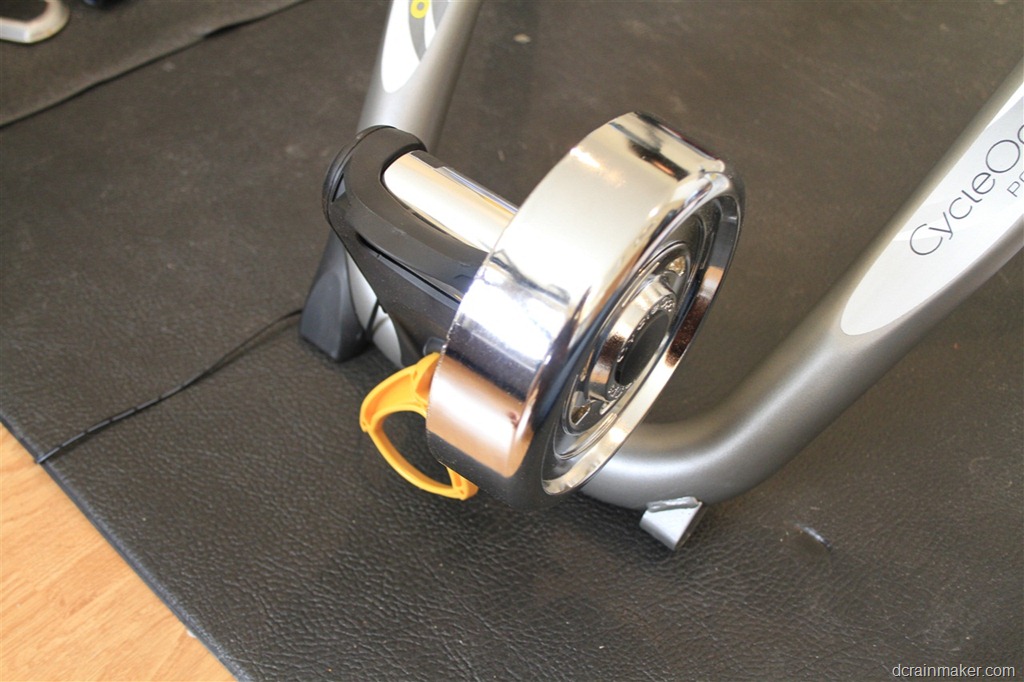
Ok, now were done. For realz this time.
Now let’s the head unit all setup.
Setup and Overview of Joule 3.0 Head unit:
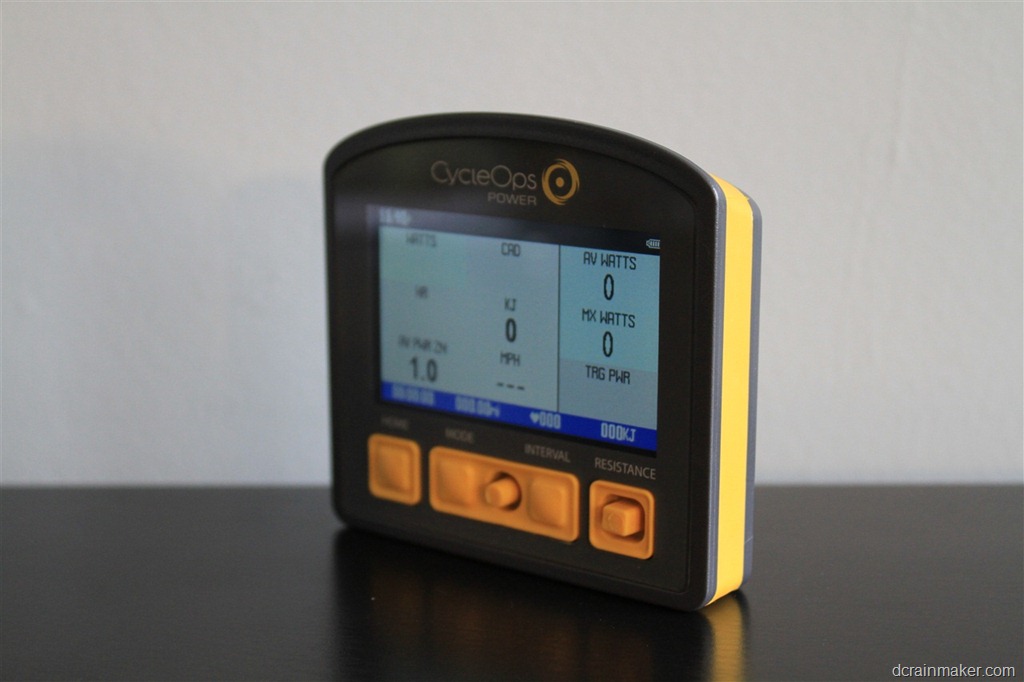
There’s no question in my mind that the Joule 3.0 head unit is probably the most elegant head unit on the market today for a trainer. Aside from the Tacx unit, it’s the only completely wireless one. But unlike the Tacx unit, this one is full color – and incredibly bright and crisp.
First though, we need to get it configured to talk to the trainer. You could start with the manual:
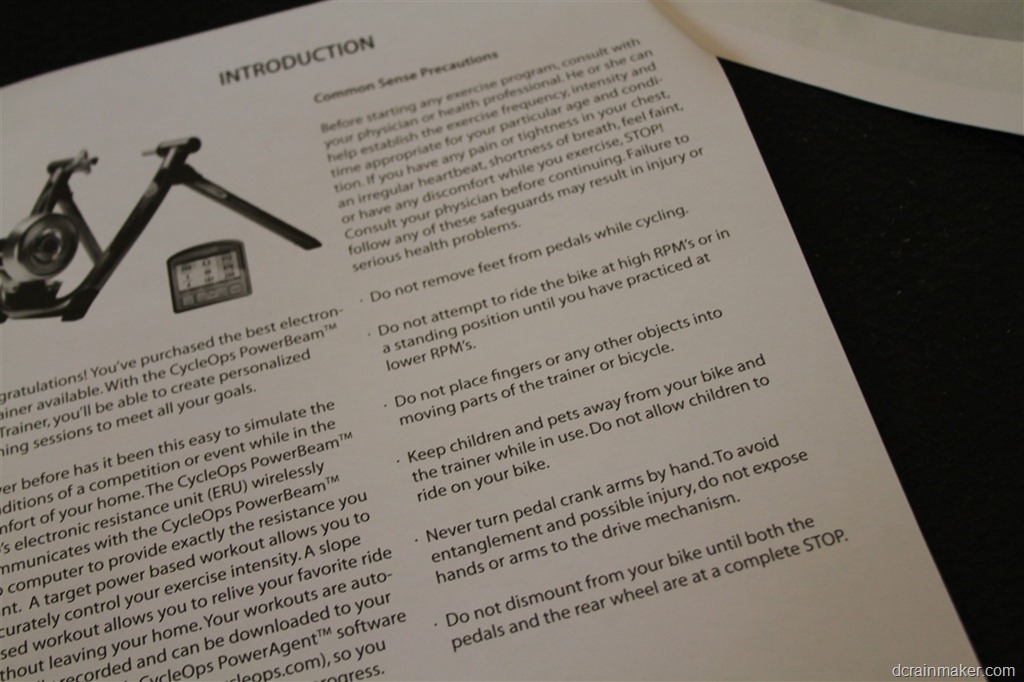
But let’s be honest, nobody reads the manual. And with the Joule 3.0 – there’s very little need to. Instead, we’ll start with getting it mounted. There’s a number of mounts that come in the box – ones for road bikes to place on the stem (the thing that connects your handlebars to the rest of your bike), or ones to place on your handlebars:
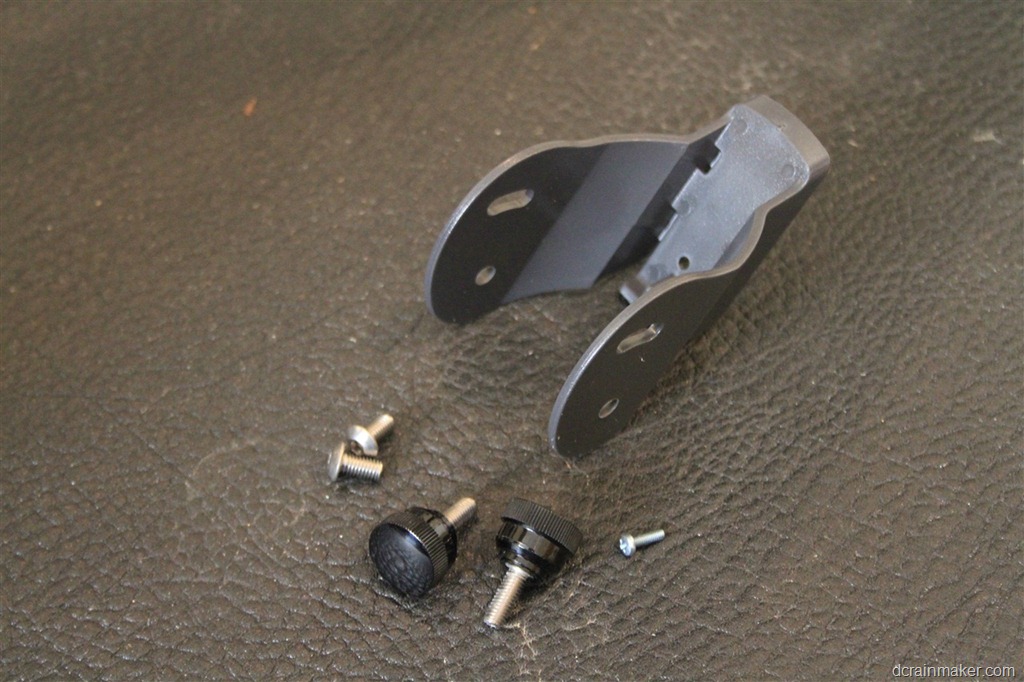
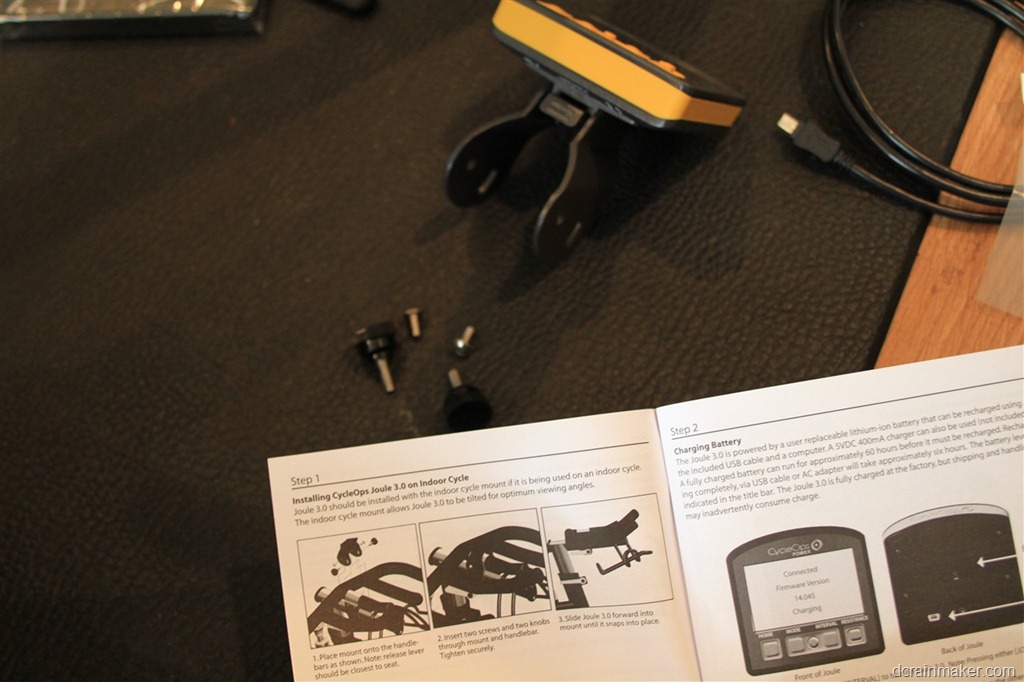
I selected neither. Instead, I went with building my own stand for $30:
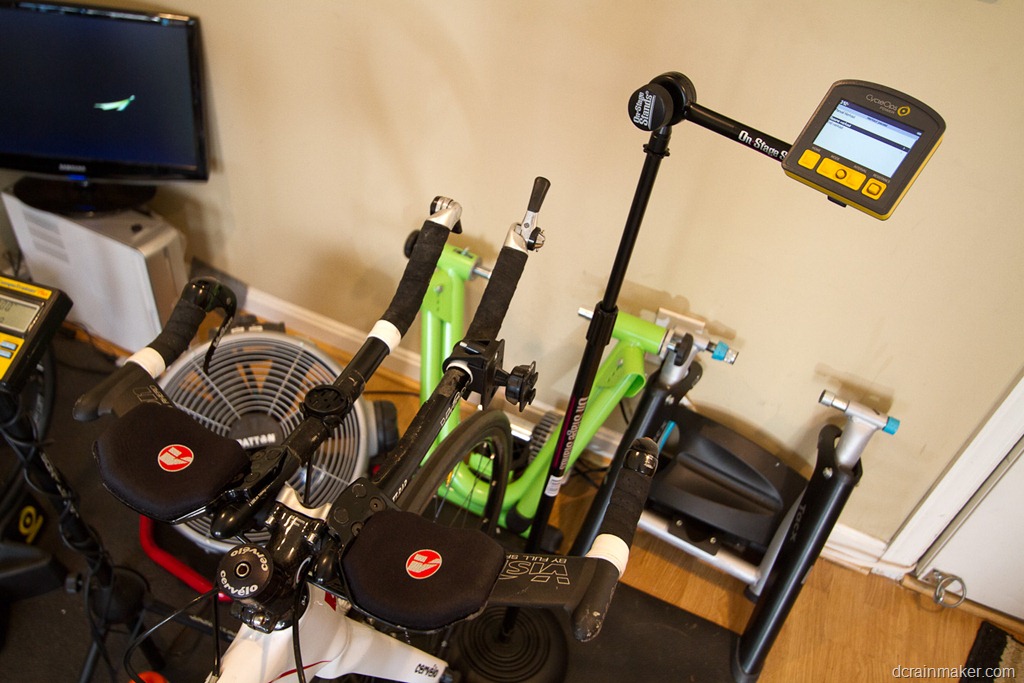
Alternatively, if you have a triathlon bike, you can place the Joule mount on your aerobars. The Joule mount system rotates 90*, so you can mount it in either orientation:
Like most ANT+ head units, the Joule works with the concept of ‘pairing’, which is like tethering. In this case, our first order of business is to pair the head unit with the trainer itself. While this is done via ANT+, it’s actually not open ANT+, so not every head unit can pair with the trainer (but, as I’ll discuss later, any head unit can get power information from the trainer).
To do this initial trainer pairing we head into the pairing menu and select to add a Resistant Unit Trainer (RU Sensor):
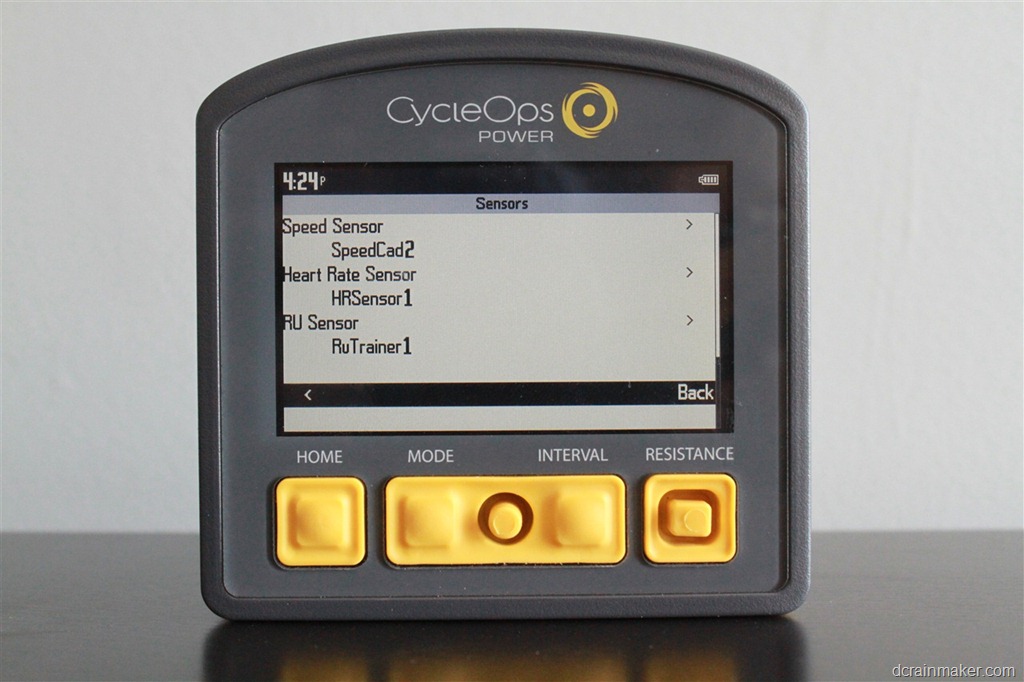
By adding this, we’ll get power and speed – as well as the ability to control the resistance unit.
Once we’re done, we’ll want to add in that cadence sensor. In my case, my bike already had an ANT+ speed/cadence sensor on it, so I just paired with that.
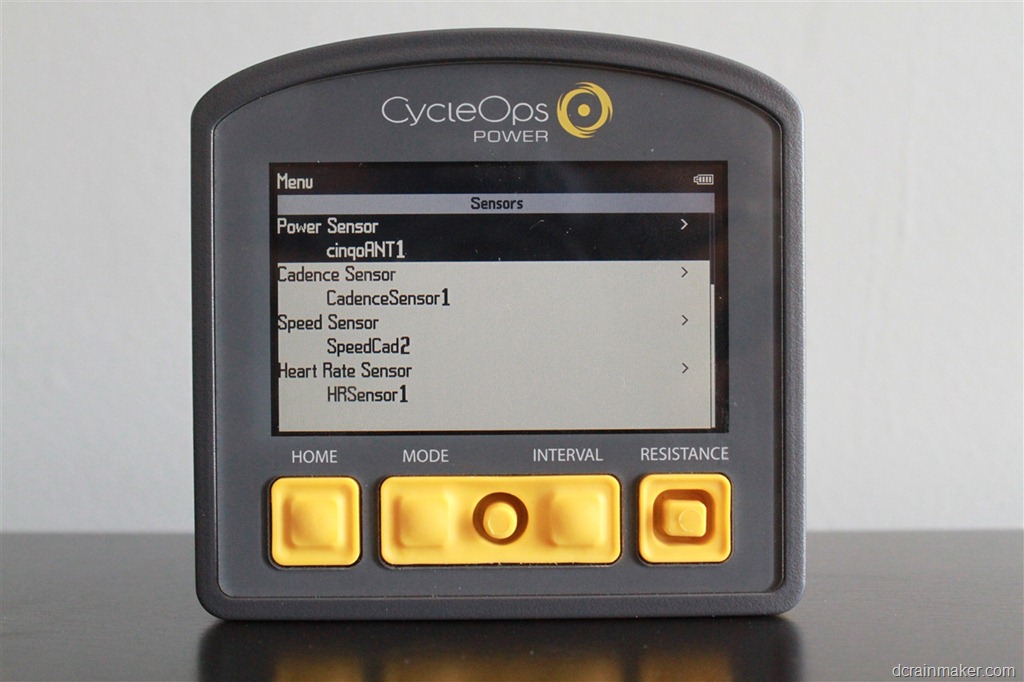
Of note is that if you wanted, you can use the Joule 3.0 head unit without the PowerBeam Pro, and just pair it to any other power meter or speed/cadence sensor. You can add paired sensors but not activate them too – just having them hanging out for switching bikes.
And finally, last but not least I paired it with my ANT+ enabled heart rate strap. If you’ve already got a strap that you love from a Garmin device or similar, you can use that as long as it has ANT+ on the back. The strap included in the box is a bit old-school, plastic based versus some of the newer soft straps.
With that, you’re pretty much ready to start riding. Of course, first you’ll want to mount your bike to the trainer:

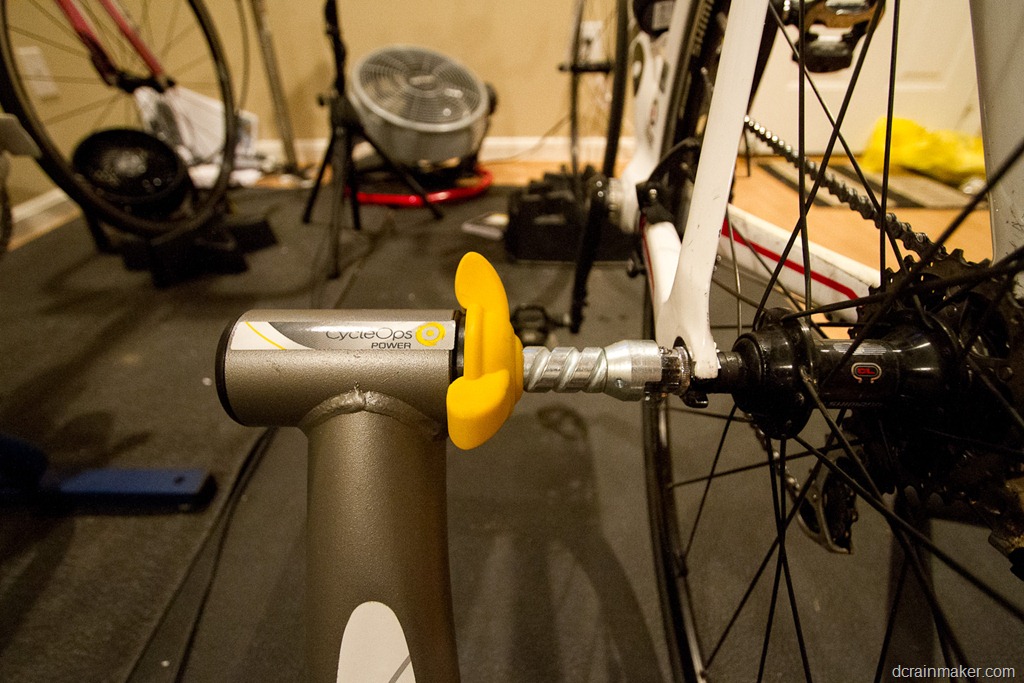
Note that you’ll lock in place the resistance unit using that yellow arm on the back of the resistance wheel. It simply folds down when you want to easily remove your bike. Speaking of adding/removing the bike, it’s pretty easy via this large plastic knob, which makes it a snap to loosen the trainer in about three twists:
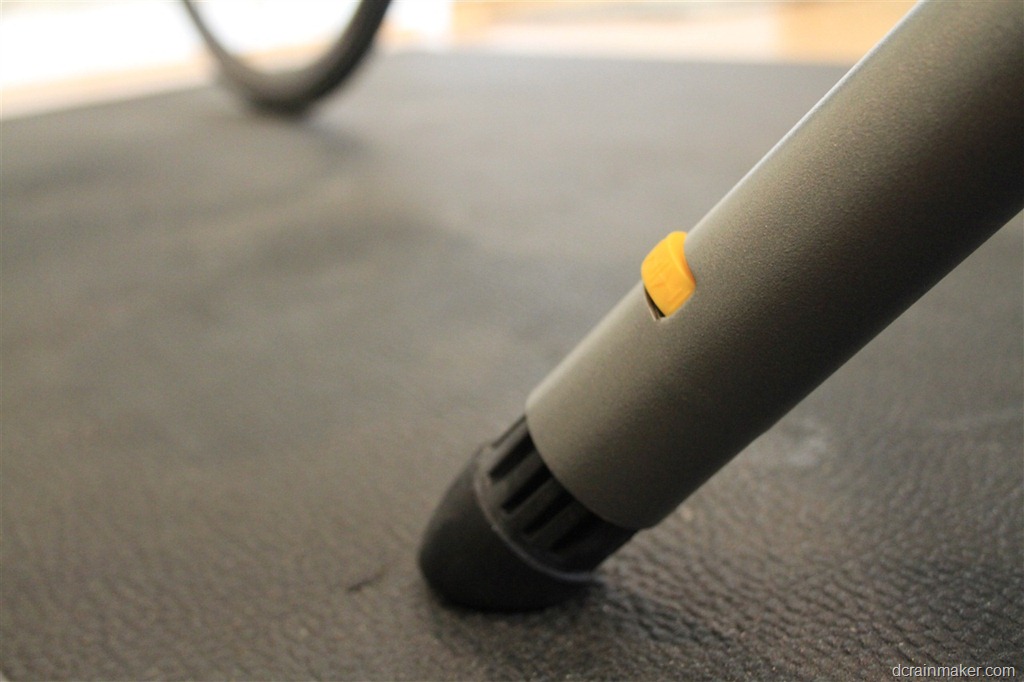
Also of note is that the bottom of the stand has a little yellow wheel if the trainer (or your floor) is slightly off kilter. I have no fix if you yourself are slightly off-kilter.
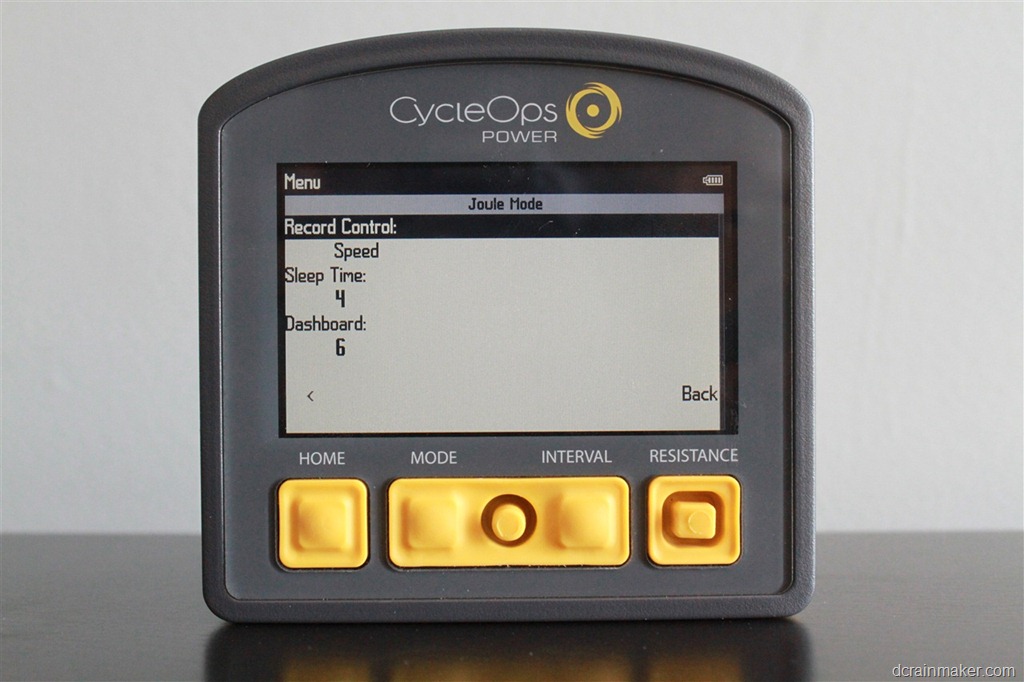
Once you start riding the Joule automatically starts recording. This is done by monitoring wheel-speed. Once that rises above zero, it triggers starting. And once it stops, the unit pauses. While you can sorta change which parameter the unit uses – I always wished there was simply a start/stop button on it (same with the other Joule, Joule 2.0).
In order to record laps, you’ll simply press the interval button. When you do this, it’ll trigger a new interval at the top of the page, and depending on which data fields you have displayed, it’ll either reset them (if lap/interval based), or keep on ticking (if ride based).
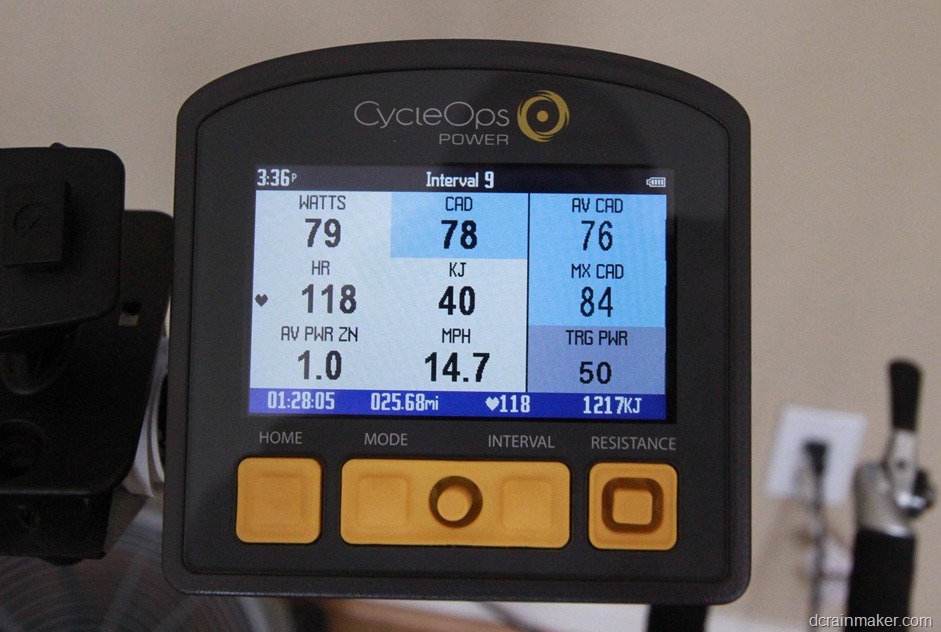
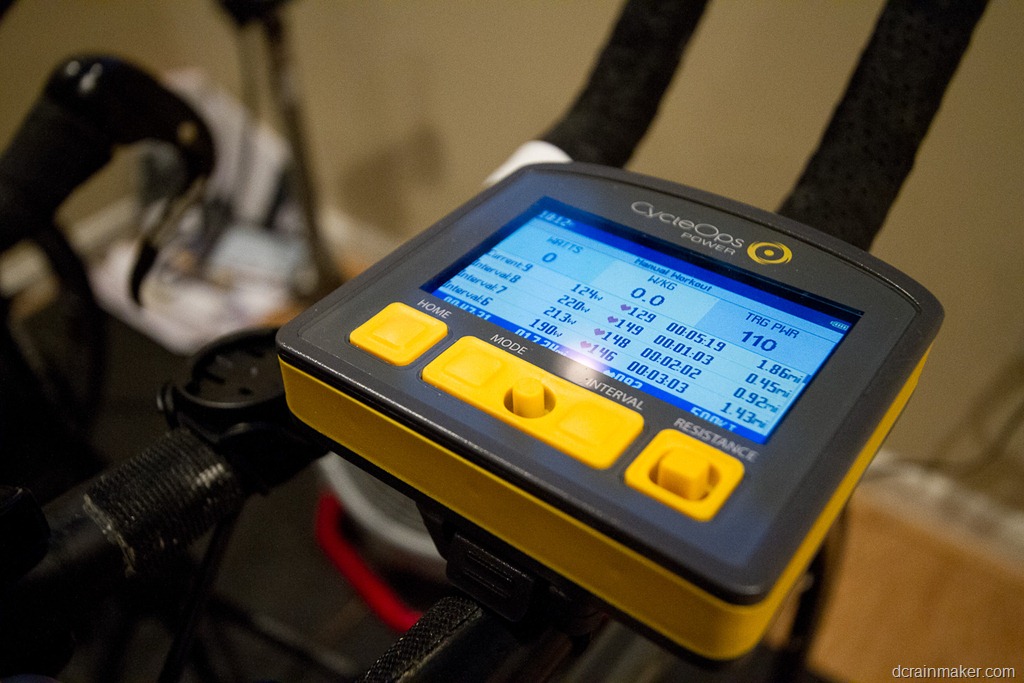
The Joule has a number of different pages (aka views) that display information in a standardized manner. Perhaps my favorite view/page is actually the interval page though. For most of my trainer sets, I’m usually doing specific items for a specific period of time. So I like the ability to see the ‘top-line’ metrics for each of those sets quickly and easily.

This is also helpful when you manage to lose track of which set you were on 90+ minutes later – making it easy to quickly count them up based on your ride plan for that session.
At the same time, along with time you’ll see the current resistance applied – which is nice because that means I’m able to just hang out in this view for many of my sets. And you’ll also see Watts and Watts/Kilogram up top. And along the bottom you have your heart rate, total time, total mileage, and total kilojoules.
In many ways, the Joule acts both as a head unit during a ride, but also as a bit of a historical computer. Most head units these days focus on gathering data, whereas the heavy analysis is done afterwards on the computer. And while the Joule can definitely do this as well, it also features the most comprehensive on-unit analysis and display of your ride history.
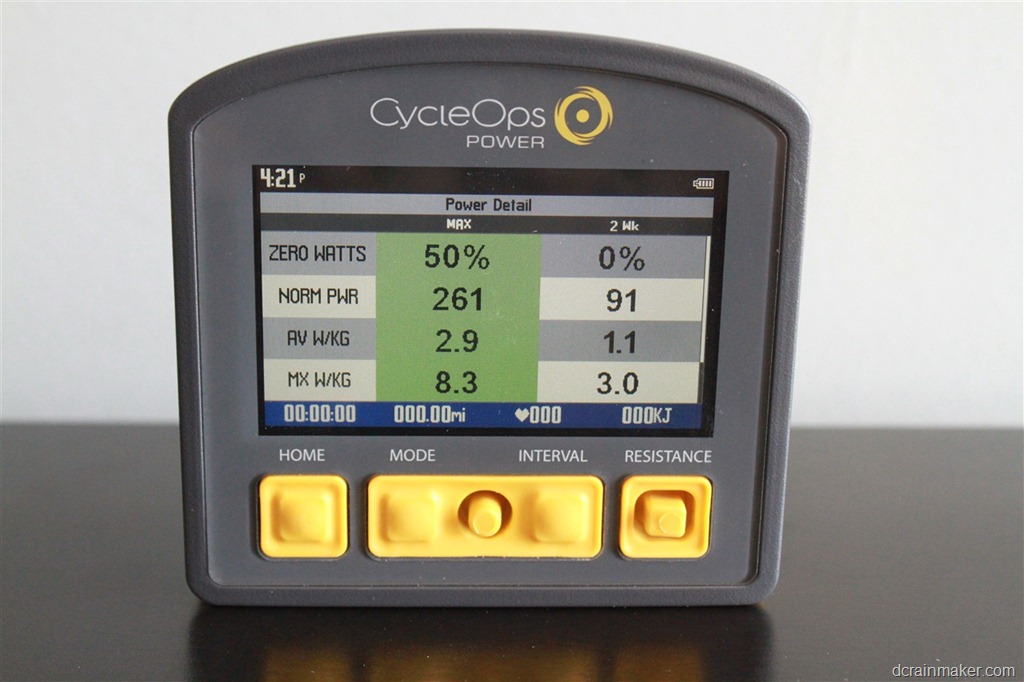
In the above case, I can switch through a slew of metrics (i.e. Normalized Power), but I can also cross reference that against different timeframes – be it weeks, months or longer. This allows me to quickly compare and contrast how my training might be coming along.
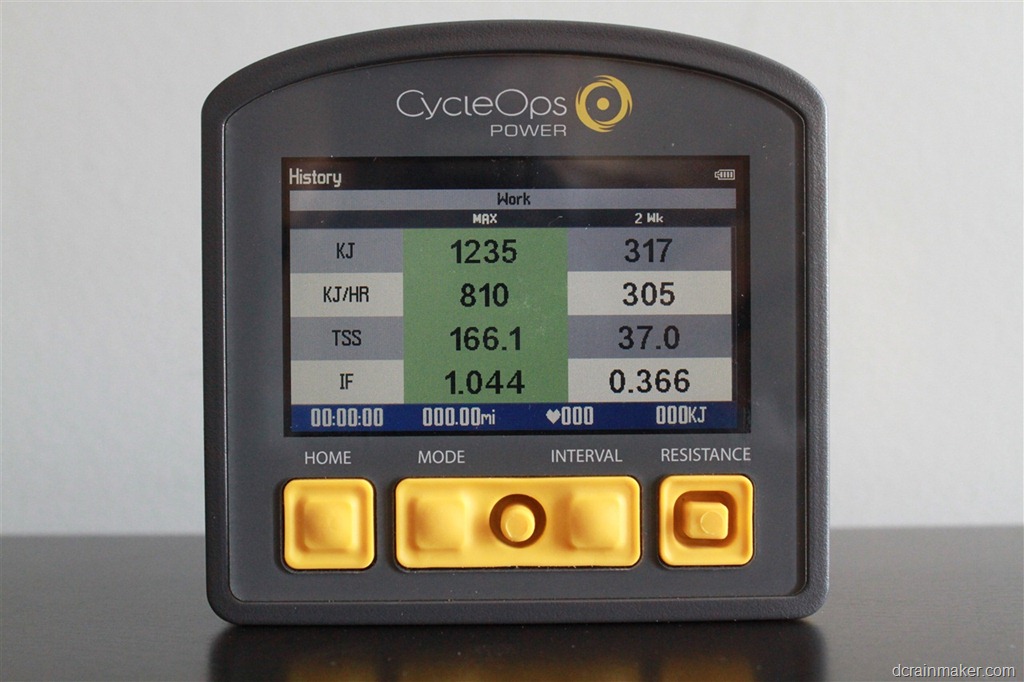
However, I found that these historical metrics weren’t always accurate. Often times it seemed to have ‘forgotten’ about rides. Rides that were saved, shown in history, and even still downloadable to the PowerAgent software. For example, in the below photo from Sunday, it seems to have forgotten that I rode multiple times in the previous two weeks on it, with most of those rides averaging about 200w…far from the 100w it claims as my five-minute maximum.
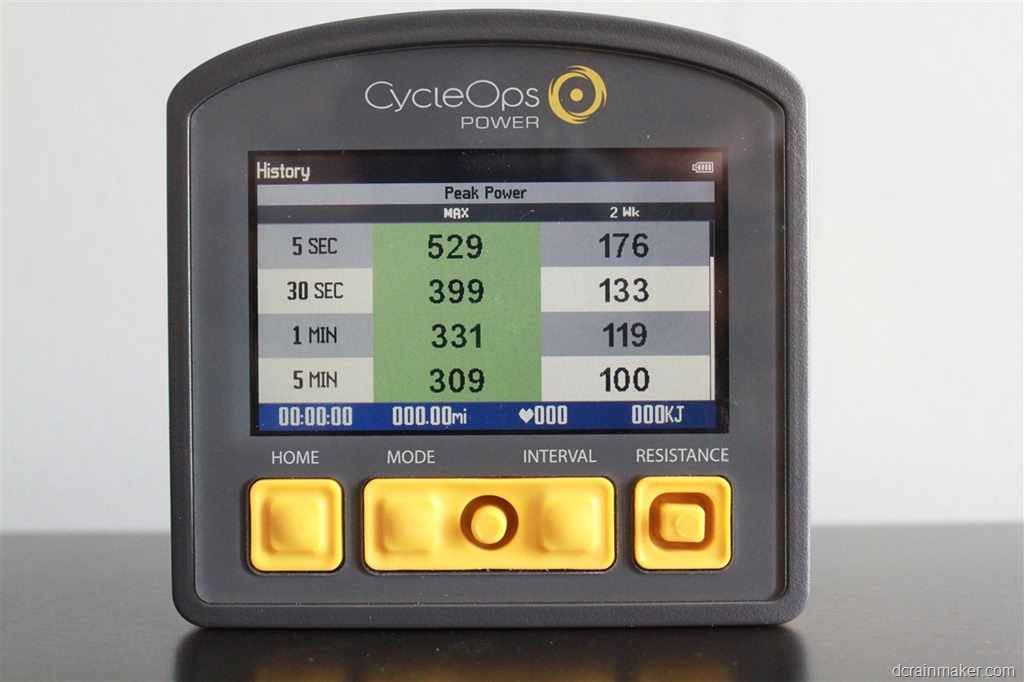
But, I suspect that most athletes are indeed doing analysis online or in software, so this particular occasionally out of sync history didn’t bother me as much. Though, it is something that I’ve also seen with the Joule 2.0 as well.
The Joule unit is fairly customizable from a data field perspective. For each field you see below on the left side, when you highlight it, it’ll allow you to see associated/extended metrics related to that field on the right side. In this case, you see I’ve highlighted Watts on the left side (in blue), and then on the right side you’ll see Av Watts and Max Watts (also in blue). Along the right corner you have the current resistance being applied (50 watts – hey, it was a cool-down!)
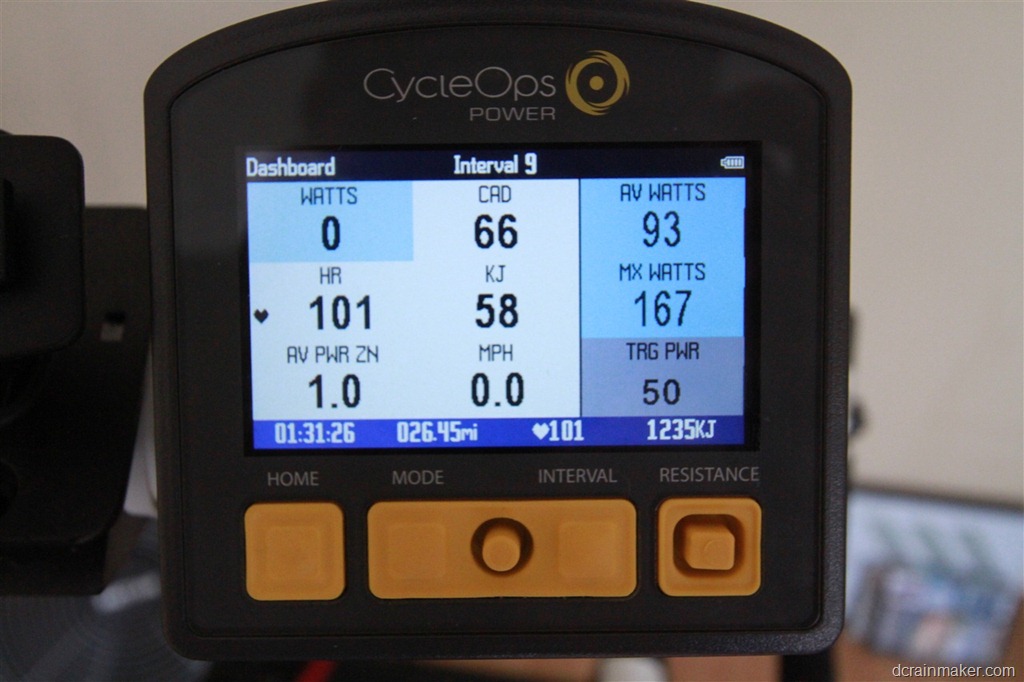
You can hold down the center button to modify some of these fields, though, you don’t quite have complete and total flexibility. I often wish I had the same ability to mix/match fields in the same manner as an Edge 800 – allowing me to choose any fields I want in plop them in any place I want.
To change a given field you hold down the center button and then press up/down. It’s a bit clumsy, but you can get the hang of it. Also, you can rotate between the three highlighted blue fields by simply pressing the center button.
Additionally, you can also modify the quantity of fields displayed, reducing the total number shown to three main metrics on the left side (one big one up top, and two lower), plus the two side metrics along the right side.
In summary, I guess the biggest thing I want you to takeaway from this section of the Joule 3.0 portion of the trainer package is just how much more advanced it is that the two competitive offerings (CompuTrainer and Tacx head units). In the case of the CompuTrainer, it simply controls start/stop and increase/decrease in wattage. That’s it. In the case of the Tacx unit – it does do a bit more in terms of control, recording and ability to go completely solo. However, it’s nowhere near as clear of a display as the Joule 3.0. If you made me pick just one head unit, I’d say Joule 3.0 wins over the Tacx head unit – with the CompuTrainer controller a distant third.
Roll-down/Calibration:
Like any other power meter, you’ll want to be able to ensure the calibration values are correct. Correct calibration means that each session you do has accurate and consistent values. Otherwise, in the world of power meters it’s very easy to have a 10-15% differential between days based on everything from air pressure to temperature. Far too many folks just start a ride with their power meter and never calibrate it. This means the data is likely pretty suspect.
Calibration of the PowerBeam Pro is pretty quick and straightforward. Within the head unit you’ll go into the sensor settings section. This is because the resistance unit is technically considered a ‘sensor’. Within that, you’ll select the resistance unit, and then select calibration.
Calibration works by doing what’s known as a ‘Roll-down test’, which effectively measures the rate at which the trainer goes from a known speed, to zero, if you stop pedaling. In the case of the PowerBeam Pro, the unit has you by default hold for 120-seconds at a speed between 18 and 22MPH. At the completion of your two minutes (wattage is unimportant), you’ll simply stop pedaling and the unit will measure that rate. Following which, it adjusts the calibration factor.
Overall it’s pretty simple and straight forward.
PowerAgent Analysis Software:
Included within the package is the CycleOps PowerAgent software suite. This software package is the primary conduit between the Joule head unit and your computer. It also acts as a gateway for uploading workouts to other services/applications. To use the suite, you’ll simply plug in the Joule via mini-USB to your computer, and then start the PowerAgent software.
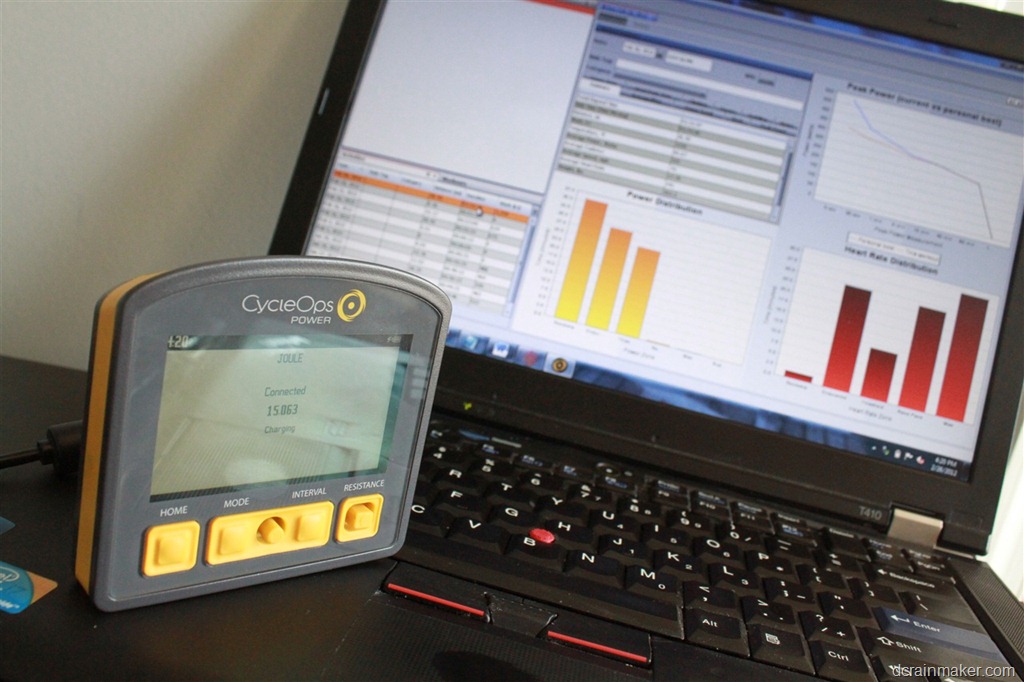
Once it’s plugged in, you’ll go ahead and select to download the workouts. The download process isn’t exactly the most Comcasticly fast experience on earth, but it does get the job done.
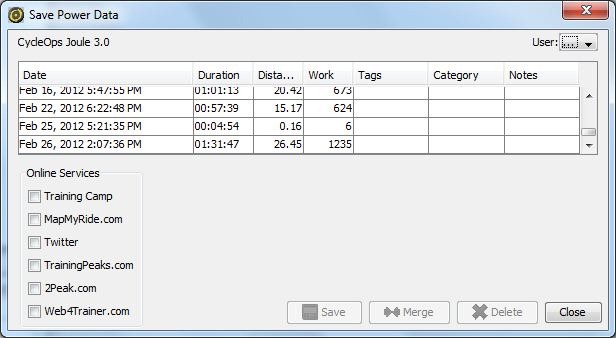
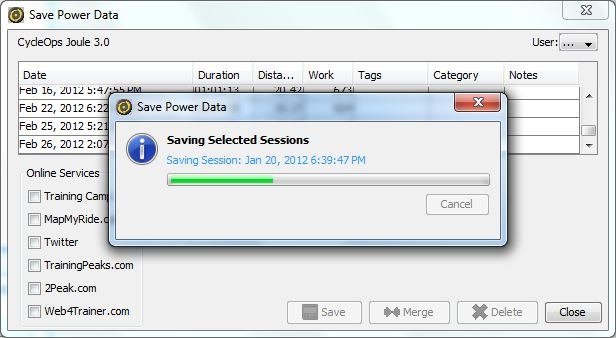
You’ll note above that you can automatically transmit the files to a variety of online services via a simple checkbox. Or, you can export out the files and upload them manually later on (see 3rd party support in the next section).
Once you’ve got the files imported, you’ll see the different workouts listed in the lower left hand pane, with the detail for each workout in the right portion of the window:

You’ll note that the right side really has two areas of focus. The first is the summary view, which should really be labeled “The mother of all summary detail”, and then there’s the detailed view, which could be labeled “A heck of a lot more detail”.
Here’s an overview of the summary page, which is divided into four chunks. The first (upper left) being the ride data, which is mostly duplicated within the detail page. Then we’ve got three charts that related to power distribution, peak power, and heart rate distribution.
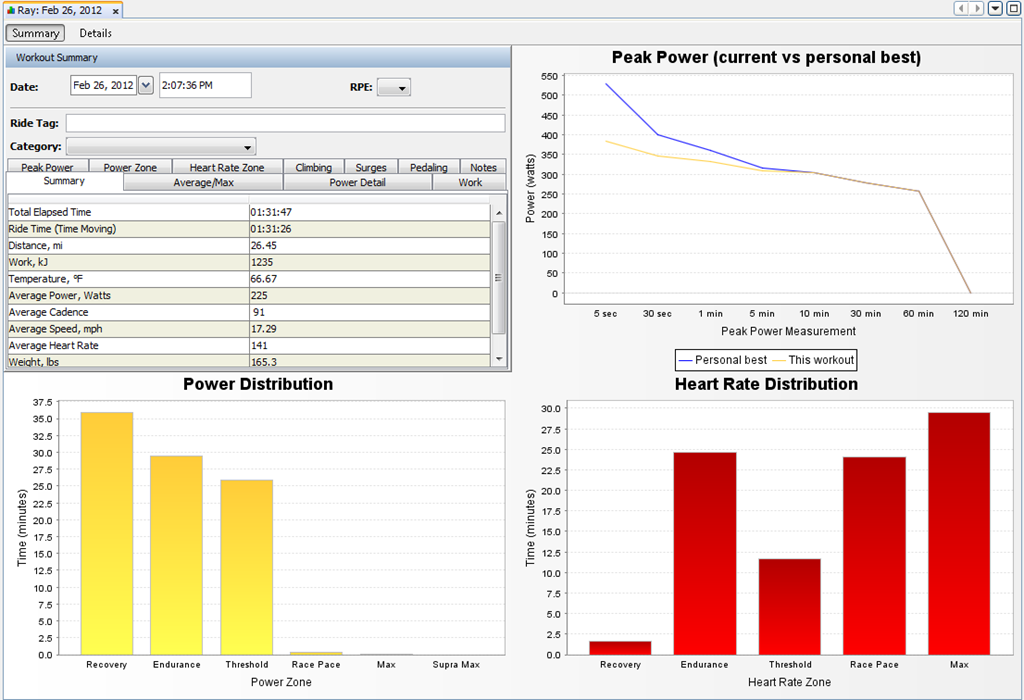
Looking at that first quadrant, you can change the various tabs to see detailed information, again, somewhat duplicate in nature with the details tab.
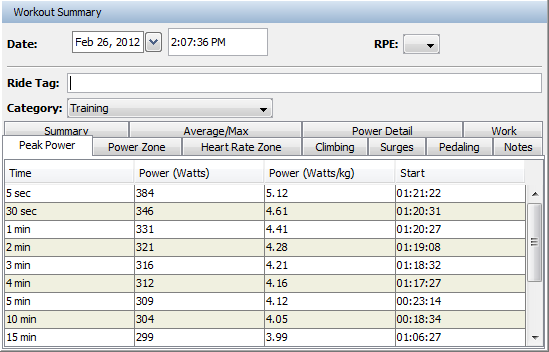
So let’s move over to the details tab instead, which then changes the screen to look like below:

Up top we have the graph. The graph can be viewed ‘as-is’, or you can click and drag to select certain sections. This allows analysis into that specific section. In this case, I clicked and dragged and created a 20-minute chunk.
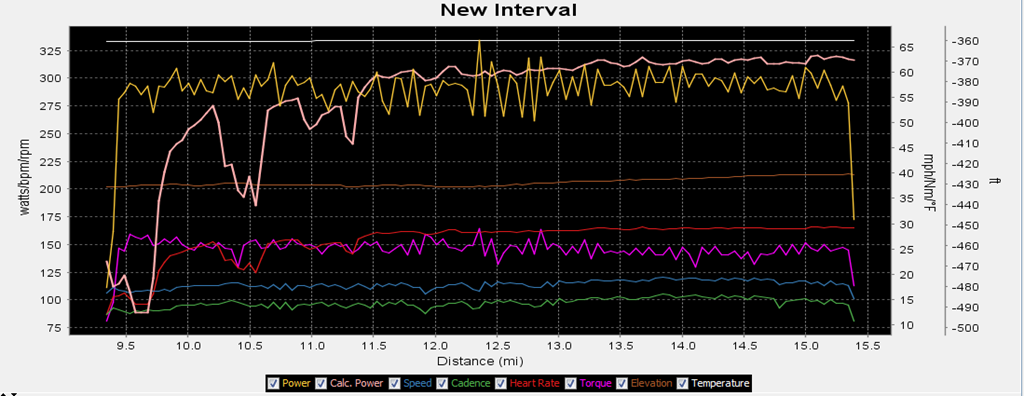
When I did that, it created a new virtual interval, and then updated the bottom page as well:
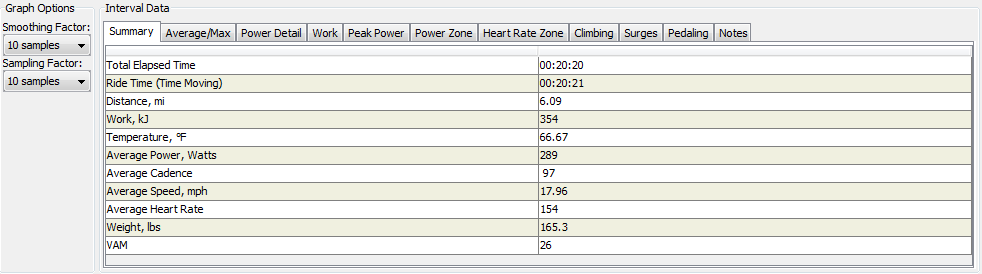
Alternatively, you can use any of the intervals that you recorded. From there you can select any of the interval data fields to display that particular interval.
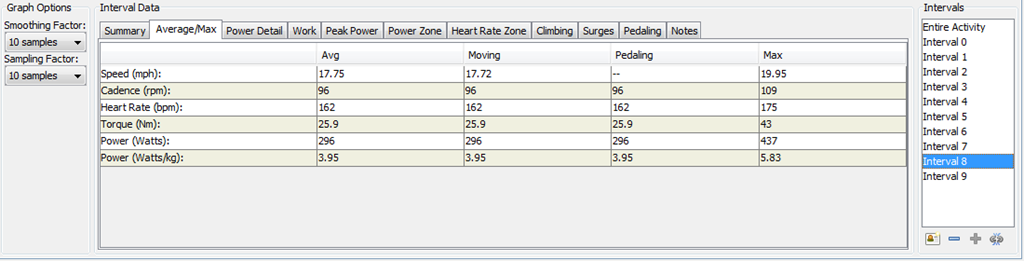
Also note that you can change both the smoothing and sampling factor. This helps to smooth out data and make it easier for a human to read. It doesn’t however change the underlying data that was recorded, as the fidelity there remains the same.
In addition to analyzing historical information, you can also create basic workouts. The workout creator allows you to add segments, with each segment having a specific goal. These goals in turn are controlled by the resistance unit. The duration can be specified as either time or distance.
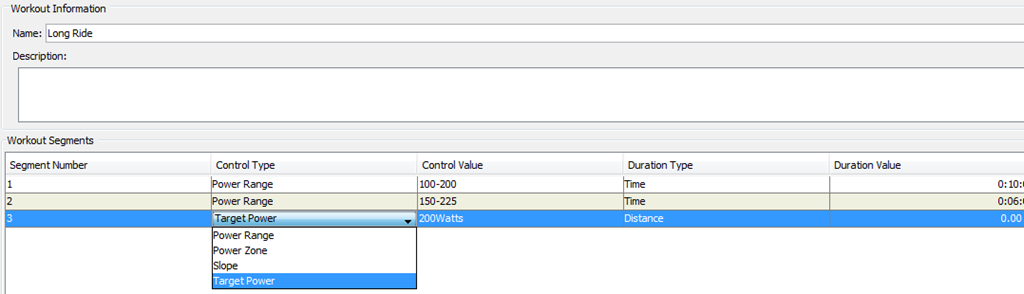
Once done, these workouts are downloaded to the Joule unit and then can be played back.
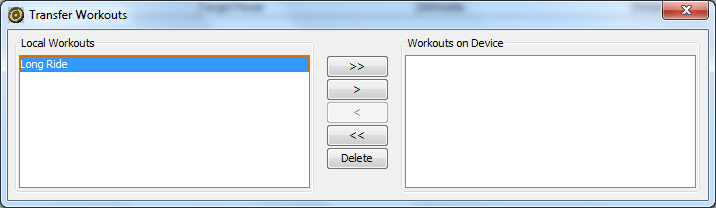
The challenge I had here was that the control type is fairly limited, and purely focused on power metrics. Often times I have workouts that focus on other metrics – such as cadence or heart rate. I’d prefer a bit more flexibility in the workout creator.
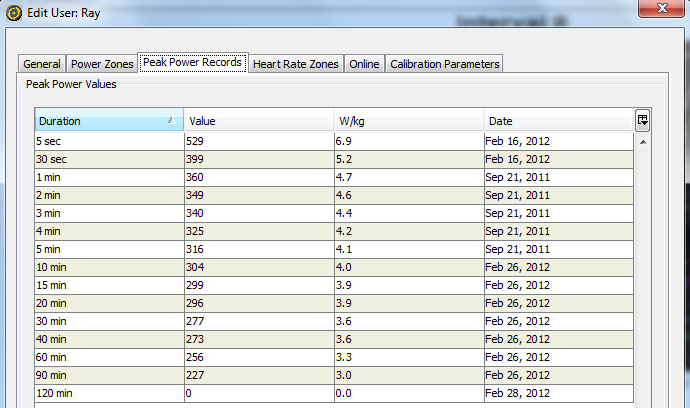
Finally, you can store multiple users in PowerAgent, and within each user you can set a number of user-specific parameters, allowing you to more easily analyze a given workout against a specific user. This includes power and heart rate zones, as well as just interesting metrics such as peak-power records. Note however that this will only include power records that were imported into the suite. Meaning that if you record the data on a non-CycleOps device, you’d need to import that data in manually (activity).
Overall, the PowerAgent is a good software suite for most users. Some power users (no pun intended) will likely use software suites with focus on some of the additional power work metrics (TSS/IF and similar), and thus may trend towards TrainingPeaks, Race Day, or the free Golden Cheetah. But, for many others – Power Agent will work just fine.
Compatibility with 3rd party products:
In my mind, the more a given product works to make their product(s) compatible and accessible to other products in the market, the more in tune that product is with what consumers want – which is to have their data on the device and platform of their choice. With this in mind, the PowerBeam Pro is pretty good and offers a fair bit of interoperability – both in terms of hardware and software. Let’s spend a second to work through these.
Hardware Interoperability:
On the hardware front, the key piece of functionality that the PowerBeam Pro does is to transmit the ANT+ power meter data stream back out as standard ANT+ data. This is an area that differentiates itself from competitor LeMond Fitness with their trainer, which requires you to utilize their head unit to access the ANT+ data stream.
With the PowerBeam Pro though, you can directly pair any ANT+ head unit that supports the standard ANT+ power meter profile. The most common ones are the Edge 500/Edge 705/Edge 800, the Garmin FR310XT/FR910XT and the Timex Global Trainer. Soon, also the Magellan Switch. There are of course a gazillion Apps that support it as well, via both Android and iPhone.
For fun, I went ahead and paired up the Garmin Edge 800 directly with the PowerBeam pro. In this case, I created a new bike profile called PowerBeam Pro:
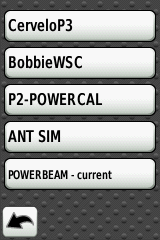
From there I scanned and searched for the ANT+ Power Meter (note, I removed the battery from my Quarq power meter so it wouldn’t show up). If you’re in a place where you pickup multiple ANT+ power meters, you can simply enter in the ANT+ ID number instead manually. Once you’re done pairing, you’ll see the unit listed as connected:
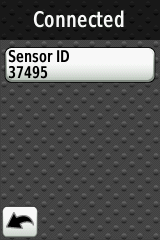
From there, it’ll work just like any other power meter would. This is ideal for folks that already have a ‘workflow’ with respect to other rides going to their Garmin device (or any other device).
Note however that it will not transmit either speed or cadence via ANT+, so you’ll need a normal ANT+ speed/cadence sensor for that. Here’s more information on those.
Software Interoperability:
As noted a bit above, the Joule 3.0’s primary path to partners is via the PowerAgent software suite. Though, that doesn’t mean you have to use that software. The unit itself acts like a USB mass-storage device, and as such, does enumerate workout files that an application can pickup. The only challenge to these files is that very few applications can understand the particular file type that CycleOps selected to utilize. Training Peaks is one, but there aren’t many others that I’m aware of.
Now, that’s not a huge concern because the PowerAgent software pretty much covers export to a wide variety of services (.CSV, Garmin .TCX, and TrainingPeaks .PWX formats). And these formats (in particular .TCX and .CSV) can be ingested by just about every training application known to man.
Fall 2012 Software Preview – CycleOps Virtual Training Suite:
Update/Edit: In 2013, CycleOps changes the way they bundle the software. Previously the trainer included a desktop version of the below training suite in most cases. Now however, that suite is no longer included (the price dropped substantially) and instead you pay a subscription service to their training suite, which I reviewed here.
(Please Note: This next section discusses a feature which is still in development and scheduled to arrive in Fall of 2012, as such, it may change significantly between now and then – both for the good, or the bad. Thus, do keep that in mind with respect to any purchasing decisions. Finally, this section demonstrates features that are still ‘beta’, and as such will likely differ from the final design. CycleOps gave me the OK to talk about them though anyway…which is pretty cool of them.)
I wanted to briefly give an overview of what’s coming down the line with the Virtual Training suite. Consider this just a quick walk-through.
The first thing you’ll need to know is that everything is tied into a backend web service. This service stores your information and training log, which is handy since it means everything is effectively backed up elsewhere. Thus, when you log in, you’ll select which user you are. You can store multiple users here as well:
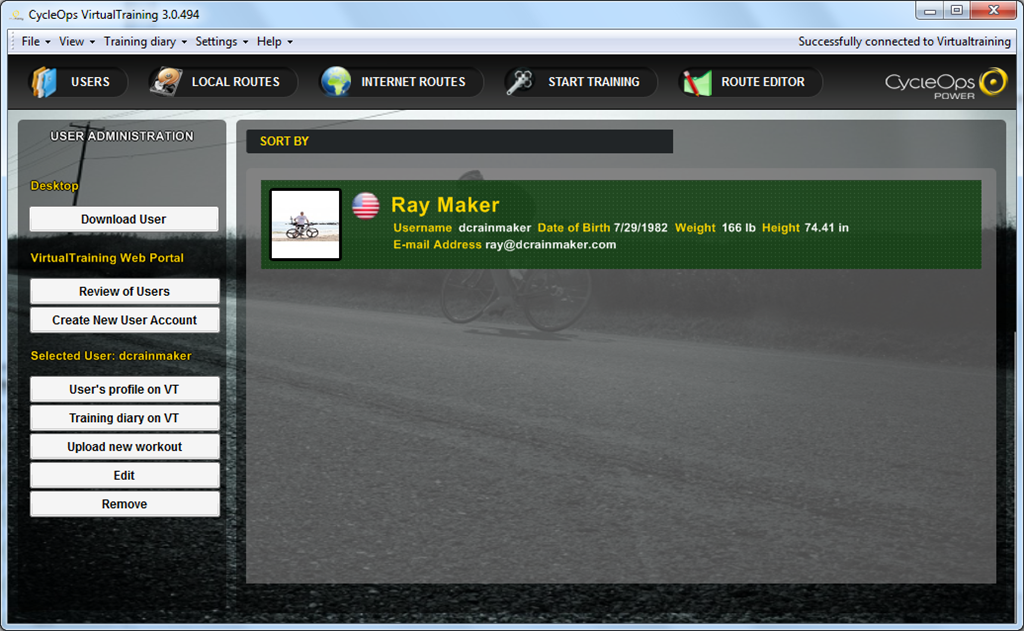
Across the top you have the core areas of the application. The first (aside from users) is the Local Routes section. This section is for routes that you’ve imported or downloaded. Think of it as a local cache of items you use frequently.
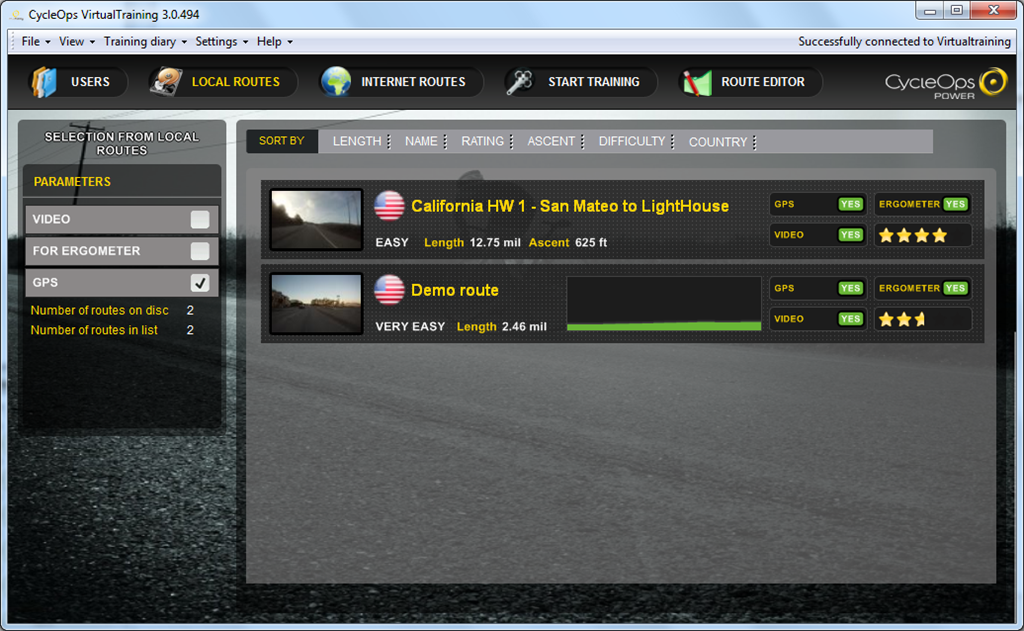
Since we have local routes, you’re probably asking yourself where you get those from, right? Well, they come from the next tab over – ‘Internet Routes’. This is where you can go into a massive database of routes and download them to your computer. You can sort these by whether or not they include video or are just ergometer (meaning, control resistance).
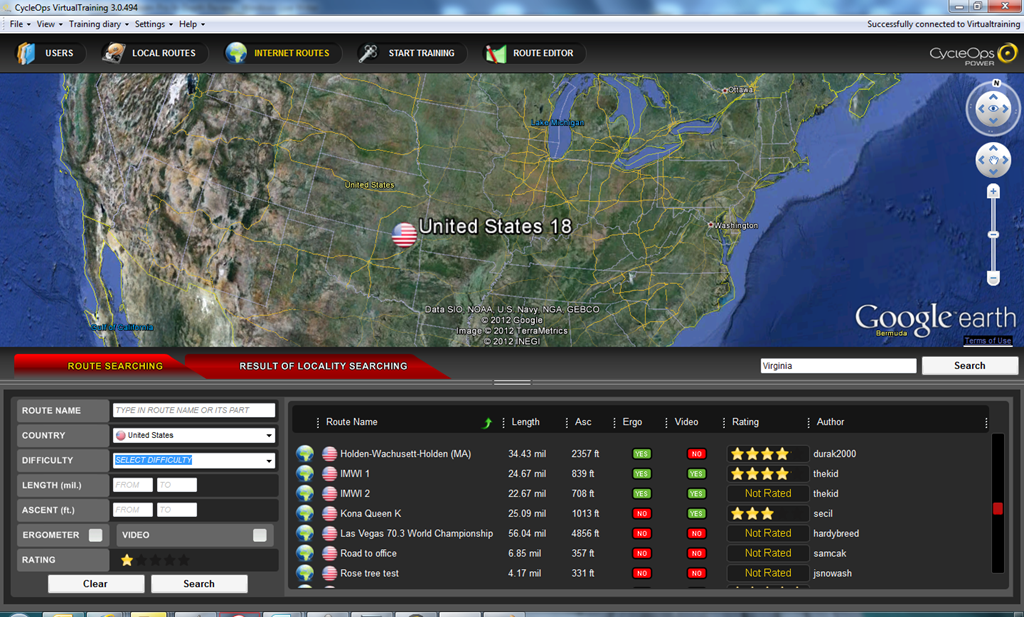
The list of routes in the database already is downright impressive. Just tons and tons of videos and routes. You can click on any given route to get more detail about it, including the integration with Google Earth – which enables enumeration of the route:
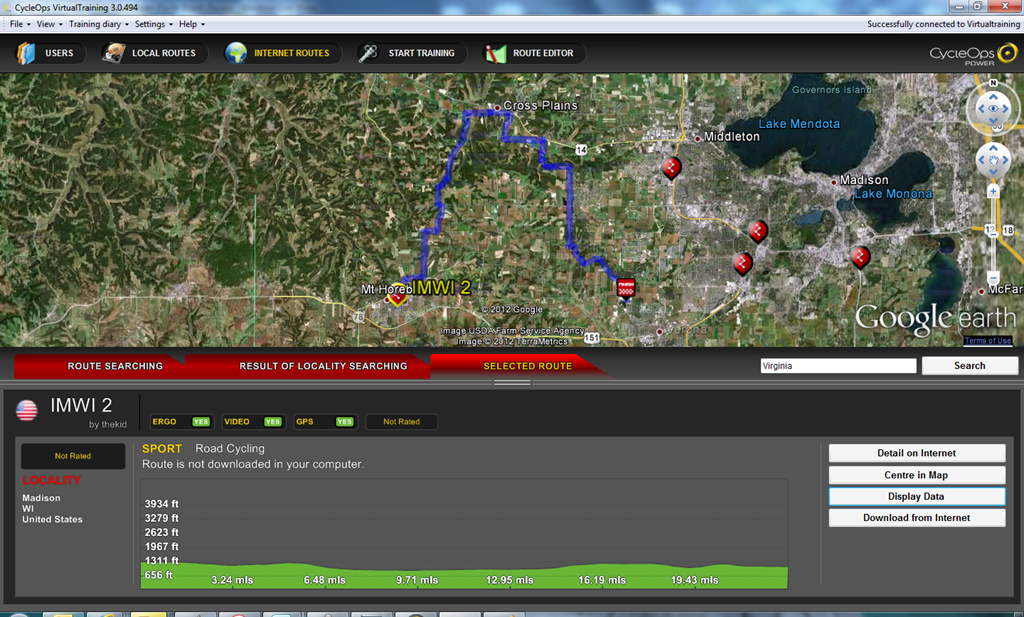
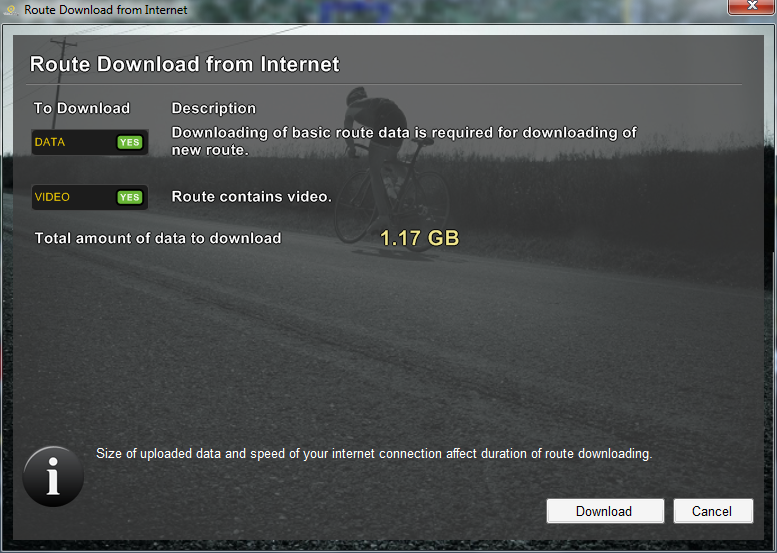
Once you’re ready to download the road, you just go ahead and click the ‘Download from Internet’ button. Which triggers the following series of screenshots:

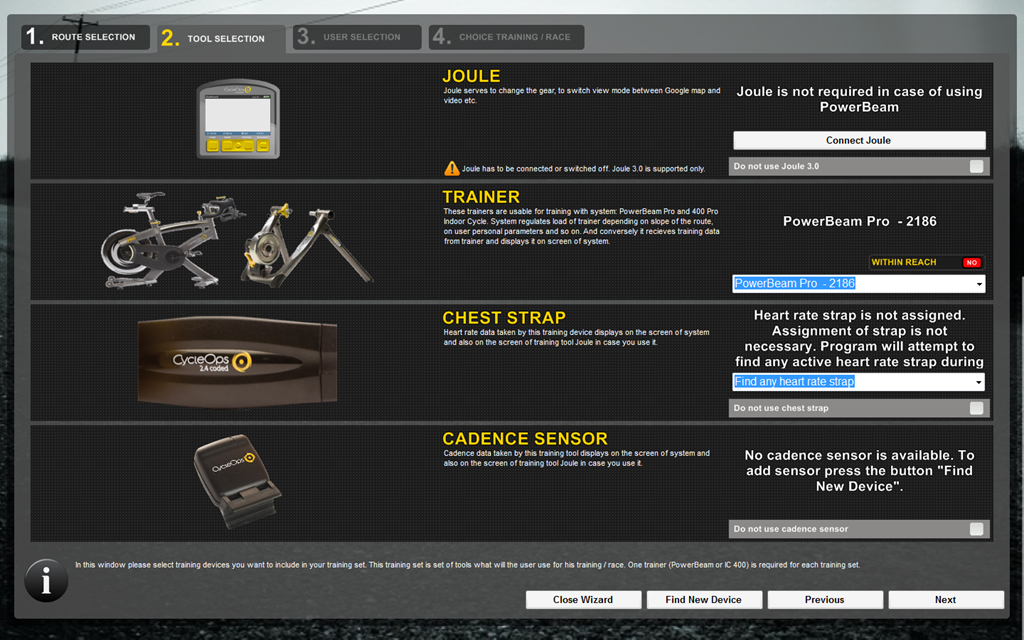
Finally, it’ll come time to ride the video/route you just downloaded. The software will pair up via ANT+ (an ANT+ USB stick) to your trainer and your ANT+ accessories. It’ll both record the data, and control the resistance of the trainer.
Once the video is started, you’ll find that it’ll add resistance as you go up hills. At the same time, it’ll be displaying synchronized recorded video from the route, alongside a smaller Google Earth map of the route and your location via satellite. You can swap what’s shown in that little map though, as well as swap the big screen for the little screen.

There’s more features that will are being incorporated into the software suite, so things are a bit far away still. But this should give you a bit of an idea of what’s coming down the line – hopefully allowing you to make purchasing decisions based on what you see.
Trainer Market Comparison:
You can utilize the below comparison table that’s dynamically updated over time (so as features change via firmware) to compare the different trainers that I’ve reviewed. Note the key part being ‘I’ve reviewed’. There are no doubt many other great trainers on the market, it’s just that if I haven’t reviewed it, I don’t feel right including it based on some marketing fluff.
Also, as you’ll probably notice, these are higher end trainers. If you’re looking for lower-end options, see my general trainer recommendations post.
| Function/Feature | CycleOps PowerBeam Pro | Elite Drivo II | Wahoo Fitness KICKR V1/2013 | Tacx Genius | Racermate CompuTrainer |
|---|---|---|---|---|---|
| Copyright DC Rainmaker - Updated May 11th, 2021 @ 4:01 am New Window | |||||
| Price for trainer | $799 | $1,199 | $1,199 | $1,340 | $1,629 |
| Trainer Type | Wheel-on | Direct Drive (no wheel) | Direct Drive (no wheel) | Wheel-on | Wheel-on |
| Available today (for sale) | Yes | Yes | Yes | Available today | Yes |
| Availability regions | Global | Global | Global | Global | Global |
| Wired or Wireless data transmission/control | Wireless | Wireless | Wireless | Wireless | Wired/Soon WiFi |
| Power cord required | Yes | Yes for broadcast, no for general use | Yes | Yes | Yes |
| Flywheel weight | 13.2lbs/6kg | 12.5lbs/5.7kgs | |||
| Includes cassette | No | Yes (11 Speed SRAM/Shimano) | Resistance | CycleOps PowerBeam Pro | Elite Drivo II | Wahoo Fitness KICKR V1/2013 | Tacx Genius | Racermate CompuTrainer |
| Can electronically control resistance (i.e. 200w) | Yes | Yes | Yes | Yes | Yes |
| Includes motor to drive speed (simulate downhill) | No | No | No | Yes | No |
| Maximum wattage capability | 1,000w+ | 2,296w @ 40KPH / 3,600w @ 60KPH | 2500W @ 30mph | - | 1,500w |
| Maximum simulated hill incline | 24% | 15% | Features | CycleOps PowerBeam Pro | Elite Drivo II | Wahoo Fitness KICKR V1/2013 | Tacx Genius | Racermate CompuTrainer |
| Ability to update unit firmware | No | Yes | Yes | Yes | No |
| Measures/Estimates Left/Right Power | No | 9EUR one-time fee | No | No | Yes |
| Can directionally steer trainer (left/right) | No | No | No | Yes | No |
| Can simulate road patterns/shaking (i.e. cobblestones) | No | No | No | Motion | CycleOps PowerBeam Pro | Elite Drivo II | Wahoo Fitness KICKR V1/2013 | Tacx Genius | Racermate CompuTrainer |
| Whole-bike physical gradient simulation | No | ||||
| Can rock/tilt side to side (significantly) | No | Accuracy | CycleOps PowerBeam Pro | Elite Drivo II | Wahoo Fitness KICKR V1/2013 | Tacx Genius | Racermate CompuTrainer |
| Includes temperature compensation | - | N/A | Yes | - | - |
| Support rolldown procedure (for wheel based) | Yes | Yes | Yes | Yes | Yes |
| Supported accuracy level | +/- 5% | +/- 0.5% | +/- 3% | - | +/- 2.5% | Trainer Control | CycleOps PowerBeam Pro | Elite Drivo II | Wahoo Fitness KICKR V1/2013 | Tacx Genius | Racermate CompuTrainer |
| Allows 3rd party trainer control | Yes | Yes | Yes | No | Yes |
| Supports ANT+ FE-C (Trainer Control Standard) | No | Yes | Yes | No | No |
| Supports Bluetooth Smart FTMS (Trainer Control Standard) | Yes (depends on version) | Yes | Yes | No | No | Data Broadcast | CycleOps PowerBeam Pro | Elite Drivo II | Wahoo Fitness KICKR V1/2013 | Tacx Genius | Racermate CompuTrainer |
| Transmits power via ANT+ | Yes and No (see review notes) | Yes | Yes | No | 3rd Party Required |
| Transmits power via Bluetooth Smart | No | Yes | Yes | No | No |
| Supports Multiple Concurrent Bluetooth connections | No, just one | No, just one | |||
| Transmits cadence data | Yes | No | Purchase | CycleOps PowerBeam Pro | Elite Drivo II | Wahoo Fitness KICKR V1/2013 | Tacx Genius | Racermate CompuTrainer |
| Amazon | Link | Link | Link | Link | N/A | DCRainmaker | CycleOps PowerBeam Pro | Elite Drivo II | Wahoo Fitness KICKR V1/2013 | Tacx Genius | Racermate CompuTrainer |
| Review Link | Link | Link | Link | Link | Link |
Remember to click the ‘Expand Results’ button as it’ll show a gazillion more rows than the quick preview above.
Summary:
There’s no question that the PowerBeam Pro is a solid performer and a great trainer for the serious cyclist. With the addition of an integrated software suite this fall, it’ll become a solid contender in the interactive trainer market. But even ahead of that release, I don’t think you can go wrong with this trainer.
As always, I’ve included a handy pros and cons chart for your viewing pleasure. But if you’re looking to drop $1,200 on a trainer, I’d definitely encourage you to understand much of what I’ve written to date, since the pictures and text above tend to do a better job at covering scenarios which may be relevant to you.
Pros:
– Very clean wireless setup between head unit and trainer
– Only a single power cable required to trainer itself (not head unit)
– ‘Just works’
– Will pair with existing ANT+ heart rate, cadence, speed, power accessories
– Will output ANT+ power meter stream to other ANT+ head units
– Fairly good power analysis software (PowerAgent), included free
– Software suite coming looks pretty cool (Beta) (NOTE: now subscription fee, not included)
– Joule 3.0 is very clear, clean and easy to read
Cons:
– Workout creation a bit limited
– Sometimes the Joule historical information doesn’t seem to load
– Software suite that’s coming is still months away, may change (Beta)
– A bit more expensive than Tacx unit
As you can see, most of the cons are limited to very specific scenarios that may or may not be critical path for your particular use case. So keep that in mind when comparing to other trainers. By the same token, the unit does indeed lack a fully integrated software solution for controlling the trainer in real-time, compared with both CompuTrainer and Tacx – which are available today.
If I were to choose one trainer (with wattage control) right now out of the three, I’d honestly have a hard time choosing. I can say though that it would likely be between the Tacx and the PowerBeam. The CompuTrainer loses on technical merits (not wireless, kinda a pain if you remove your bike constantly). Between the Tacx and the PowerBeam, the PowerBeam is more stable as a platform, but Tacx has infinitely more software integration aspects today, and probably will for a while. For me though, day to day, I’m doing written workouts – so I tend to just want a trainer that simply lets me control wattage and is easy to setup/use. But, that’s just my two cents.
As always, if you have questions on the unit – feel free to drop them below, I’m happy to help try and answer them. And thanks for reading!
Side note: If you’re looking for information about the Joule 2.0 and/or the PowerTap, see my review on them here.
Found this review useful? Here’s how you can help support future reviews with just a single click! Read on…
Hopefully you found this review useful. At the end of the day, I’m an athlete just like you looking for the most detail possible on a new purchase – so my review is written from the standpoint of how I used the device. The reviews generally take a lot of hours to put together, so it’s a fair bit of work (and labor of love). As you probably noticed by looking below, I also take time to answer all the questions posted in the comments – and there’s quite a bit of detail in there as well.
I’ve partnered with Clever Training to offer all DC Rainmaker readers an exclusive 10% discount across the board on all products (except clearance items). You can pickup the PowerBeam Pro (and software) below. Then receive 10% off of everything in your cart by adding code DCR10BTF at checkout. By doing so, you not only support the site (and all the work I do here) – but you also get a sweet discount. And, since this item is more than $75, you get free US shipping as well.
– Virtual Training Software (standalone)
– PowerBeam Pro Trainer with Virtual Training software
Additionally, you can also use Amazon to purchase the unit or accessories (though, no discount on either from Amazon). Or, anything else you pickup on Amazon helps support the site as well (socks, laundry detergent, cowbells). If you’re outside the US, I’ve got links to all of the major individual country Amazon stores on the sidebar towards the top. Though, Clever Training also ships most places too and you get the 10% discount. Thanks for reading!
And as always, feel free to post comments or questions in the comments section below, I’ll be happy to try and answer them as quickly as possible. And lastly, if you felt this review was useful – I always appreciate feedback in the comments below. Thanks! Finally, I’ve written up a ton of helpful guides around using most of the major fitness devices, which you may find useful in getting started with the devices. These guides are all listed on this page here.
















Thanks for the preview of the CycleOps VTS.
Do you know if the routes will be free to download or will you have to purchase them – especially the ones with video?
1. Based on the way you use a trainer (coach/training plan custom workouts). If you owned a computrainer, Tracx Bushido, and Powerbeam Pro. Which would you have setup and be training on???
2. Will any of the 3 I mentioned work with my garmin speed/cadence sensor???
3. Do you think it wise to waiting till computrainers new software and the new powerbeam software can be compared???
After having used a Computrainer for 10 years and a Bushido for 3 months, this sounds very promising. The computrainer is so dated, even with the new software coming out. Once you have it set up, you don’t want to move it. The Bushido is really slick being wireless but they have been having some issues with the TTS 3 software updates that cause some significant problems such as sometimes being unable to continue a ride if you pause mid way and no way to restart where you left off short of creating a new course. I have also head communication lost between the head unit and the brake that totally prevented me from continuing for a day. Not sure if it was wireless interference or what but I couldn’t get the head unit to reconnect no matter what I tried during that session. That said, when the Bushido does work (which is most of the time) it is great. Tacx did just come out with the TTS 4 software but I am going to wait to see if others have many problems before upgrading as it is a completely new suite.
I have never owned a cycleops product but everything I have heard is that they are solid. This review seems to back that up. CT and Tacx haven’t demonstrated this from my experience.
I have been using the Power Beam in a progressive power training class for 2 1/2 years now and recently had to replace 5 power units due to complete failure. We use the units 3 times per week from November to March and according to Cyclops that is a lot of use, which I disagree with. Anyone living in the North East knows we tend to use our trainers more then that including some times in the warmer weather.I purchased 15 of these units for my classes and as you can imagine people didn’t always show up for their classes, so the units were not even used as much as stated. I have also owned a Computrainer for about 10years which I use at home on a much more regular basis and more frequently and have never had one problem with it. Granted, it in my opinion is not as versatile as the Power Beam for power training but does have other features the power beam doesn’t. Cyclops was unwilling to warranty the units for me saying that one year is all they are warrantied for and wanted to charge me $500.00 per new unit. After very much arguing and negotiating I was able to make a deal of $200.00 each only because I originally purchased 15 units through the bike shop I work for. In my mind your better off purchasing a Computrainer or Tacx unit and spending the money up front for a product that will last years with regular use and not have to be replaced every 2 years or so. They also discontinued the Joule 3 which I felt was an awesome unit for the classes partly because it accommodated a wide variety of athletes. I have people from 20years old to 65 years old in my class and the older people especially appreciate the Joule 3 since they can see the numbers. The new unit is difficult to see and in my opinion not as versatile. There are many disappointing things about this latest problem with Cyclops and in my opinion this company is not run well. Their customer satisfaction does not seem to be very important. I welcome any questions about this comment. Thank you
as always, great review Ray!
As a recent purchaser of a Powertap/Joule 2.0, I can agree about seeing historical data load problems.
Also, this comment really related to me: “Once you start riding the Joule automatically starts recording…While you can sorta change which parameter the unit uses – I always wished there was simply a start/stop button on it (same with the other Joule, Joule 2.0).”
This is the major beef of mine with the Joule, and I really wish I had a start/stop button a la Garmin. How does this start/stop recording work with a Joule when riding outdoors and hitting a traffic light?
You mentioned the workout creator is lacking. Do they allow you to create workouts based on % of FTP? Do you know if any of the others have this feature?
I never used an erg trainer so if it did have a HR setting for the workouts, would the unit increase/decrease resistance until your HR was at the range specified in the workout?
Come fall when CycloOps releases their software and the TTS4, and new computrainer software is out you planning any trainer comparison reviews?
Are you doing an in-depth review of the Lemond trainer (if you did one already, I apologize for the overlook)
Ray, is access to power a must to use this as a regular trainer? It’d want to use this at the race site for warming-up. Thanks for the review.
Pricing on the software side would be great. Any idea if the $1,200 for the unit will include access to the software when released? Also as asked above, will there be separate charges for downloaded content?
What would be really nice to see is the ability for users to upload routes. From a quality standpoint (especially with video) that may be tricky, but could open the door to a huge amount of variety and options!
Hi, great review as usual.
I was wondering if you used your quarq to test the accuracy of the resistance unit in terms of power output? And if so how does it match up?
Great review – Thanks
So today you could create an interval workout (say based on a sufferfest video) and the Joule would control (force) the resistance to what you programmed? Would be a good way to insure I am forced to do the work during a sufferfest video. Synch the video with the programmed workout.
Looks like the future software will allow us to upload courses from my Edge 800 and then ride those courses. The resistance would be changed based on elevation like the 3d or real life videos in the CT. Correct? It would be a good way to ride my regular outside courses indoors.
Hi All-
Thanks for the comments, I appreciate it! Here’s some answers to your questions:
RE: Will videos cost anything
At present, they don’t cost anything, and I don’t see anything in the software indicating that’s coming – though it certainly could. I’ll get clarification. I actually believe though that an AppStore like model for reasonably priced videos could lead to a really interesting cottage industry. Folks like myself, I’d be happy to upload videos that people want to download for free. But maybe someone else wants to charge $4.99 for video (forever) – and you can go ride some crazy place. If it’s reasonable, like normal apps, it could invite lots of interesting videos.
RE: Will new software cost anything in fall
I’ll get clarificaiton on that too.
RE: If I owned all three, which one
I currently OWN (bought) both the Tacx and CompuTrainer. That said, I plan to buy the PowerBeam at some point. I would probably do most of my training on the PowerBeam, it’s got the same ‘it just works’ aspect as the CompuTrainer, but without all the cables.
RE: Garmin Speed/Cadence sensor compat
Both the Tacx and PowerBeam work with the Garmin SPD/CAD sensor. The CompuTrainer will work with it when driven by TrainerRoad. Alternatively, CTANT+ (see search) will allow it to work with CT.
RE: CompuTrainer new software
I don’t see it being competitive. I’ve seen the demo’s, and I’ve seen what it can do in person. Yes, it’s an upgrade, but it’s just not in the same leauge as either CycleOps or Tacx.
That said, I’ll certainly review it (new post) – and update previous reviews as applicable.
RE: Outdoors with Joule at trafficlight
Same concept, it pauses – takes about 3-4 seconds for it to trigger the pause. Then resumes when you resume.
RE: Create workouts on FTP
Sorta. You can’t do it straight on %FTP, but you can do power zones (which are basically mapped to % ranges of FTP), as well as target power (watts) and power range (watts). Also, simply slope (as in incline, like a hill).
RE: LeMond Revolution Trainer
Yup, that’s next. I’ve mostly been operating on a first in, first out method. So now I’ll be switching over to that. In some ways its simpler (less features), so should take less time.
RE: Power requirement
Yes, it’s required.
RE: Testing against Quarq
Yup, actually did a number of rides with both recording, they matched pretty closely. I’ll get some of the charts created this week and put up.
RE: Workout creation to match sufferfest
Yup, absolutely. You could design a workout around the video, and then transfer it over. Alternatively, look for TrainerRoad to help out in this space and with the PowerBeam pro here shortly (they do lots of Sufferfest integration).
RE: Resistance based on elevation
Correct, export from Garmin GPS, import into suite, ride the route with elevation.
Thanks all!
You mention that the Tacx Bushido can use the Garmin Speed/Cadence sensor. It doesn’t pick up the cadence from my SRM power meter and the computed cadence it creates is pretty far off. So are you saying that if I add the Garmin GC-10 cadence sensor to the bike, the Bushido should pick that up? Thanks.
I seem to remember you saying you were using a beta firmware upgrade for the Bushido brake to incorporate alternate power meters. Maybe that is necessary to use third party cadence sensors as well.
Thank you for great review (another one!)
would you mind please sharing if three of those trainers produce similar noise or you can tell the difference between them? thanks! (looking ahead to LeMond review and heard it’s super noisy)
Henrik
Any idea if the CycleOps VTS would have a similar group training option like the MultiRider system with CT? I’m debating creating a group training center and would love to see some alternatives to MultiRider…
How did you go with the MultiRider center? Any luck with the Powerbeam?
Another great review Ray, thanks so much for all your time and work it’s fantastic to be able to read someones in depth experiences of these products before leaping in and spending a lot of hard earned cash.
I was wondering if I bought a powerbeam pro now do you know if the upcoming software suite would then be able to link straight in to the trainer even though it’s slightly older come the fall?
Also do you know if Saris are planning to just use real life videos on a sort of ride once basis or are they planning to incorporate a facility to race against your own previous rides like the Tacx by way of something like a marker of previous rides (or other people’s) in google earth?
I’d be interested to hear how you found the powerbeam on a GPS based ride in terms of smoothness when it comes to changing gradients based on google earth. There are a few whinges in the Tacx forum of people finding it hard on the knees when they suddenly go from easy spinning on a flat bit of road to suddenly hitting a steep incline with little warning?
Finally do you know if the real life downloadable video rides include some European places, for eg some of the routes of the classics like Flanders or Roubaix. Would the existing Tacx RLV’s for eg be able to play on the Saris?
Sorry for so many questions, I guess I’m super excited by this product as I can see it being a brillaint tool for winter training.
Thanks again for reading and all your time and work.
Quick comments about workouts.
You can use workouts from ErgDB . So you can write your workout once by FTP and update accordingly. Sufferfest videos area already there ;). Any workout you create can be used on the CT, Tacx or Powerbeam Pro.
I think the Poweragent software gives you a lot of neat features of writing workouts. You can do it based off target FTP, FTP range, or distance so you can mix them up as you are going.
JB, here are a few answers for you:
The software will be fully backward compatible to any PowerBeam.
With any route, whether its video based or a ‘follow the dot on google earth’, you will have the option to A)Train, or B)Race. Training means you stop and start at will, take your time, speed up, etc. doesn’t matter. You will still be able to collect and download your data.
Racing means that you start the route to a countdown and you race the course. Once you’re finished, your user ID will be tagged with that finishing time, allowing you to compare race times with anyone in the world who has raced that route. As of right now, there is no ‘ghost rider’ or carrot to chase of a previous ride or rider on the course.
The resistance mechanism of the PowerBeam is inherently gentle to change grades and to me feels much more realistic in terms of transitioning from slope to slope.
I’m not sure if Flanders or Roubaix specifically are there, but there are currently thousands of european routes right now with more being added every day.
From what I understand, Tacx routes can be imported and used.
What do you think about mounting a PowerBeam Pro resistance unit to a Kurt Kinetic Rock and Roll frame? I’m a big guy on a Cervelo P4. A buddy at a LBS (another large guy) broke a chain stay while training on a Road Machine with a carbon fiber bike..so I’m hesitant to move forward. Thus my idea of a custom trainer. I like the Rock and Roll because it takes stress of the frame, but want to train with power using the PowerBeam. Do you think there would be significant loss of accuracy if I had the Cycleops mount fitted to the Kinetic? Thanks BW
I purchased the Powerbeam pro about 2 weeks ago and have done a workout everydey with it. I also own a Powertap wheel. There is a pretty consistant 10% error high from the Powerbeam pro compared to the Powertap wheel. I even sent my Powertap wheel back for recalibration because I thought that was the issue. I love the trainer just not happy with the accuracy. Just my 2 cents.
I just wanted to follow up with my post above about accuracy. I found out that you can tweak the powerbeam settings to match another power device that you have mounted on the bike. I have a powertap and went into the Joule sensor settings for the trainer and adjusted the Powerbeams ITU value so its power matches my powertap. Now both the powertap and powerbeam are close enough on power readings.
Same problem here, Kelly. I wish I could use the same trick on the virtual trainer app run by my phone.
Hi
I stumbled onto your site and would like to compliment you on your work. i love the in depth nature and independent thought. Its all about whats practical after all.
I am weighing up a few trainers. AM interested in which you find the quietest?
Cyclops powerbeam pro vs bushido vs kurt kinetic (have you ridden on the rock and roll unit?)
Thanks for your help and if youre ever in the opposite hemisphere (Perth Western Australia), give me a holler.
Lorry
Hi! I’m from Spain.
Great job Rainmaker!
I’ve two question about Powerbeam, evidently there’s a difference between powerbeam’s power with powertap’s power, and that’s a problem if you want to test someone to plot his/her training zones, so what I can do?
On the other hand, some coaches have told me another problem, which is, at hihg power values the wheel doesn’t fit property and then skid.
Thanks!
What do you know about Cycleops doing a design change of the Powerbeam and do you think the software will be delayed to release with the new Powerbeam which is hopefully going to be available this winter?
Also, do you know if the upcoming VR software will be compatible with the previous Joule 2.0/3.0?? I want VR software, but I also want to buy a Powerbeam now.
From my understanding the VR software will be compatible with previous versions or at least a Powerbeam with Joule 3.0.
I am curious as to how the Powerbeam Pro feels vs the Tacx Bushido?
Found this:
The Joule was the first cycling computer to feature power-based data. Now, CycleOps is catching up with the times by offering a GPS-enabled version ($269), slimming down its footprint, and making data easier to view – there will be 35 customizable data fields to master. A non-GPS Joule will be available for $169, and both will be available for pre-order in mid-September.
Cyclists who own a CycleOps PowerBeam Pro or indoor cycle can then transfer Joule data from their workouts – including video – and ride the exact same courses indoors on their machine. The software integrates with Google Earth so you can watch the road and the map profile simultaneously, while recorded elevation data will transfer to the load-generators on each indoor device to replicate the outdoor experience. There are no messy wires, as with the CompuTrainer, since the software is ANT+ compatible; as such, workouts recorded from devices such as a Garmin computer watch will work. However, unlike a CompuTrainer, users will not be able to view pedal efficiency data.
Pre-orders for the virtual training software will also open in mid-September for $349. A bundled version of the PowerBeam Pro trainer with the software will be available for $1,299. One bundle that caught my eye was a CycleOps package deal for a Joule GPS, PowerCal heart-rate strap, PowerBeam trainer and virtual training software for $1,599.
When I consider what I spent on my current set-up of disjointed power meter, bike trainer, and GPS-enabled computer watch, I weep just a little. The new CycleOps power suite may help alleviate that pain for others in the future though, shifting pain to the vanquished on the road.
Hi I had a power beam about 18 months ago. In principle it is an excellent trainer but I had problems in that the power was not accurate by this i mean I compared it with my power tap against the power beam and there was 25 watts difference at 300 watts. The joules also would not let save rides (I tried three head setsall were the same). I had to send it back in the end and carry on with my 15 year old tacx grand. I been looking at new model and I am assured it has ironed out the above issues do I will probably be giving it a go when it’s released
Has anybody had the issues I had or was it just a one off?
Michael
Hello Ray,
have you heard something about the price of the virtual training software? And will there be a update version of powerbeam pro this year?
Helge
Hi Helge-
I haven’t heard about any specific pricing – but I suspect it’ll be announced Wednesday at Eurobike – stay tuned on that.
On the new PowerBeam, there isn’t a wholistc new model – but rather updates to the existing model. It’ll look basically the same, with the same functionality, but will contain some fixes to address various little issues. In short, if you find a good deal on one elsewhere – take it. But if you’re buying a new one, hold off a short bit longer. Which, honestly, should be easy since they stopped making them back a month or two ago so the channel is drying up in preparation for the updated model.
Make sense?
Thank you!
So I will wait for the updated version. I hope that I have not to wait too long:-)
Helge
Is the new Power Beam Trainer now available? I see it for sale on the Cycle Ops website
So I bought a Powerbeam Pro in April largely on the contents of this review and with the anticipation of the Virtual Training software coming in the future.
Now, I have discovered that the Virtual Training software is an additional $245? That strikes me as really weak. If I had waited and bought the trainer today, it would have come packaged with the trainer. I feel screwed.
DC, thanks again for another reliably informative review.
I so have a query about the joule unit…is it essential? I already have a garmin 500 that will pick up the ant+ variables, however, I am not sure what else the joule would add. From my current understanding, the Joule unit is required if you want to just get on the trainer and train without booting up a PC. So without a Joule, I would need to rely on the VR software.
Also, I see the new POwerbeam is shipping with Joule 2, which whilst it lets you control resistance, it isnt through a dedicated button as it is with the Joule 3 unit. Is this correct?
Looking forward to yours and others’ thoughts.
Hi there,
Thanks so much for the in depth review. I was wondering if the new joule would work with a trainer unit that was bought a few years ago. so would it work with a trainer bought in 2009?
Thanks!
I’m reasonably confident it needs the Joule unit, since that’s how you control the resistance. I know of no other method to do it.
Though, yes, with using the PC software, you could get away with not using the Joule. Also, you could pickup the new Joule GPS – which is much much much cheaper. And correct on lack of defind button compared to Joule 3.
Hi Anon-
RE: Joule with old trainer
I checked with the CycleOps guys and they didn’t differntiate between them. That said, it might be worth to give them a quick ring (they’re in Madison, WI), just to confim. I’ve found their customer service folks pretty sharp.
is it more silent than the taxc trainer?
Hi, just bought a Powerbeam. I like it, especially the ability to map out routes anywhere in the world and ride them.
However like above posters I find the Powerbeam overestimates power by around 10-25W (compared to Powertap hub)
The Virtual Trainer also overestimates VAM for power/weight
Together this means you get some very unrealistic route times. I just “climbed” Alpe D’Huez in 55 mins at an easy endurance pace. I have done the real thing many times and breaking an hour takes a whole lot more effort.
Martin, I have had the same results as you have had with the power overestimation. What I did was adjust the trainers ITU value through joule 3 to match my Powertap output. Now they are very close to each other.
Current Cyclops website is confusing compared to your review. No control unit is shown on the Cyclops Power Beam Pro trainer and the other option indicates it is paired with a Joule GPS and the instructions that I downloaded indicated same. Does control on current versions only come from the software?
No, current version can be controlled by both the older Joule 3.0 as well as the Joule GPS. I’ve got one sitting here to unbox, probably today, maybe tomorrow.
Unless I missed it, the instruction does not indicate any type of controller(3.0) is included and Joule GPS is optional. Pictures for the two models illustrate no controller on the base model and a Joule GPS is pictured and referenced in the model title description. Either this is correct or the Cyclops website and instructions leave a lot to be desired. I could make no sense of them. To be fair, there are many more TACX models and no tool to compare the features.
Like an above comment, I bought a Powerbeam Pro earlier this year with the idea that the software would be out now. However, I did not anticipate it being $349. Cycleops customer service indicated that they raised the price on the trainer to compensate for the software. Am I incorrect in thinking the trainer was $1199 (with no software) up until very recently, but is now $1299 for the same trainer and the software? If their goal is to attract more and more users to the software to build up a following and customer base, am I the only one that thinks $349 is a little steep when I already have the $1200 trainer?
Ray, any idea if they plan on dropping that price and shrinking the price differential to attract more “old school” users?
Does the powerbeam pro pair up with the Garmin 310XT? I can’t seem to get my power to pair, it reads the cadence but not the power.
I had the same problem and called Saris. You can no longer pair a Garmin to the Powerbeam power meter. They now use a ‘proprietary’ Ant+. You could pair the older trainers to a Garmin (see Ray’s review above), but the ones currently being sold cannot be paired. I expressed my displeasure (politely) to the customer service rep, but doubt it will do any good.
I’ve also found the current Powerbeam Pro offering confusing, so I called support. The $1299.99 version comes with the Virtual Training Software, but no head unit at all. You control it from the PC whereas the $1599.99 adds the Joule GPS. Neither has cadence included. Does anyone know the usability compromises if trying to use the unit without a head unit? Beyond downloaded training routines, does the head unit offer improved UI when it comes to using the Virtual Training Software? For the prior buyers figuring they got scammed a bit because they now have to buy the new software, the reality is they have a head unit which isn’t standard equipment anymore. Does anyone know if the units come with a front wheel stand?
Larry, I use the head unit to control the trainer for my interval training on TrainerRoad and use the PC software for just the virtual ride. I dont use the head unit with the virtual training because it kept sticking in virtual training mode when I wanted to go back to manual mode which was a real pain. I just keep my laptop close by so I can hit the few buttons that are needed to start/stop. IMO the head unit doesnt provide much value if you are using the PC virtual training software.
Any tips on paring the Powerbeam with a Garmin 910XT of Edge 800? Neither Garmin device seems to be able to find the Powerbeam pro.
Greg, the new version of the powerbeam pro does not broadcast its power anymore like the older version(which is the reviewed version). I confirmed this with Saris.
I am double confirming what Kelly and Charles stated. When I purchased my unit, I expected it to be able to broadcast the power data to other Ant+ devices. Per emails from Saris, the older, reviewed unit can, the new Powerbeam Pro cannot. As I told Saris, had I known I would have likely made a different purchasing decision. I did request they make they make their Ant+ power data available to software developers and device manufactures. Perhaps other current owners and prospective buyers can do the same.
Indeed, you are correct. I confirmed it as well today with the engineering teams. Trying to get clarification on WHY they’d do it. Seems incredibly stupid (aside from pushing their own Joule units).
To clarify, incredibly stupid at a time when computerized trainer competition has never been higher.
In addition, Cycleops is advertising the Powerbeam Pro is 3rd party ANT+ compatible. Note the table at the bottom of the page: link to cycleops.com
Yeah, though, that is technically true. It pairs (well, the head unit does) to the ANT+ speed/cadence/HR sensors. Just not re-outputting the data like it used to.
Nonetheless, I’m still e-mailing with them on it…
So regarding the above issue with the joule not outputing power data, would that mean that you could not pair your trainer with TrainerRoad using the actual power from the trainer?
Ps, i’ve been using your site as my go-to for reviews, you are always very thorough and detailed. keep up the good work.
Yes, though only for the older PowerBeam trainers (the one in this review), and not for the newer ones, as the newer ones have cut out that functionality.
Hi, can anyone confirm if you can drive resistance on the Powerbeam Pro from Tacx VR videos?
Unfortunately not. Heck, I have hard enough time getting the Tacx TTS software to pair to the Tacx trainer, let alone the Powerbeam. ;)
In all seriousness, they are both using private-ANT, and their own variants of it, so no cross-platform love.
Any thoughts on how this compares to Elite’s software for the Real Axiom / Real Power?
Also, the PowerBeam Pro can simulate up to what grade of hills? The RealPower and Tacx Fortius I know can simulate up to 20% and use motors to simulate downhill too. Can the PowerBeam do that?
If you are like me and have the NEW Powerbeam pro trainer then you have realized that the power output no longer is broadcasted from the unit. This makes it impossible to record power data or use services like TrainerRoad(until they release it which is coming). So, I decoded the private ANT+ message and rebroadcasted that out as a standard ANT+ message allowing you to finally record your ride data. It only runs under Windows and I have also opened up another channel to read in another power meter just in case you suspect that there is a difference between the two. There is a cal% offset that you can use to make simple offset adjustments if you would like for the rebroadcasted power to align it with a different power meter. You will also need a second ANT+ USB stick if you are using an application like TrainerRoad since applications can’t share those devices.
The software is located here: link to wuala.com
Enjoy!
Very cool stuff btw – and thanks for sharing! I’ll try and remember to link to it again in my PowerBeam Virtual Trainer review.
Hey do you still happen to have that software i have a powerbeam pro and its not calibrating with my trainerroad software
Kelly. Thanks very much for doing this. I used the 04JAN version when you posted on TrainerRoad FB page. The newer 14JAN version seems to update the power value quicker. Works well in both TrainerRoad and Peripedal. Thanks again. Tom
With the new PowerBeam Pro are you able to adjust watts on the fly. For example I need a trainer for conducting graded LT tests. I’d prefer to manually add wattage every few minutes rather than create a workout. From what I’m gathering, you need the model with the Joule to do this, as there is no way to do this with just the virtual trainer and the USB stick. Is this correct, that you can use the Joule to increase and decrease watts on the fly?
That’s correct from what I’m hearing as well. Which, is a bit of a bummer. Actually, a big bummer.
I’ve got an e-mail to write to the CycleOps folks later on, and these items are amongst them. :(
The Joule GPS can control the workload on the fly, increasing or decreasing the load in 10W increments. This cannot currently be done using the Virtual Training software.
The Cycleops version of the Univets Virtual Training software does not include interval training: A screenshot is shown here, just below the Cylceops clad rider on the Powerbeam: link to univetsystem.com I have asked Saris if this will be included in future updates, hoping to be able to more easily do intervals without the Joule GPS. Additionally I am hoping the ability to directly control power on the fly using the keyboard would be incorporated with interval training.
I’m considering replacing my Computrainer with the PowerBeam. Currently, I use my CT in standalone or ERG mode and adjust the wattage manually based on my workout prescribed. I use a Powertap hub and Garmin 500 to record my data (even when I do use the 3D or coaching software).
Anyway, the biggest appeal for the PowerBeam is the Virtual Training software for me. However, I’m also very interested in the standalone mode and how that works. I can’t get a read on if my Garmin 500 will work to increase and decrease wattage in standalone mode…or if I need to purchase the PowerBeam bundle with the Joule.
Lastly, it looks like the Joule itself is a different version of the one you received in your box. Perhaps just an updated model?
Hey, I own the powerbeam with Joule. I have had it for about 2 weeks now so its the newest model. To answer your questions (or sort of):
1. Virtual Trainer is pretty awesome. I almost exclusively use that now instead of erg mode.
2. Your garmin 500 will be able to read the power data, but NOT control it. You will need the JOULE unit in order to do that. So whether you buy the JOULE separately or in the combo is your call. If you just want to do the virtual trainer, you can by the powerbeam without the JOULE and it will work fine.
3. The version Ray showed in this in depth is the OLD model. Now it is the JOULE GPS which comes with the Powerbeam.
I love my powerbeam and won’t be back on a computrainer until they get in the 21st century with their software.
Hi Rob,
Can you use the joule to change the power while using Virtual Trainer?
I’m trying to mentally prepare for mine being delivered next week!
Ray, did you ever get any real answer from them on rebroadcasting ANT+ power? I’m *really* bummed that I bought a new PowerBeam Pro with the expectation of being able to use my Edge 800. The Joule GPS just isn’t doing it for me as a head compared to the Garmin.
I suppose I can merge data streams on TrainingPeaks, but having to do so for no good reason is just dumb.
Brian, look at Ray’s new post here for your answer: link to dcrainmaker.com
Just Purchased a PowerBeam from a UK based retailer. No ANT+ power broadcast.
I would also recommend the Joule head unit for structured workouts. Courses are great but you can’t do random hill repeats or a warm up/cool down as you can on out on the road. I went without the Joule GPS but I don’t think I will last long with just the rides. Unless I can see a software solution in the near future. I’ve already got an Edge 500 so don’t really want another head unit.
I just ordered one from clevertraining using your 10% discount.
Thanks for the support!
i hope i will get the new model which broadcasts power even though i’m using a powermeter crank
I got this reply from clevertraining regarding the broadcast of power:
Dear Wawan Setiawan,
I spoke with CycleOps and they stated that this unit will not work with a Garmin. Would you like me to cancel the order? This order is currently on hold until I hear back about what you would like to do.
and after that, this:
Dear Wawan Setiawan,
Please disregard my recent email. I was able to speak with a specilist from CycleOps and he stated that the CycleOps 9475 can be used with the Garmin but you would need to route the information through the computer that comes with the PowerBeach to control the device, since the Garmin is not capable of this by itself. I have released the order so it will process as your intitial request.
She may mean powerbeam rather than powerbeach.
Ray, do you have the direct personal phone number or email for clevertraining other than their phone number on the site or sales@clevertaining.com ?
I want to cancel the order and order wahoo kickr plus 4iiii HRM instead.
Appreciate your response.
thanks
wawan
Hi Wawan-
I’ll help forward it on, but given it’s a Saturday, it may not get processed (cancellation) till Monday. The good news is nothing will ship to Monday either.
In any case, just to be clear for others, no Garmin units can control any trainers today, as they (Garmin units) don’t support any form of resistance control protocol.
Thanks for the support!
Thanks Ray. I asked your help because their email to me was nearing 5pm their local time and my reply to them was after 5pm, thus maybe you have a better channel.
Clevertraining is my first option with its 10% discount if my purchase is more than $100.
thanks
wawan
Great review as always
Do you know if calibration of the power meter can be done without the joule unit. (I dont want to buy the joule since i have a garmin edge. Thanks
CycleOps/PowerTap power meters can be calibrated on any ANT+ head unit that supports power meters. However, their trainers require either the Joule or a PC with their Virtual Training software.
Great review but I have one more question. What i find really important is that the video speed will slow down when you slow down, or will speed up when you speed up compared to the speed of the video that was recorded. Otherwise you can climb the stelvio easy with just pedalling at your lowest gear while the video just passes by. Does the software correct your speed versus the speed the video was recorded? this is for me the buy/not to buy argument.
forget to check the notify checkbox. :-)
Great review as always. I currently have the Tacx Genius, but find it very choppy on steep hills. On the Cycleops website it states that the Powerbeam does unto 10% gradients. What happens if a GPS/RLV route you have has hills that are above this?
Thanks
Have got the cyclops joule 3 and have a new resistance unit as the first two were faulty.
Heaving trouble pairing it in. Any noddy instructions for doing this would be appreciated.
Hi Ray,
Great review – Thanks
I have a Tacx Cosmos and I’m not happy with the wired cadans sensor, the inaccuracy, the power drift
due to temperature increasement and the wired headunit.
Therefore I’m looking for a replacement and would like to know whether the PowerBeam is capable to
control the power to keep the heartrate at an certain level?
e,g, program 20 min HR 140, 40 min HR 160, 10 min HR 120.
Is this (also) possible on the on the Wahoo kickr?
Kind Regards,
Erik
Hi Ray !
Your reviews are awesome. You helped me decided between the TACX Genius and the Powerbeam pro. I just bought a CycleOps PowerBeam pro ANT+ with your 10% discount link.
With the 20% discount that’s everywhere these days and your 10%, I got it (shipping included to Montreal, Canada) for 740$ !!
Question : I haven’t bought the Joule GPS unit because I already have a Suunto Ambit2 for my outdoor rides. Will I be able to manually control the Power of my PowerBeam trainer with my PC (and virtual training software) ?
cheers from Montreal,
Dimitri
Yup, you can control it from the PC (or, a tablet).
Hi Dimitri,
Further to reply #87
I am in Toronto and have also been reviewing the CycleOps Power Beam pro Ant+ and I am curious where you purchased the unit from.
Was it a Canadian company or through a US company. If US did have duty taxes?
John
Hi, John P Faiczak
I bought it at CleverTraining.com (the link provided by DCRainmaker at the end of the review with 10% discount). Thank you Ray !
Today, they’re supposed to call me and tell me how much the duty fees will be before they ship the unit.
I will post my feedback here.
Dimitri
CleverTraining has just announced me that this item cannot be shipped internationally. I got a full refund but will not be able to train this week :(
Dimitri you were lucky in getting the additional 10% discount from CleverTraining.com. Entering the code no longer works and after contacting them twice to confirm, the say that anything on “sale” does not get the additional 10%.
Hi Lanny-
The reason is that the PowerBeam Pro is currently on deep sale (20% already). Otherwise, the 10% would count as normal. Thanks for the support!
Lanny,
I’m not so lucky. I cancelled my order because they (CleverTraining) couln’t ship to Canada.
Instead, I bought it at Niagara Cycle Shop(US) (via Amazon.com) for $800 : Powerbeam Pro ANT+
Yesterday I bought a continental training tire for $44. I still need the spare training wheel.
Can’t wait to train on this !!
do I really need the virtual training software subscription (10$/month) or I can use PowerAgent to plan and export my training programs ?
Just received the PowerBeam Pro today and appears you must purchase the training software subscription to get anything to work. I didn’t purchase the Joule GPS and was hoping there would be some methodology of allowing saved gpx rides to be “ridden” using the trainer.
Lanny,
try downloading the PowerAgent software (from PowerTap, the power measuring technology in the powerbeam pro trainer)
link to powertap.com
I did not receive my powerbeam pro yet but I downloaded the PowerAgent and it seems you can connect via ANT+ with your PC and make your own training programs by segments, it seems very intuitive.
If you bought it for $800, then I assume you did not purchase the Joule GPS. Poweragent can be used to plan workouts that are then exported to the Joule GPS. It is the Joule GPS that controls the Powerbeam and executes the workout, not Poweragent. Plus, you will find creating workouts using Poweragent is tedious.
The CycleOps virtual training software, TrainerRoad and as of this past Sunday, Peripedal can control the Powerbeam directly from the computer. Peripedal support for the Powerbeam is still in beta but I just used it tonight and it worked well executing a workout I previously planned in Peripedal10 months ago.
And creating workouts in Peripedal or TrainerRoad is much easier than using Poweragent and the workouts are scaled to your FTP value. Poweragent does not do this. Each time you improve, you have to manually update each of our workouts and re-export it to Joule GPS.
ATucker,
Thank you very much for the info about PowerAgent not being able to control the PowerBeam Pro without the Joule device.
I checked TrainerRoad and “WOWW” it seems perfect for serious scientific training. I really like the fact that workouts are automaticaly scaled to my fitness level. Is there something similar with CycleOps’s VirtualTraining software ? (both are subscription based, 10$ month) .
If I had to choose between videos, virtual routes and online races (Virtual Training software) or scientific training that gives measured results (TrainerRoad) , I go with TrainerRoad for sure. But if CycleOps software have something similar in training, I would enjoy some online races too.
I do not use CycleOps VT. However, I do know that now, with the new subscription service, you can create interval workouts with CycleOps VT. But I do not know if there is a large library of pre-canned workouts, like withTrainerroad or Peripedal. Also, I do not know if the workouts can be scaled using your FTP, or if each interval must be setup manually. Or if the workouts can be synced with cycling workout vids. I checked their site briefly but did not find much information.
I tested both Peripedal and Trainerroad last year and opted for Peripedal, in part because Peripedal does not require a subscription. Like Trainerroad you can easily create your own work out or use canned workouts, including those that are synced with Sufferfest and other videos. Trainerroad added support for the Powerbeam earlier this year. As noted above, Peripedal added support on 08DEC.
Just as a general FYI, I added two notes into the review to clarify that nowadays the software is a subscription-based model, rather than included as a desktop suite.
Thanks all!
OK I’m looking to buy the PowerBeam. I’m confused if I need to by the Joule device or not. I have the edge 500 and I will be trying to use the virtual trainer with my iPad . Most of my workouts will be programmed though. My questions are: 1. Will I need to buy the Joule if I want to do my own programmed workouts. 2. Will I be able to program my workouts and download them to my iPad or Garmin 500? and then they work on the Powerbeam If I’m doing a workout will I be able to adjust the power tension from my iPad just in case I’m having a rough day. 4. Is it anyway compatible with TrainingPeaks.
Thanks
Ray, you did a great review that made me fall in love with the PowerBeam Pro and order one (through the CleverTraining link) a couple weeks ago to go along with my first road bike. I appreciate your thoroughness and wanted to offer a few updates based on my recent purchase:
After reading your extremely thorough review (and your other reviews/views on ANT+ vs. BT4.0) I decided to go with the ANT+ version (SKU 9480). I ordered the version without the “Joule GPS” as I had no desire/need to use a GPS enabled head unit that I only intended to use indoors, and I really wanted the nice Joule 3.0 version featured in the review. The research I did on the new “Joule GPS” seemed to indicate that it was a significantly different computer from what you reviewed and looked nowhere near as nice. The product info on the CycleOps website was sparse at best, but the user guide posted online for the PowerBeam Pro still showed that the “basic” trainer still includes the Joule 3.0 as a standard piece of equipment, which made me feel comfortable ordering it.
After receiving my PowerBeam Pro from UPS today, I was extremely disappointed to find that I received something significantly different from what was reviewed in the article above. The trainer itself has a few design changes which are probably insignificant (I haven’t been able to use it yet for reasons that are about to become obvious), but the biggest problem I have with the system is that it doesn’t include ANY head unit whatsoever. There is a power supply to plug into the trainer and that’s it. The user guide I received with the trainer (which is different from the one that was and is still posted on the CycleOps website) now lists the Joule head unit as an “optional accessory”. There was no mention of this anywhere on the CycleOps website I could find when I ordered the system, and apparently I now own a $1,000 paperweight.
I did confirm that I could pair the trainer with VirtualTrainer and TrainerRoad, but I’m not super excited about having to pay a subscription fee to a third party for the rest of my life just to be able to use a piece of hardware for which I have already paid a hefty sum. Per the comments above, it does not appear that the free “poweragent” software can directly control or communicate with the trainer. All of this is essentially trial-and-error as I was unable to find any useful documentation, either in print or online, to describe how to actually make this trainer work (other than the detailed instructions in the user guide for how to connect the Joule GPS that didn’t come with the trainer).
It would be one thing if CycleOps had communicated the lack of a head unit clearly on the website/product description AND if they had dropped the price several hundred bucks accordingly but neither was the case.
It now appears that the Joule 3.0 is no longer in production – as best I can tell – and that the entire Joule line has been replaced by an entirely new series of computers (still called Joule) that appear to be designed as small, minimalist “on road” computers vice indoor trainer head units. Not very appealing as trainer head units when considered alongside the Joule 3.0 from your original review. Again, there’s minimal info or documentation online and this is only what I can garner by reading between the lines on the various fragmented CycleOps/Powertap websites.
I went from super stoked in anticipation of this trainer to being super pissed and disappointed upon receiving it. Just wanted to spread the word for anyone considering buying this in 2014.
David – Have you tried using PowerAgent yet? Per the Powertap.com site, it should control the trainer.
link to powertap.com
I am just ready to purchase the ANT+ version and will be using Virtual Trainer on my PC with an ANT+ stick to control it, but also want to use an Android tablet with PowerAgent.
So, there is a Freeride function on VirtualTrainer (not PowerAgent as I stated earlier – sorry). It states “The Freeride function allows the user to use the VirtualTraining app for *free* in a manual workout setting. With controlled resistance units like the Powerbeam and i400/i420, the user will be able to control the resistance while riding.”
link to cycleops.com
Mark – I played around with PowerAgent and confirmed that it will only connect to a Joule unit (which I was forced to buy in order to control the PowerBeam Pro in a “standalone” configuration). It will not connect to the PowerBeam Pro directly as far as I can tell (and I’ve tried).
That’s good news about the VirtualTraining app having a free manual mode; anything that can be used to manually control the slope/watts resistance setting on the trainer in realtime without getting off the bike is what I was looking for. I haven’t been able to verify that it works as I caved in and did a paid subscription under the belief that it was required to be able to use the app at all (my trial period had expired). The paid version does indeed control the PowerBeam Pro and you can control slope/watts manually. Unfortunately, the app has some other bugs that I’m not happy about (it auto-pauses even when auto-pause is deselected which really screws up data gathering for an on-bike/off-bike workout). And maybe I’m just a curmudgeon, but I really despise software that uses the subscription model – it makes me inexplicably angry.
My intent was to control the trainer with a single device (was planning on Joule 3.0 – will have to settle for the new Joule which I am not pleased with at all) and record all my training data with the Wahoo app on iOS to export to Strava/Training Peaks. I’ll give that a shot tonight, but I think it will work.
Unfortunately, I don’t have any Android devices to test out for your use case. Maybe someone else can chime in…
David – good info THANKS! After you get everything working and have some time with the system, I think many here would appreciate hearing about your experiences. I am wondering if I really need the Joule GPS myself, because like you, don’t really want to buy one as I have a Garmin. Also wondering if the Joule GPS is easy to use for manual control as was the older Joule.
Mark – no worries, and happy to help out someone in a similar situation to my own. I did one quick training session last night with the VirtualTraining app (subscription active) on an iPad and everything worked from an interoperability standpoint. Unfortunately, due to some UI frustration (refer to bug described in my previous comment) my workout got split up into multiple datafiles and did not upload properly to Training Peaks (though TP did recognize the second part of the workout so some data made it through). I much prefer open solutions for this kind of software application, so I’ll try to do my data capture with the Wahoo app instead tonight and see how that goes.
There also appeared to be a little lag when playing around with incline and watts settings in VirtualTraining; it was a few seconds between changing the setting and feeling a difference in the trainer resistance unit. Not sure if that is normal or not but it wasn’t a showstopper.
I have no prior Joule experience so I have no baseline to compare with. The Joule unit I ended up purchasing (the new PowerTap branded one) functions as advertised but you can pull the “full version” user guide down from the PT website to see a description of all the menus and functionality. Since this device appears to be designed as a small, light, compact on-road bike computer the physical user interface leaves something to be desired when using it as a trainer control head. There are four buttons and most of them have non-obvious secondary functions (i.e.: push to hold for menu or option scrolling). On the plus side, most of the configuration can be done through the PowerAgent application when the Joule is connected via USB. On the minus side, PowerAgent is Java based and crashes all the time. I’ve tried it in both OS X (Mavericks) and in Windows 8.1. In OS X I haven’t been able to get it to actually recognize a connected Joule computer, though I’ve been able to configure the Joule and transfer data in Windows 8.1.
I need to go back and re-read Ray’s other review of the newer Joule models, but he has a good review on this site in case you haven’t yet read it. I missed it the first time I looked up the PowerBeam Pro here. He actually has several reviews revolving around different iterations of the Joule, so make sure you find the most recent one. It features the new form factor and I believe the versions he reviewed there are still branded under the “CycleOps” brand vice “PowerTap” but they otherwise appear to be the same new “streamlined” form factor and functionality, though they probably had earlier firmware and possibly some UI differences.
Hope that helps.
Peripedal can control the Powerbeam using a Windows PC and ANT+ USB stick. One time cost. No subscription. http://www.peripedal.com
Works well with my Powerbeam Pro. I no longer use my Joule GPS for indoor training. The author is very responsive with support requests.
Hi,
I am seriously considering quiting my job and opening a multirider cycling studio. I am doing a lot of research about the different virtual trainers out there and like 90% of the people…I am in a huge debate about what to get or whats gonna work for what I want to do. I want to start small..a studio with no more than 8-10 riders at a time and several classes a day. Will this system work for this purposse. I know the Tacx system has a multirider up to 8 riders at a time and the whole package will be about 17K + taxes +shipping etc etc. Cycleops Powerbeam Pro looks way more affordable and according to your review I am leaning towards it. I am new to cycling for about a year and a half now and I am loving it, but I am not really familiar with this type of systems, I have watch tons of videos in you tube and have read a few articles about the different systems out there. But I would like some advice from people with experience in regards of indoor cycling group rides. If someone can shime in I would greatly appreciate it.
Yeah, I’m not 100% familiar with how a multi-rider studio would look on the PowerBeam system. If I were building a studio though, I’d be looking at either PowerBeam or KICKR.
Ray, a few questions:
1) Do you know when/if Saris plans to allow control of the powerbeam via the new ANT+ profile?
2) Has anyone looked at the precision of these things carefully? Saris advertises 5% accuracy, which is more than adequate. But +/-5% precision would be unacceptable. An entire season of hard training will get you gains in the few % range, so repeatability needs to be much better than this.
3) Saris claims “Closed loop resistance control allows you to target and lock in exact power output or slope for precise interval training with instantaneous resistance changes.” In my experience, the changes are anything but instantaneous. In fact, of the three ergotrainer systems I’ve used (bushido, CT, pb), the PB is the slowest to respond to changes in resistance setting. And it’s the slowest by a large margin. Have you ever discussed this issue with Saris?
(It seems like they set their feedback loop parameters extremely conservatively so that no user ever, ever encounters the oscillations in resistance that you can get with other trainers. Giving the user control over the speed of the feedback would be *amazing.* Also, if they included a little feedforward in their algorithm, they probably wouldn’t need slow feedback at all.)
Thanks!
The response time to the PowerBeam is slow to change power. I find that if I shift up or down a few gears to help it out it is instant. However it only takes 5 secs or so to change at that’s not going to make a big difference in your interval. You have to also remember that it is slow to change at the end of the interval. Therefore you are getting the total amount of interval time.
Interesting that yours is 5 seconds. Mine is 15-20 seconds. And yes, you are implementing a manual feedforward when you change gears. I do this as well. But, seriously, this could and should be done with a software/hardware based feedforward.
(btw, a slow/delayed change in power should conserve the average power, but it does not conserve normalized power, which is a possibly more useful metric for interval workouts where one would care about fast changes.)
Ray,
Thanks for the review. Quick Question…if I have add a workout into my garmin 510 and pair the powerbeam pro will the powerbeam pro add resistance when indicated in my workout? For example, 5min at power zone 3 then recover for 2 min, etc….will the powerbeam pro know to add more resistance to the tire and back off on the recovery?
Respectfully await your reply.
Raul M
No, unfortunately as it stands today the Garmin units don’t control trainers. Sorry!
Raul I have a 510 also but you don’t need it if you have virtual training app on your iPad. If you have an iPad 2 or higher you just make up your workout on the virtual traning app (very easy and fast)and you don’t even need your 510. The powerbeam will adjust the power auotomatic. It also has a readout of the important metrics and downloads to TrainingPeaks and several others automatically. The subscription is only 60 bucks a year. You can also run virtual routes which is nice for those cold winter or rainy days. I’ve ad the Powerbeam for about a month now and love it.
Does the box from outside actually say “Made in USA”?
I don’t have a current product box, though, I suspect it certainly would – since the device are indeed made in the USA. What’s the reason?
Customs on US products is 0% where as it would be 30% if it is made in China or anywhere else. Made in Europe is 8%. But it has to say “Made in USA” on the box for customs to agree (Country: Jordan). It would be great If you can get a definite Yes. thanks
I’ve confirmed with them that it does say ‘Made in USA’ on the box.
Hi,
thanks for the great information you are delivering with all your test.
Thats why I bought the Wahoo Kickr.
I bought the software Wahoo segments also, but there are only very short rides and mostly hills.
I want to create my own route via Strava and put them somehow to the Kickr.
Which software do I have to use? Is the Cycleops software – supporting BT for Ipad now – better then Segments?
Thanks for any hints.
I just set up my Powerbeam Pro up a few weeks ago and have some information others might find helpful, I control my PBP with TrainerRoad software (I love this setup!!!). I do not work for either company- just a mediocre age-grouper. Of note, I have a Quarq and Garmin Edge 500 so I have been able to compare power readings from the PBP with the Quarq. Here is what I have noticed. If I do the 2 minute spin down at the beginning of the workout (really easy to do with TrainerRoad) then the PBP and my Quarq readings are very close (within 1-5 W). Forgot to say that I do the calibration of the Quarq via the Edge 500 before each ride. However, I notice that over the course of my workout, eg 45-90 minutes that the PBP starts consistently reading 10-20 W HIGHER than the Quarq. I wonder if this is because the tire gets warmer (I really do not know). If I pause the TR workout and do the 2 minute spin down again, then when I return to the workout the PBP power is now back to being within a few (1-5 W) of the Quarq- it is really close again. So what I have started to do is do my 15 minute warmup on the TR, then do the spin down, then return to the workout.
As an unrelated note I really like the PBP, it is very quiet and the heavy (?18lb) flywheel is very smooth. I also like the TR software- I use TR with some Sufferfest videos and they work/synch up really well. In the usual ERG mode when the TrainerRoad software calls for 220W for example, the PBP forces you to do 220 W. When doing intervals it takes about 5-7 seconds for the resistance to increase, eg goes from 150 to 250W. Also takes 5-7 seconds for resistance to go back down, eg 250 to 150, so total interval time is not really affected.
Also, PBP customer service also told me to keep the PBP unplugged when not in use. When I plug it in it is ready to go in 2 secs. That is not in their manual or FAQ.
Last thing- I had a problem where the TrainerRoad ANT would search for the PBP and not find it (while it was also searching for my HR strap and my Quarq). I called PBP customer service and there is an easy solution. If I unpair the HR strap and Quarq then the PBP pairs immediately every time, Then if I hit pair for HR strap and Quarq then those pair immediately. In case you are interested I pair the Quarq NOT for power (since gets that from PBP) but for cadence readings in TR.
Elliot – thanks so much for the comment above. I was having the same issue where my powerbeam pro wasn’t pairing w the Traineroad software, and it was because of the heart rate strap trying to pair.
re: calibrating the TR software and PBP, I have the opposite issue from you, where frequently my powertap is reading 20-40 watts higher than the PBP. It is pretty frustrating and happens somewhat often. i’ve found that I need to warm up, calibrate the PBP using spindown mode and also mess with either hitting manual zero on my powertap, or unpairing and repairing my powertap. Once it works, it is pretty solid. That said, I would not recommend the PBP due to issues like this, and I am actually thinking of returning mine if this continues to be an issue and trying the Wahoo KICKR
Elliot,
IME, the tires on trainers do in fact warm up and can affect the power readings. When I was training with a group on CompuTrainers, we warmed up for 15-20 mins before calibrating for exactly this reason. I actually like this since I don’t like going into any program of intervals cold. I also run a Garmin, and the one anomoly I have noticed is that my Garmin reads a much higher total distance after a set of intervals than my PBP. The speed looks spot on, but I’m thinkng there must be a way to calibrate wheel size and I have mine incorrect. I can’t find any setting to do this in CycleOps VirtualTraining.
As an update for those who have the in-between Powerbeam that does not broadcast Ant+ for 3rd party as the new one does. I sent it my unit and they flashed it for free and are in the process of returning it. Loved the product before, but love how responsive the company was to my request.
Nice work DC :)
So, hopefully, someone can help me with this. I’m really just looking for a trainer that will allow me to use VR rides that will control the trainer based on speed, incline / decline, etc. While I don’t really want a subscription based service, if that’s what I need to do, then I’ll do it. I’m leaning towards the Cycleops because, sadly, I need the higher maximum weight limit. So, with all that said, what is the best set up with the trainer to be able to do the VR rides?
Thanks!
JT
i`m looking for a trainer for the exact same thing how you finding the power beam pro ?
Check out my apps post here: link to dcrainmaker.com
got the power beam pro today . thanks for the web site n all your work helps us out ,
Question for DC and any other PBP users out there – is it easy to constantly move? I.e., once set up, is it easy to put it away in the closet and take it out when you want to use it? I don’t want this permanently set up in my living room, but I would like to use it there.
Thanks!
Yup, super easy. The legs fold up, so quick and simple.
Awesome, thanks for the quick reply.
I ended up ordering my trainer yesterday. Got a fantastic deal for the ANT+ version and couldn’t really pass it up.
Just a note. I just received my Power Beam pro and had issues with getting it to pair with my PC and Virtual Trainer(VT). According to tech-support, VT won’t recognize the Ant+ USB if Garmin Connect/Express is running – even in the system tray. I needed to uninstall the Garmin connect software. I also uninstalled the Garmin USB drivers. Not sure i needed to do the last one. I use a different PC for the VT software than i use everyday with my other Garmin devises. It all works now.
There are so many trainers out there, but for interactive experiences from what I can gather there are 3 options. This CycleOps PowerBeam with the Virtual Training software, the BKOOL trainer, and the Tacx i-Genius (plus some others) with the Basic or Advanced software.
On price the BKOOL seems like the obvious choice since it is 2 to 3 times cheaper than the CycleOps and Tacx trainers. There must be a catch right? Plus BKOOL now have a VR environment similar to the Tacx VR software, although from the videos I’ve seen the Tacx looks a bit more polished.
What do people think? Anyway feedback would be much appreciated.
Neil … I looked at those bikes as well and, ultimately, went with the Cycleops simply because it supported a (sadly necessary) higher weight limit. Plus, I got a great deal on the Powerbeam Pro (delivered for $850US). I really liked the BKOOL as well but am very happy with the Cycleops.
Thanks a lot for the reply. I’m in the UK and the best I can find is £600/£700 for the Powerbeam. Our prices always seem to be more…
I’ve had some good rides using the BKool Pro turbo. The hardware seems decent enough but I’m starting to think the catch is the quality of the BKool software. While on the whole it’s decent enough I’ve had a few episodes where, like tonight, I gave up trying to use the turbo after failing to get any session to start despite trying for 30 minutes.
In general though the software and website lacks a bit of polish. Snippets of text often appear in Spanish or the place holder for the translation is displayed. None of the routes I’ve uploaded (some 6 weeks ago) are yet to be available in 3D which is irritating given the ‘ALL THE ROUTES ON EARTH ON 3D’ tag line they use. And on the 3D routes I have ridden I’ve often found myself riding through cliff faces or past hovering trees.
I’m starting to be tempted to send the trainer back as I’m still in the 30 day trial period.
Thanks for this Mike, very useful.
Have you contacted them to tell them about the issues you are having? It would be interesting to hear their opinions because obviously their software and online communities are major selling points for them.
Cheers, Neil
I have contacted them but it was only last night so unsurprisingly I haven’t got a reply yet. Have you taken a look at their Facebook page? That’ll give you a good idea of issues that people have faced. Most of it is in Spanish though so you need to use the translate function and read in between the lines.
I had a reply from BKool this evening. The email suggested that it might be a firewall or antivirus interfering with the software but I’m sure this isn’t the case as it has worked fine at points. A further email then said they’d rebooted their server and asked me to try again.
I did successfully manage to do a session on the BKool this evening (after a software update) but had further issues with:
– other riders not showing up in 3D mode
– the session appearing to not complete uploading to the servers
– not being able to export my training session (which showed up despite the above) from BKools site
I’ve emailed them back about these problems and also asked how I go about returning the unit. It looks like it might be a Powerbeam Pro for me.
Thanks again for the update. Let us know how you find the CycleOps if you decide to buy. Elite have their own films and online communities too don’t they? Have you ever looked at them? I think their high-end trainers are expensive though…
Cheers, Neil
Elite’s trainers are tempting but certainly aren’t at the cheap end of things.The fact that they’ve said they’ll update all of the Real models to open ANT+ is a major pro however. The new Tacx Smart (Bushido and Vortex) look good for the money but they won’t commit to open ANT+ the same as BKool.
The Powerbeam Pro arrived yesterday, it seems nice and solid and was a doddle to set it up. I did a couple of rides using TrainerRoad, one with 3 sets of 3×3 minute intervals and another with 10 sprint intervals.
First impressions weren’t the best with the trainer taking up to 30 seconds to adjust the resistance when going from ~100W to ~225W. And the 10 second intervals were just silly with the unit getting no where near the target power nor back down to the initial power for the rest periods.
I’m just waiting for Cycleops to get back to me as to whether this is usual or not.
Mine does the same thing, ie takes 5-7 secs for power to ramp up with an interval, however there are 2 simple solutions:
1) If you keep pedaling hard when interval “ends” you will have to work hard since it also takes several seconds for resistance to decrease as well, so it balances out in the end.
2) Independent of #1 above, you can just set the desired interval time for 5 seconds more, so if you want a 30 sec interval set up your TrainerRoad or other goal for 35 seconds.
Notwithstanding the above, if intervals are longer, eg 2 mins or 5 mins then obviously the small lag for resistance to change is an even smaller issue as a percentage of the interval.
Hope this helps!
My PowerBeam Pro does the same thing, ie takes 5-7 secs for power to ramp up with an interval, however there are 2 simple solutions:
1) If you keep pedaling hard when interval “ends” you will have to work hard since it also takes several seconds for resistance to decrease as well, so it balances out in the end.
2) Independent of number 1 above, you can just set the desired interval time for 5 seconds more, so if you want a 30 sec interval set up your TrainerRoad or other goal for 35 seconds.
Notwithstanding the above, if intervals are longer, eg 2 mins or 5 mins then obviously the small lag for resistance to change is an even smaller issue as a percentage of the interval.
Hope this helps!
I’d be happy with 5-7 secs for the ramp up as it’s rare that I do particularly short intervals. But 30 seconds of a 4 minute interval is still a fair chunk of time and excessive IMO. Also with TrainerRoad I’m using pre planned sessions so editing each one to add the additional time isn’t really a viable option.
My PowerBeam Pro does the same thing, ie takes 5-7 secs for power to ramp up with an interval, however there are 2 simple solutions:
1. If you keep pedaling hard when interval “ends” you will have to work hard since it also takes several seconds for resistance to decrease as well, so it balances out in the end.
2. Independent of number 1 above, you can just set the desired interval time for 5 seconds more, so if you want a 30 sec interval set up your TrainerRoad or other goal for 35 seconds.
Notwithstanding the above, if intervals are longer, eg 2 mins or 5 mins then obviously the small lag for resistance to change is an even smaller issue as a percentage of the interval.
Hope this helps!
I talked to the guys at TR, and they said that with the PBP short short interval work is better done in slope mode with changing of gears because it takes a long time for the PBP to ramp up. For longer length intervals, you can either slightly slow down your cadence just before the interval hits so that the PBP is preloading the power to compensate, or you can grab a couple of higher gears just before hand to do the same thing.
Thank good work!! I need to compare it with wahoo…. To finish the decision makeing
I recently picked up an older Powerbeam Pro hoping to motivate myself to train a little better and longer indoors over the often wet (and dark by the time I get home from work) western WA winter evenings. One thing I’m hoping some of you that have a newer (read less likely to be damaged than one bought on eBay) Powerbeam may be able to tell me is if the resistance unit makes some semi-loud noises when the resistance is adjusting or if I seem to have gotten a damaged one. The noise seems to only be made when resistance is ramping up, not down, and there’s a blue light that’s associated with/happening at the same time.
Any input would be greatly appreciated.
If it sounds like some combination of breakdancing samples and a robot when you are first starting, then that’s appropriate. If it’s some noise combination that is happening well into your workout, then i don’t know what that’s about.
Hello,
Very interesting study like always. One question though as you live in Europe. Is the power supply work for 110/220v or is there a specific model for Europe? Thanks again.
JC
Yup, dual voltage (unless they’ve changed something since I got it last).
Hello Again dear Dc rainmaker,mi hâve à other Quick question related to the power synch ant+. Just received the box from clever raining and discover there is no joule gps device. I understand I can download the virtual training app from Apple (which I did on my iPad) but this sounds very elaborate for me now. I just want to get a small device (iPhone for instance) to Set up some levels to offer different resistance, and potentially record what I am doing. Is there such an app without getting the full blown virtual training app. Silly and last question, I assume I can not use the device without such a device to control thé motor? Thanks for your answer and HNY TO ALL. Paris, Jan 1st 2015
TrainerRoad.com
I’d agree, for simplicity with the trainer, Trainer Road is very good.
At the same time, check out my massive Trainer App listing that I put together just recently – many of which support the PowerBeam Pro: link to dcrainmaker.com
just to keep you inform. after many weeks of efforts… i have finally tried my cycleops powersynch / TrainerRoad ios opp/wahoo ANT+ dongle combo for inside cycle training… I can say just one thing: fun!
I did not think it will be so complex though to get to this point though:
1/ clevertraining has been long to deliver order
2/ I was charged for VAT in France, so no real bargain to buy from US (especially now that € goes down…)
3/ i discovered i needed something to control the motor and needed to buy ANT+ from Wahoo
4/ I need to pay 10$/month for TrainerRoad ios app
but this was a good journey to stick with because i am really impressed with the result. so this post just to let aware people interested… it is not so trivial..and even after the super posts from DC, i would advise u read twice ;-)
just a final question: i download .tcx from TraineRroad to upload it in sporttrack.mobi (works great even if we are missing the automatic link you get on GarminConnect when u record your running over Bluetooth), but this is not a big deal. You can post your exercice on FaceBook just to impress your friends… easy, works great.
A final question though? how do you record speed and (equivalent) distance. i was thinking may be cycle ops power meter would do that… and let the trainerRoad apps record it but i am not to sure now.. at least i do not see it. so when i want to know how many kilometers equivalent, i do not know… advice welcome if another step is needed.
but… Really a journey you want to make to train hard and have fun! Thanks again DC.
I’m really starting to get into training with my PowerBeam Pro with Virtual Training. I also use a Joule GPS (came with the trainer) and my Garmin Edge 810, to also record my workouts. My bike has the standard Garmin combo speed / cadence sensor, and I use the standard Garmin HR strap.
My question is, what exactly does the Virtual Training software use to measure speed and distance? Logically, it should know the circumference of the flywheel *exactly* and it should know the speed of rotation *exactly* – therefore it should use this instead of any speed sensor (*much* more accurate, no chance of user error WRT wheel circumference settings, etc). But when I compare the total distance cycled after a workout, I don’t get the same distance from the Virtual Training software as I do from my Joule and Edge. The Joule and Edge are in the same ballpark (I don’t expect them to be perfectly matched, to the last millimeter) – but sometimes they both vary greatly from the distance given by the Virtual Trainer software.
For example, for a ride I did recently, VT gave the total distance as 31.79km. My Joule GPS gave 36.82km, and my Edge 810 gave 36.9km. With other rides, the difference is much smaller – and I have changed no settings at all, either in the VT software, nor on the Joule or Edge.
Why such a big difference?
my garmin 510 wont pick up power meter from my power beam pro dont know if i have the few they made which they changed the ant+ on ?
also like to know if the virtual bike and gearing and weight of bike makes a difference to the power output on the power beam pro .
I don’t know how to identify those units, but I’d imagine a quick call to CycleOps they could confirm serial numbers. Usually when you call them you get a human immediately.
cheers i`ll email them the unit id code , any ideas if the bike profile, gearing /weight alters any thing on the trainer
Can this simulate negative grades ? Or does it stop at 0. For example if I have a gpx route mapped and use the virtual software, will i be able to ride anything close to realistic resistance uphill and downhill ?
Please help – I am desperate. I have searched for days and called Saris customer support a half dozen times and nobody there seems to know how to do basic setup on the PowerBeam Pro Ant+.
I got one last week, set it up, linked it to the iPad Virtual Training app, set up a free ride at 100 watts just to check things out and see how it all worked. After riding for a few minutes I noticed I was actually cranking out 150 watts (confirmed by 2 different power meters – Garmin Vector and the PowerBeam itself. I calibrated the unit, which is where things get weird. For two minutes I had to crank out 250+ watts just to do a calibration. My guess is a majority of consumers would have much trouble doing that, and it’s very weird that it’s set so high for a spin down calibration.
At any rate, I slogged through the calibration then I tried to do a free ride again at 100 watts, and the lowest resistance provided was still 150 watts. Same thing happened when I set up a custom interval workout. The unit would not resist below 150 watts. It would resist higher no problem, but not one watt below 150.
Saris customer support was no help at all. In fact, they copied and pasted text from this review as well as Slowtwitch in a fairly lame effort to help me. My half dozen calls could get nobody on the phone who could do anything beyond copy and paste, tell me to calibrate, or have me clean off the optical sensor with a q-tip. All done, and all failed.
After all that, I decided that maybe I just had a bad unit. I returned it and upgraded to the PowerBeam Pro Ant+ with Joule GPS hoping at least the unit would work, and maybe the Joule could control the unit independent of the app. I just got the new unit, set it all up again, and was very excited to finally get to know the thing a little. I set up another free ride, and ended up with the same result – the unit would not resist below 150 watts, and calibration took a 2 minute VO2 max effort.
Does anyone know the unicorn of a secret to get this thing set up correctly? I find it very silly that something out of the box is set at a Cat 2 – like resistance and will not go below it, and surely this is not the way Saris designed it to work. So, logically, I am missing a step, and it should be embarrassing that nobody at Saris seems to know what that step is. Please, DC denizens, come to the rescue like I know you can. Somebody out there surely just wants the occasional Z1 spin on a nice power trainer, right? Or am I supposed to be doing all my work at VO2+?
I’m not super familiar with the i-pad app. Are you using the Wahoo Ant+ key with your Ipad?
Hi Ray
Great reviews, very helpful! I used review to purchase Powerbeam Pro Bluetooth recently and also bought a stages ultegra power meter. When I have the powerbeam running on iPad, I have my Garmin 810 running to read power and cadence from the Stages and even though I do a calibration prior to starting on the powerbeam, I get quite different power readings, about 210watts on the stages if the powerbeam is showing 245 ish. Also I have noticed that when I stand up to do sprints, the Powerbeam could be up above 300watts and the stages drops to near 200?? Have I got some settings wrong or does the Stages need a calibration??
Regards
Chris
It’d be hard to say with Stages, due to the left-only leg piece. It makes it really tricky to do any comparisons, especially in sprint situations where it’s known that many times people have biases.
Hi Guys, is it possible for an external power meter to control the resistance with a PB pro, I believe the Kickr allows this?
Many thanks,
Mike
I’ve just seen the Questions and Answers section on the PowerBeam Pro webpage (link to cycleops.com) states the PBP is ANT+ Fe-C compatible. I’ve not heard of any updates so I assume this is a mistake.
Do you have any info Ray?
Someone asked one question, and they answered with a different question.
It is ANT+ compatible, in that it transmits ANT+ Power/Speed, but it is not ANT+ FE-C compatible compatible (which allows ANT+ control of the trainer). At this point they didn’t have a date for when it would be, but it sounded like one would need to send the unit in for updating once that does occur.
That’s what I assumed but not what I hoped!
Thanks for the reply.
Re Trainer market comparison Cycleopps & Genius
– Function / feature:
Maybe you should update the comparison feature -“USES PHONE/TABLET AS CONTROL UNIT (HANDLEBAR)” in combination with Tacx Genius in your list.
Since tacx both released an android and an apple ios smartphone ant+ & bluetooth app for controlling the resistance unit;
as a specific FREE tablet app wich adds a light version of the pc TTS software for live training control and creating custom workouts and mobile rlv playback.
Second feature update is that: the new genius generations produced after mid 2015 with the added “smart” in their name : do allow 3RD PARTY TRAINER CONTROL by bluetooth smart or ant+ fe-c since they opened up their private ant+ broadcating protocol to be able to use 3rf party software like zwift , bkool, trainerroad, kinomaps etc.
Greeting from P.K-man from the NetherLands. 7th December 2015.
Indeed, with this post now four years old, it’s best to look at my newer trainer guide here: link to dcrainmaker.com
That takes into account all of the above noted changes.
Thanks for the post. This question is a bit out of scope but based on your expertise I figure you’d be a good source. I know that the Powerbeam Pro and the Supermagneto Pro are different in terms of specs, but could you give me a general idea of why the Powerbeam Pro is a better model?
If I use this trainer with Zwift will it automatically change the resistance based on the incline in the game? Thank you.
Yes, that’s exactly what I do.
It’s $399.99 over at competitivecyclist
Today only
Thanks for the review! I am choosing between two used models right now and could use any input: Powerbeam Pro for $370 or the Tacx Bushido Smart for $400. Anyone have thoughts between these two?
Thanks!
Wanted to take the time to give a response. I’ve had the PowerBeam pro for three years now and still use it weekly on Zwift. Everything works as expected and get a great workout. I have wanted to try some of the new softwares out there but just haven’t taken the time to download them.
Want to point out that the powerbeam has had a few revisions over the past three years so mainly just ensure whichever you want works with what you want to do.
Best wishes and Happy New Year.
Thanks for the info Lanny! Happy New Year to you too :D
I’ve had a Power Beam Pro for a few years now. Initially it was great. But wheel slip got progressively worse. Its got to the point that its just about impossible to use when I try to ride hills (even small 5% ones). I’ve tried replacing tires, and now got a trainer specific tire to use with it. If I use sandpaper to sand down the roller and tire it works better for a short while (an hour!). I seem to have worn a shallow grove into the roller, but I would have thought that shouldn’t matter as calibration should adjust to it. Any suggestions on how to fix it, as it got to the point where I’m reading your reviews on other trainers and wondering whether its time to move away from Cyclops. p.s. I emailed them and got no reply.
Hello,
Did anybody experienced excessive wear of flywheel? I have used it with a trainer tire, inflated according with instructions and with the knob properly tighten. The first flywheel was changed by Cycleops at around 3000km, but the second one is showing significant signs of wear after only 1300km. I think that the main problem is that I am using it mainly with small chainring and with a large sprocket in order to have low speed thus low noise (using it early morning at 5AM when any noise is too much) – I think that has as a result high friction…
Thanks,
Andrei
Yes, I wore a grove in mine after a year, and try as I might I couldn’t prevent wheel slippage. So I gave up on it and bought a TACX NEO, much better trainer than the Cyclops.
Hi,
I bought a cycleops power beam couple of years ago, with ANT+ support. It works great. But since iPad does not support any+ plugin, I am obliged to use a converter (ant+ to ble from vivaa). It works but the battery gets low very quickly and it is sometimes hard to get it to pair.
Is there a way to upgrade the power beam device itself from ant+ to BLE?
(I am glad about the purchase that really revealed great in those pandemic times and locks down)
Hi there. I bought one of these trainers secondhand. Is it possible for zwift to control the resistance via the joule? Thanks.
Not via the Joule no, but it is compatible directly with Zwift, either via ANT+ or Bluetooth Smart, depending n which exact model you have: link to zwift.com