![]()
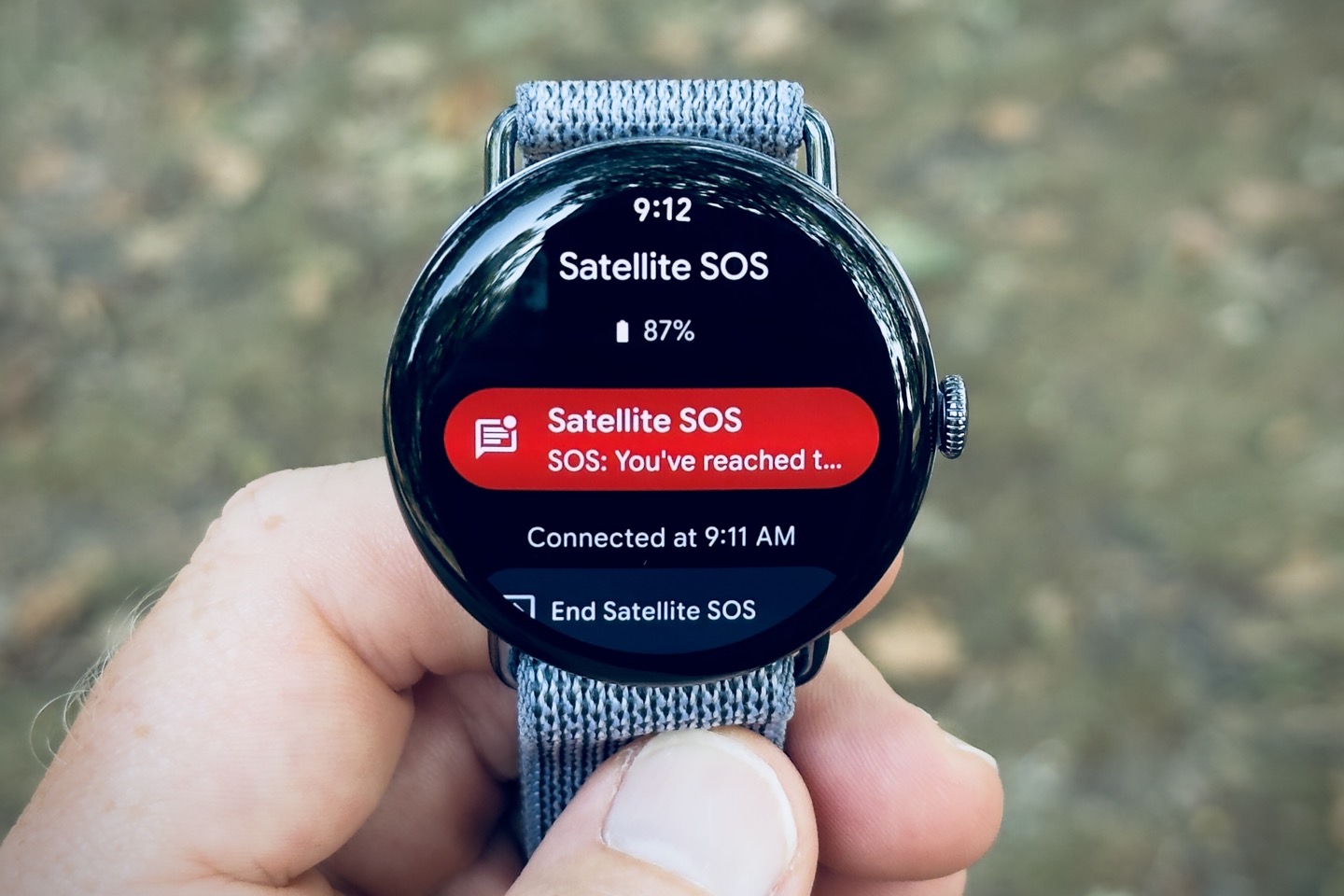
Last summer, in late August, Google was the first smartwatch company to announce satellite SOS features. At the time, it was a massive deal, as it allowed consumers to send emergency messages directly from their smartwatches to emergency response centers, even outside of cellular range. Well, at least as long as they were in the US.
Of course, as (unfortunate for Google) luck would have it, within two weeks both Garmin and Apple announced similar services, albeit with greater service areas and features, and ultimately beating Google to actually ship said watches/features to consumers. But today, Google is starting to turn the tide a bit in that realm.
They’ve announced that their satellite SOS piece for Pixel Watch 4 is now rolling out beyond just the continental United States, specifically now available in the following regions:
United States: Expanding to Alaska and Hawaii
Canada: Adding the whole of Maple Syrup land
Europe: Adding all of these countries: DK, DE, UK, ES, IE, FI, FR, IT, NL, NO, SE, BE, AT, SK, PL, HU, RO, PT, CH, CZ, SI, LV, LT, EE
As with before, this is still run by Garmin’s Emergency Response center (aka Garmin Response), the same one you’d talk to on a Garmin device. That’s good, because it means there’s no ‘learning curve’ on the part of Google for these added regions. It’s something Garmin has been doing for 15 years (fun tidbit, they just published this 2025 SOS recap last week).
Speaking of good news, there are a few other features coming to the Pixel Watch 4 as well:
Left behind phone reminders, phone lock on disconnect and mobile trusted location via Watch: Pixel Watch works proactively to secure your phone, with instant alerts if you accidentally leave it behind and an automatic lock on your phone the moment you move out of range. Plus, a connected watch and phone now offer faster identity checks for smooth, secure access. [Phone lock and Left Behind on Pixel Watch 2+, Trusted locations Pixel Watch 3 & 4]
Express Pay: Pay even more conveniently by just turning and tapping your Pixel Watch to a retail terminal without opening the Wallet app–or compromising security. [Available on Pixel Watch 2+]
Find Hub on Pixel Watch: Find your misplaced devices and essentials in seconds, right from your wrist with Find Hub on Pixel Watch.
One-handed gestures: Our intuitive one-handed gestures will be expanding to Pixel Watch 3 [Already on Pixel Watch 4]
Earthquake alerts: The new standalone earthquake alerts notify users of nearby earthquakes in real-time, providing seconds of warning before the shaking starts. [Available on Pixel Watch 2+]
Finally, I don’t tend to cover phone stuff unless it intersects with sports/fitness stuff, but it’s worthwhile noting that this is all part of Google’s larger March 2026 ‘Pixel Drop’ where an assortment of Pixel products (phones, watches, etc…) are getting new features. In addition, there’s also a slate of Android feature updates being announced. I didn’t see anything else in the list that intersected with the sports/fitness realm, but you can dig into those here if that’s up your alley.
In any case, back to watches, I’d have to assume the next step here is expansion beyond emergency SOS features (e.g., to regular satellite texting and location updating like Apple has, or some other variant like Garmin has). I had confirmed last year with the Google Pixel Watch team that there wasn’t anything technical from a hardware standpoint that limits them here, but really more of the software side. That of course, makes sense, because the hardware layer doesn’t really care if you’re sending out a message that you’ve been attacked by a bear, or that instead, you’re just texting a friend that you ran out of Haribo. Same-same to the watch NTN hardware, just different bears.
I’d have to imagine just a feature expansion would happen no later than a Pixel Watch 5 launch (presumably late summer 2026 or early fall 2026), though equally, I think there’s a strong case to be made to do that as part of Google I/O (May 19/20th, 2026), or something else aside from new hardware launches. Either way, looking forward to that happening at some point.
With that, thanks for reading!
Found This Post Useful? Support The Site!
At the end of the day, I’m an athlete just like you looking for the most detail possible on a new purchase. These posts generally take a lot of time to put together, so if you're shopping for the Pixel Watch 4 or any other accessory items, please consider using the affiliate links below! As an Amazon Associate I earn from qualifying purchases. It doesn’t cost you anything extra, but your purchases help support this website a lot.
And of course – you can always sign-up to be a DCR Supporter! That gets you an ad-free DCR, access to the DCR Shed Talkin' video series packed with behind the scenes tidbits...and it also makes you awesome. And being awesome is what it’s all about!





It really frustrating/sucks to see companies like Google and Apple update their watches for years but then Garmin will only add new features for a year or so even though the hardware has zero issues running new software like lifestyle logging, new sports apps or new UI.
I know it’s frustrating, but Google and Apple make their money selling phones. The watches are lock in devices for future phone sales, hence they don’t care if you keep a watch for 5 years so long as it keeps you buying iPhones. Garmin don’t have that luxury – they only make money when you buy a new watch, hence the lack up updates to old devices which push you into buying new product every couple of years.
I think there’s additionally two other elements to remember…
When it comes to Google’s updates, this is basically the first update Google has delivered to the watches since release, and possibly, they’ll do one more. It has roughly half a dozen features. For context, Garmin’s most recent quarterly release for all their current watches has roughly 20-30 features of equivalent size/complexity (depending on how you count them). And they do that every quarter. Now the downside is each Garmin watch tends to only basically get 2 years worth of these fast and furious updates, whereas Google is is 2 years, maybe 3 years, we’ll see. Apple is definitely longer, though equally, just a handful in comparison to Garmin.
For Apple, in addition to the handset (or computer) side, Apple has continued to carve out the services business. So beyond that, they’re now gaining all sorts of ancillary revenue from you that Garmin isn’t. That’s a core reason why Garmin wants Connect+, and wants you to subscribe. Obviously, at this point that value prop is pretty low. Whereas for an Apple user in the entire Apple ecosystem, aspects like cloud backup of photos and such, they’re likely paying for Apple’s services. Past analyst estimates have said roughly 70% of Apple US users are paying for expanded iCloud storage.
“For context, Garmin’s most recent quarterly release for all their current watches has roughly 20-30 features of equivalent size/complexity (depending on how you count them). And they do that every quarter. Now the downside is each Garmin watch tends to only basically get 2 years worth of these fast and furious updates,”
If you had bought a Forerunner 965 in April 2025, that watch was (a) the very best Forerunner model that you could buy as of that date, and (b) is still under warranty as of today
And yet it gets no feature updates (aside from bug fixes) now that the 970 is out
There was a time when Garmin would update both the current model AND the previous model with new features, like when the 255/265/955/965 all got new features at the same time, albeit the older watches only got some of them. But at least they got some.
link to dcrainmaker.com
As a 965 owner – and yes my watch is still under warranty – I get none, and this sucks
There is surely no reason why my watch cannot have Auto Lap by Timing Gates, for example
I agree, it sucks, don’t get me wrong. Especially if you buy at the end of that cycle, versus the begining.
That said, in Garmin’s view, the 255/265 955/965 wasn’t actually a new subsequent release, but they viewed it as the same watch with two different displays. Hence why they kept the firmware around.
It’ll be semi-interesting to see what happens going forward. In theory, them *finally* having all watches (Venu/Forerunner/Fenix/etc…) on the same underlying firmware from last summer means there’s in theory less reason to do this reset each model. How that impacts things is an interesting, outstanding question.
The whole SOS via satellite feature on wearables is nice, but the entire procedure for establishing and maintaining a satellite connection with Apple, Garmin, Google, etc., isn’t very emergency-friendly and is highly dependent on the environment/location to get a connection. Sure, it’s nice to have (and initially free (except Garmin), but from my perspective, it’s more of a false sense of security, though it’s better than nothing. In a real emergency, time is often of the essence, and SOS emergency call systems like those on Garmin’s iR handhelds are clearly superior, since you only have to press the SOS button (“fire and forget”) and don’t have to go through the hassle of acquiring a satellite signal. Of course, this costs extra (device and subscription) and you have to carry another device with you, but it can be more effective in genuine emergencies. Opinions on this are naturally divided.And I would bet that a large number of users who have the SOS function on their phones or wearables have not familiarized themselves with it and, in an emergency, at least lose valuable time. Just my 2 cents…(I have owned a Garmin F8 Pro and an AWU 3 now and I have still a Garmin iR handheld (so I know what I am talking about)).
It’s true it’s a bit more cumbersome on the wearable, but I’d argue that in an emergency, it’s really not going to impact the outcome.
The reason is simple: In every scenario involving satellite SOS, you’re outside of cellular range, and thus that almost always means you’re in a remote place. The extra 60-90 seconds that it takes to deal with the watch-holding steps just aren’t going to impact the rescue itself, because those rescues in remote places aren’t showing up in 5 minutes. They’re showing up in 1-5 hours.
Next, unlike the standard inReach devices, when you press SOS on the wearable side, it actually gathers the ‘what’s wrong’ data first. Thus, when it sends that first message, Garmin/Apple have all the details upfront. Whereas on an inReach device, it’s a back/forth conversation. Point being, it’s actually a wash there.
Don’t get me wrong, I’d love to see some of these bits less cumbersome on the wearable, but I don’t think it’s having any material impact on how fast a person is getting assistance compared to traditional inReach. The entire response lead-time is just so long in remote places, it’s merely a drop in that bucket.
Sending general messages (beyond emergency) through Satellite is complicated from regulatory side.
Google would be seen as a telco operator and would need to cooperate with authorities (data retention, etc.).
Basically different laws in different countries. Not sure if Google can shift these responsibilities to Garmin.
I believe Apple is not willing to do this step (aside from maybe alienating its telco partners).