

Huawei has launched the new GT Runner 2 watch to pretty strong fanfare: A dedicated running-focused event with Eliud Kipchoge in Madrid, a slate of new features, and a new GPS/GNSS antenna design that they are saying is the headliner feature and beating what they defined at the gold-standard GPS watch. As part of this, they held media briefings at a fascinating level of detail into how this new system is supposed to work, including side-by-side labeled comparisons with other benchmark competitors, such as the Garmin Forerunner 970 & Apple Watch Ultra 3. As a side note, it’s pretty rare for companies to actually label the competitors in these media briefings.
Obviously, with this much GPS-focused fanfare, I’m here for it. And more specifically, here to validate (or debunk) these claims in the real world. Thus, welcome to this post.
Now to be clear, there’s lots of other software-focused features that make this watch interesting. From expanded training load metrics, to expanded training plan pieces, to smart re-fueling reminders, and more. Though, as we’ve seen the trend recently, these features in and of themselves are no longer category-leading, but just category baseline. Of course, it’s cool to see Huawei pushing deeper into the running side – with an acknowledgment during the briefing that this is the sport they’ll be tackling first, in terms of feature depth.
That said, the cornerstone of this newly announced watch is the GPS antenna design being revolutionary, and thus, I wanted to focus on that.
What’s New:
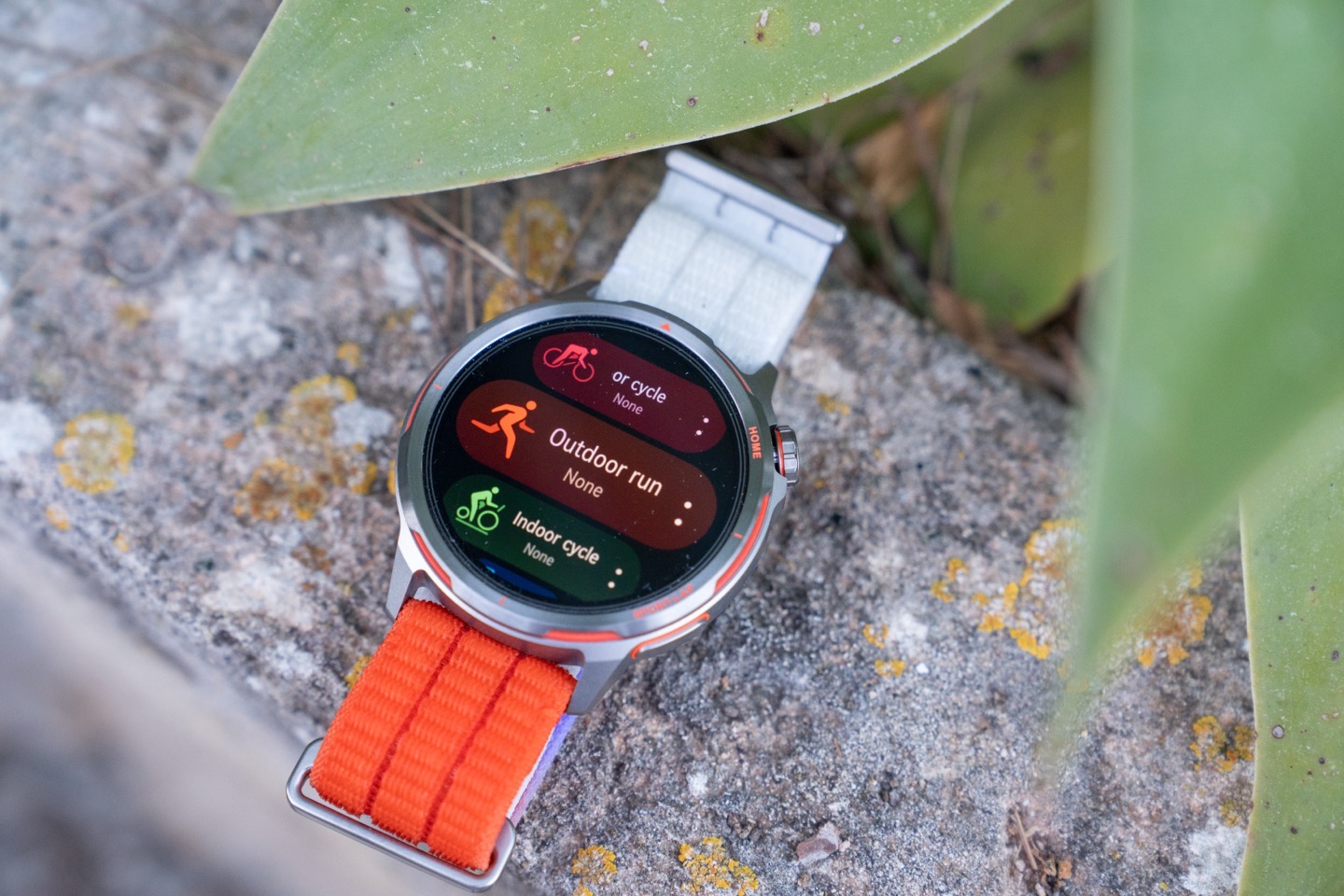
Now, before we talk about the most highlighted feature (GPS Accuracy), let’s just briefly run through some of the changes in the watch (and platform). Here’s the quick and dirty:
– Added optimal training load widget/tracking (e.g. low/medium/high load)
– Added historical trend line for optimal load (aka ’the tunnel’)
– Added RAI (Running Ability Index)
– Added running power
– Added running power curve
– Added dynamic recovery guidance (accounting for factors like sleep, stress, etc…)
– Added smart training plans (specify goal race, and will populate rest and dynamically change)
– Added in-race marathon guidance data pages (showing progress towards goal, and specified targets on HR or Pace)
– Added support for free-diving to 40m
– Adding upcoming NFC payment support with Curve
– Added new breathable fabric strap (dries far quicker than other straps), also silicon one in box too
– Contains full metal case (titanium alloy)
– Display is 3,000 nit display with Kunlun glass
– Battery claim is 32-hours of GPS time, and 14-days smartwatch (gesture-based)
– Watch weight is 43.5g (lighter than most watches in its class, claimed as the lightest metal GPS watch)
– Watch thickness is 10.7mm (most watches in this class are in the 12mm range)
– Case diameter is 43.5mm (roughly the same ballpark as others in the 43-47mm range)
Note that it comes in three case colors/combos:
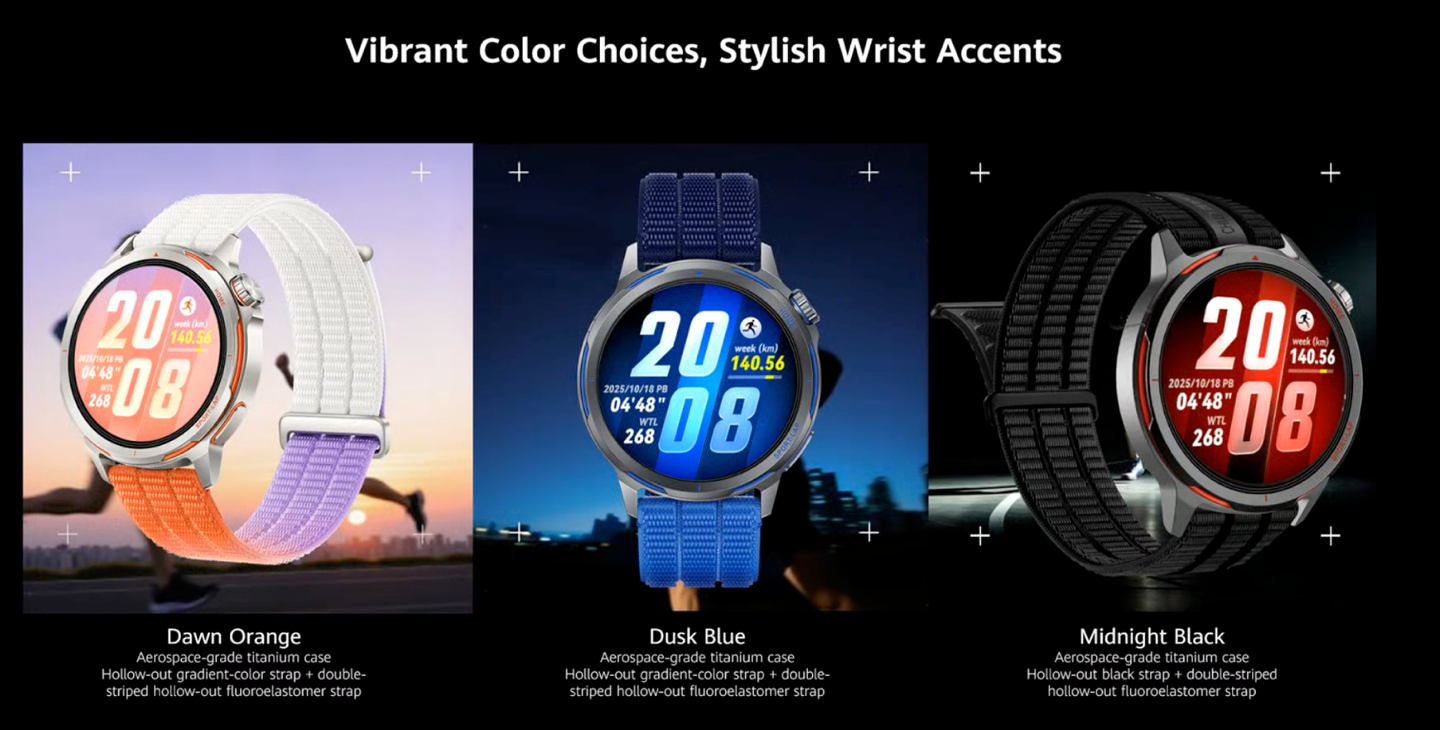
The price is 399EUR/349GBP.
As always, Huawei watches are available outside the US, but not officially available inside the US (due to the US Government blockages of Huawei products). Huawei did make some interesting notables in their presentation around sales numbers, which I figured were worthwhile pointing out:
– No 1 global wearable wrist-worn unit sales in Q1-Q3 2025 (expected to hold full 2025)
Shipped 200 million wearables thus far (till 2025)
– Shipped 55 million+ Watch GT Series units
They did preemptively counter-claim that while it might be easy to say that “those are mostly in China”, they noted that they are number #1 in their home market, but often #3 in many other markets as well. Obviously, you can validate/invalidate those claims with IDC if you have a subscription.
The New GPS Antenna Design:
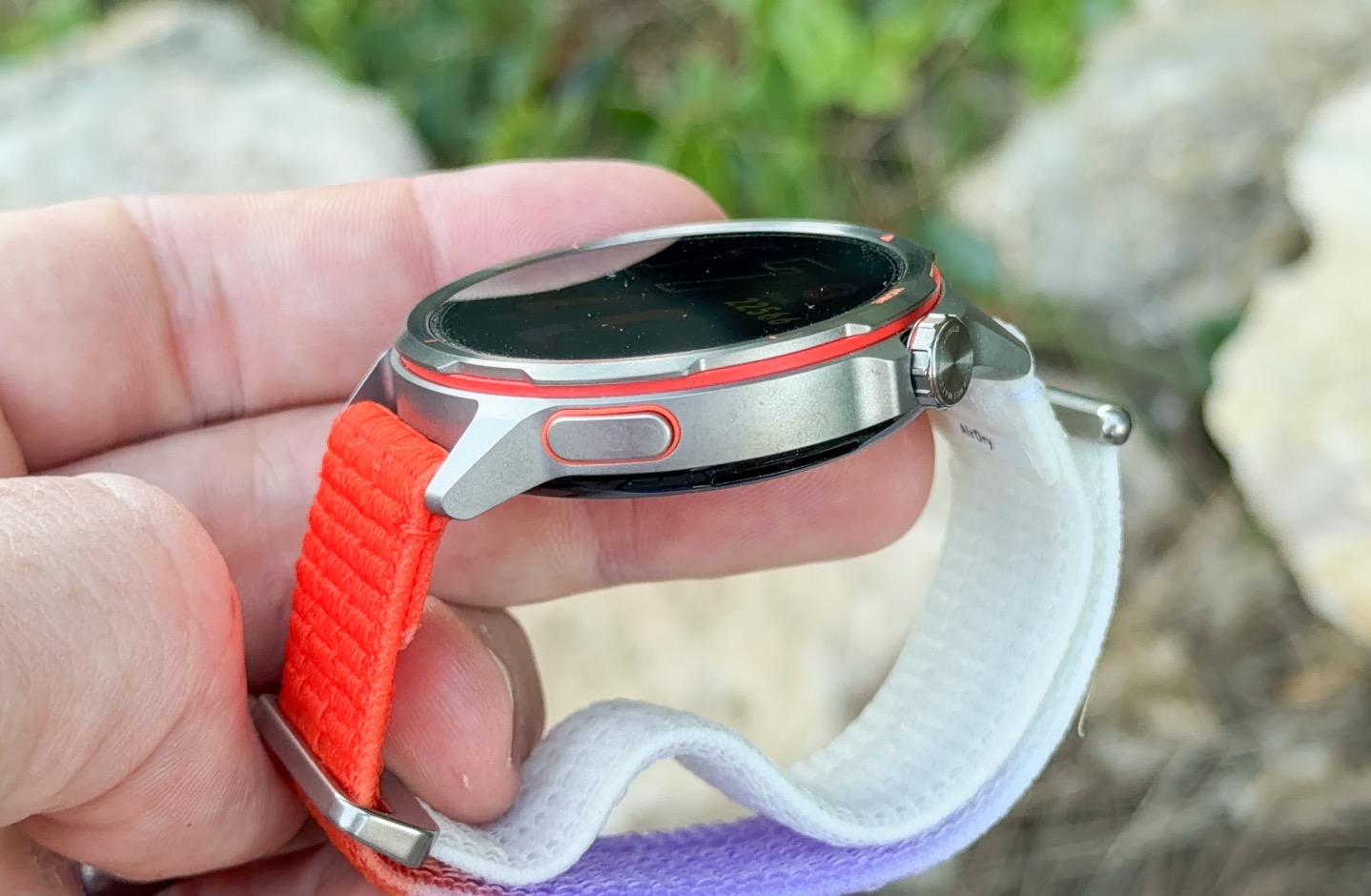
While the watch received other hardware styling changes, the biggest ticket item by far is the new GPS antenna design. Back in the 2010’s, the main focus when it came to GPS accuracy was often the GPS chipset itself (e.g. from Sony, MediaTek, etc…). But by the end of the decade that shifted more towards the actual GPS antenna portion, which is basically the tiny wire that’s typically embedded into some portion of the bezel. Every single watch needed a different GPS antenna design (since every single watch had different bezel shapes, materials, sizes, etc…). The difference between success and failure was measured in fractions of a millimeter. While the actual chipset, and the firmware customizations certainly still mattered, the antenna was make or break.
It’s a lesson that many companies had to learn the hard way, notably both COROS & Polar having previously openly discussed their GPS antenna design failures after first attempts (in the COROS APEX 2 series, and Polar in the Ignite 3). Generally speaking in this area, Garmin is considered the leader in GPS antenna design since roughly the Fenix 7 era (and carried into virtually all of Garmin’s other device), though Suunto is mostly seen as equal here in recent hardware as well. Others may be close, but never quite being as perfect.
Which is likely why in Huawei’s media presentation, they consistently refer to the Garmin Forerunner 970, which they specifically noted as being a “gold standard” device (their exact words, not mine).
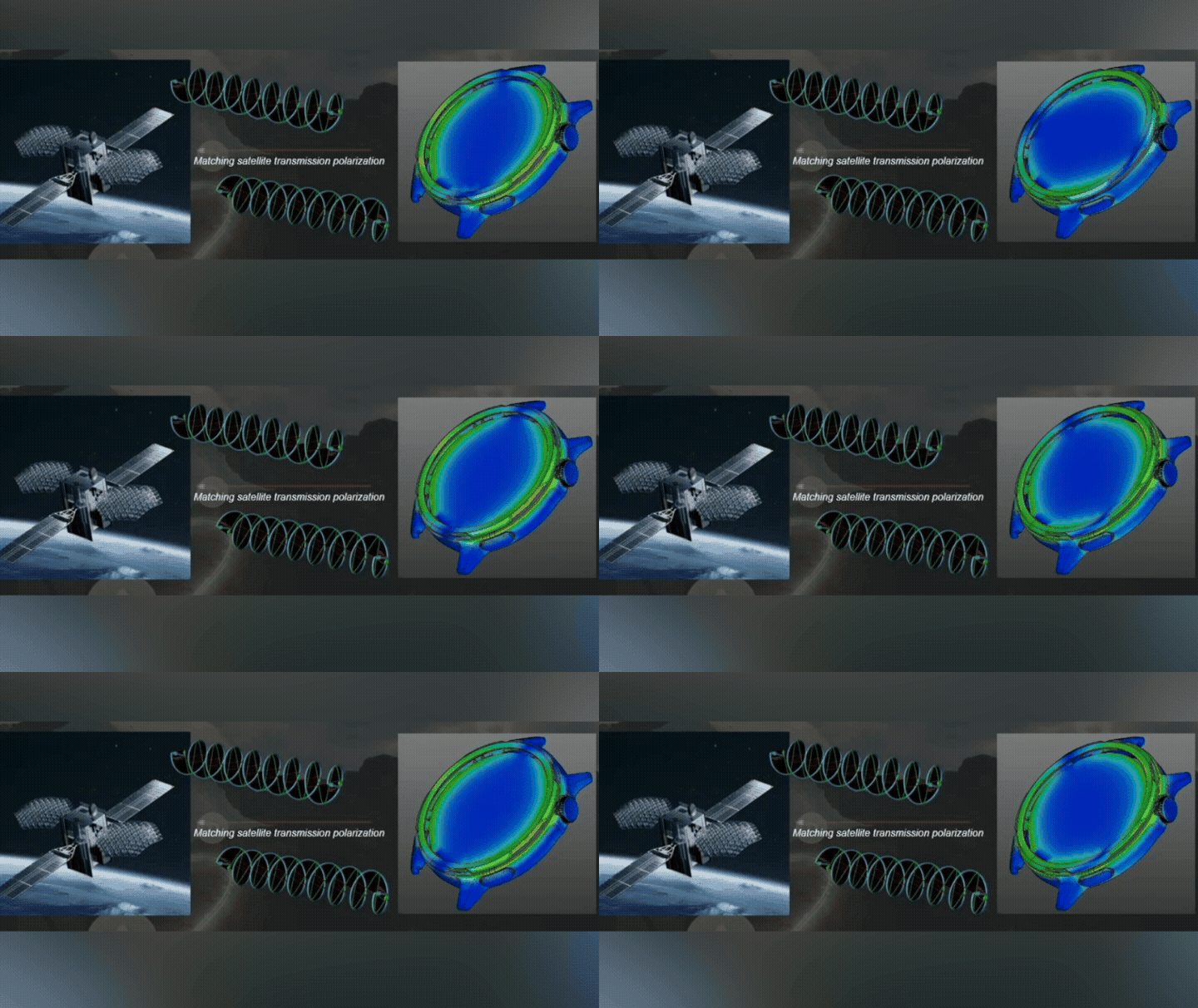
So with that backstory, let’s talk about what Huawei is doing. Below is a slide from their presentation. Essentially, they have not one, but *two* GNSS antennas here. The first antenna is built into the case itself, whereas the second antenna is built into the titanium bezel. That aqua-colored ring is an isolation ring that keeps the upper antenna floating there, ungrounded (whereas the lower antenna is grounded).
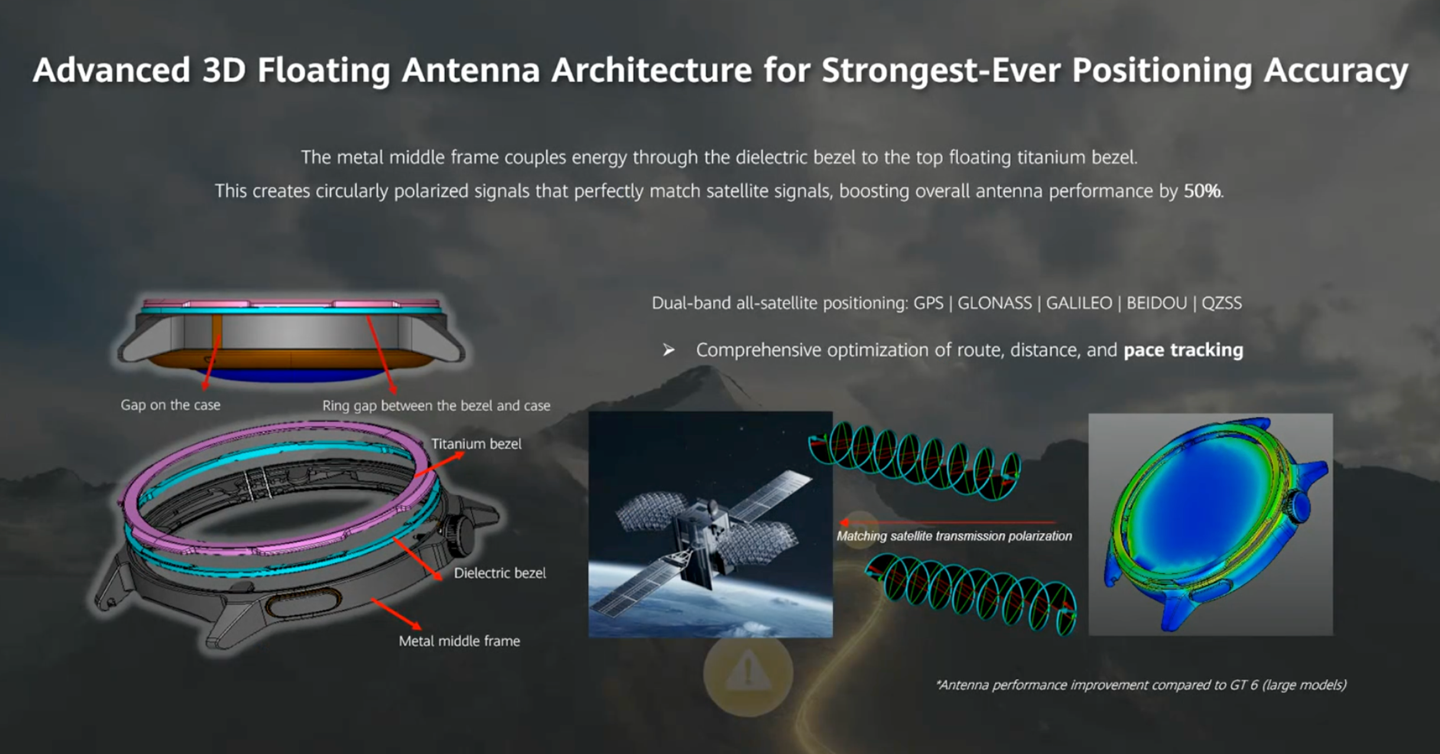
The idea here being that they can use the two antennas operating in opposite directions to match the polarization of the satellite transmission. Here, in this little animated GIF, you can see the rotation (electrically, not physically), if that:
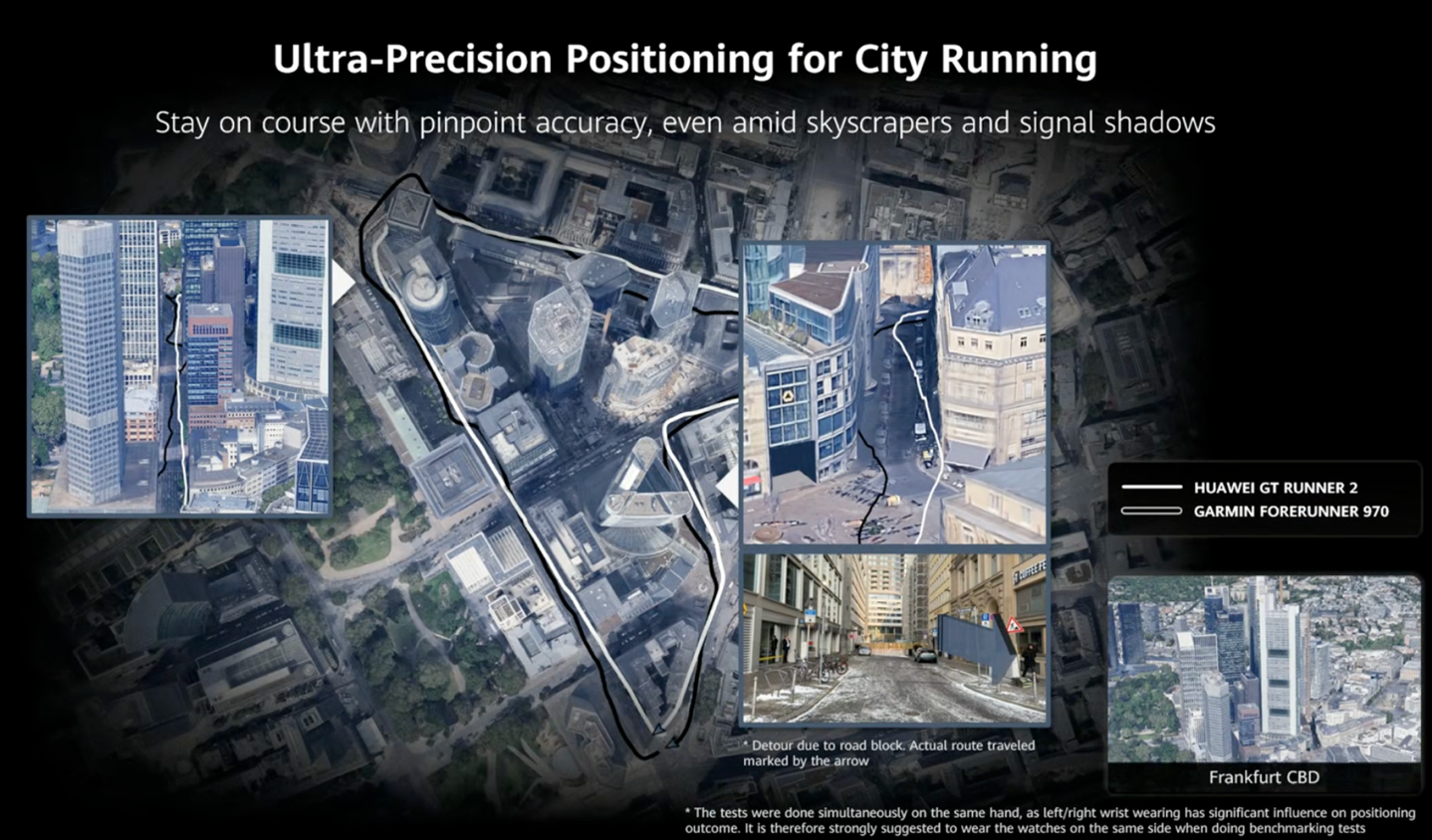
Within this, they talked a lot about how this would handle tough GPS conditions better than their competitors. Here’s a slide they had showing the downtown business district in Frankfurt, along a tight street in between tall buildings:
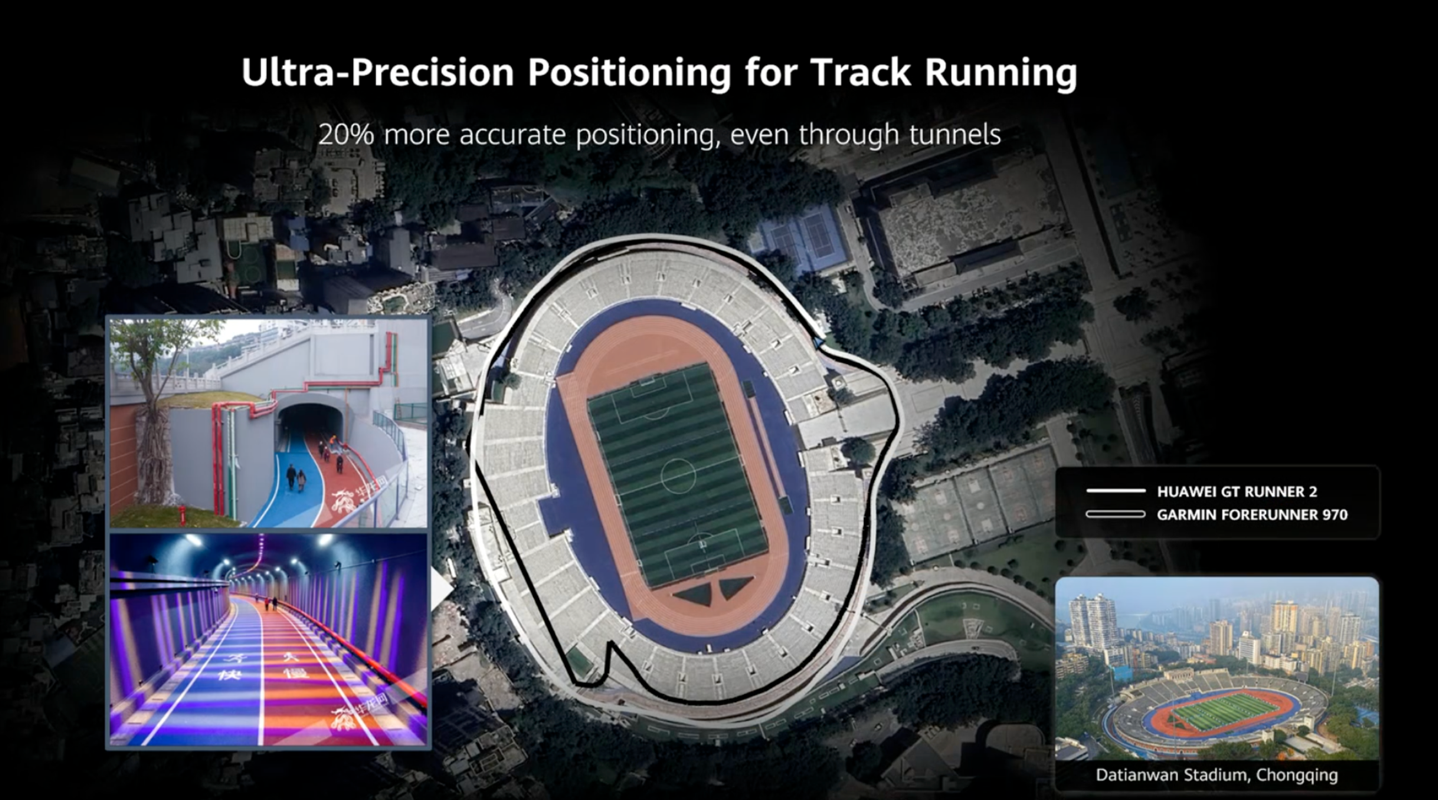
And another more interesting one talking about how they were combining this with algorithms to figure out where you’re going, even when no GPS exists. They do this by blending GPS data with mapping data. In the case below, the title says “Track Running”, but you can see it’s actually the outside perimeter of the track, where it goes under a stadium in a very neat-looking tunnel. Here, because the Huawei watch has the actual running path details, it locks onto that once it loses GPS signal. It’s a creative solution, and something we’ve seen Apple dabble with a bit over the last few years (though, not quite to this level).
As a result of all of this, they noted very high accuracy levels for distance and pace, including this slide where they are testing against a NovAtel CPT7 GNSS reference device in a backpack (which has centimeter-level accuracy).
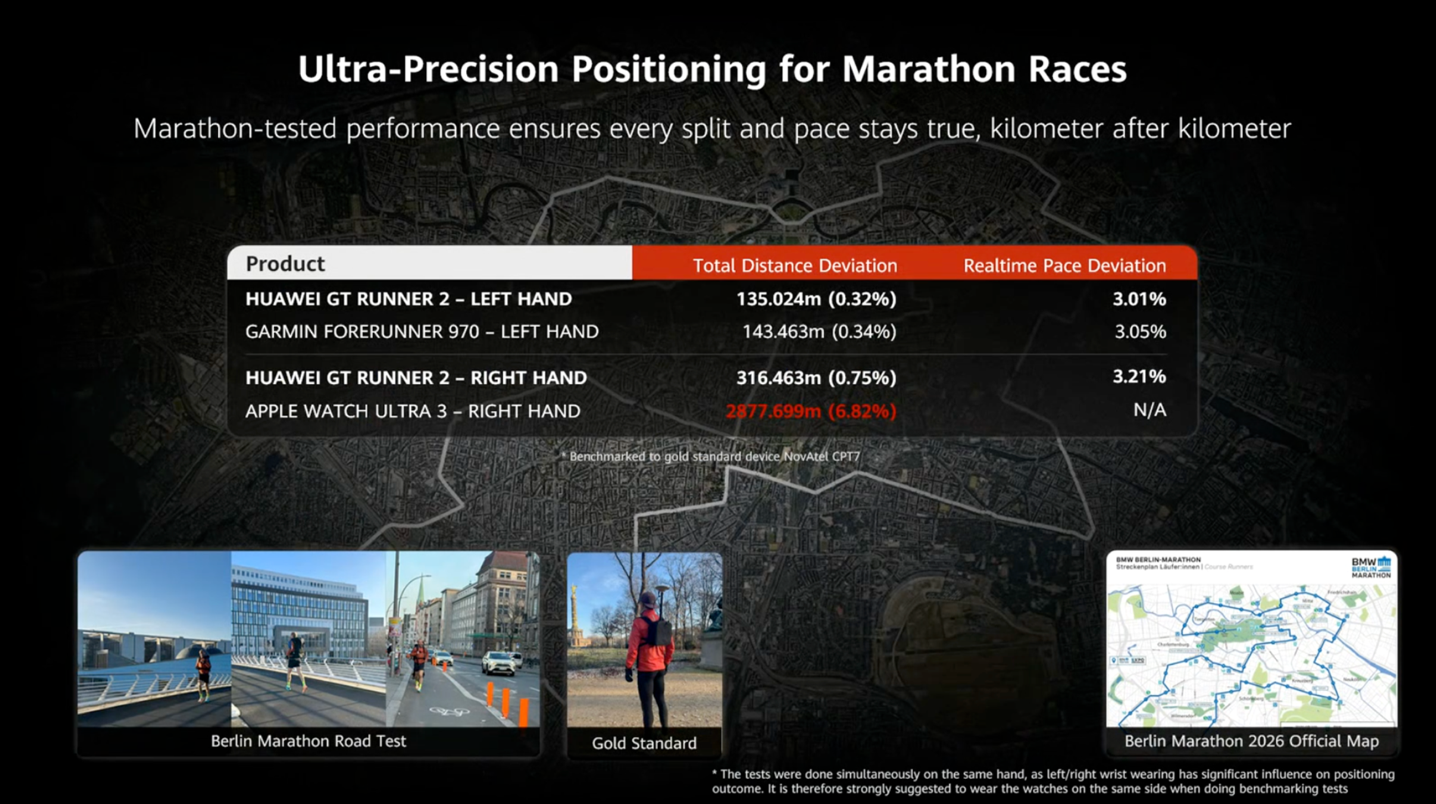
I will note that the Apple Watch Ultra 3 result there seems highly unusual. I’m not saying Huawei did anything purposefully wrong, but equally, that kind of error simply isn’t the norm for any devices these days (I don’t have any more track detail to understand what happened).
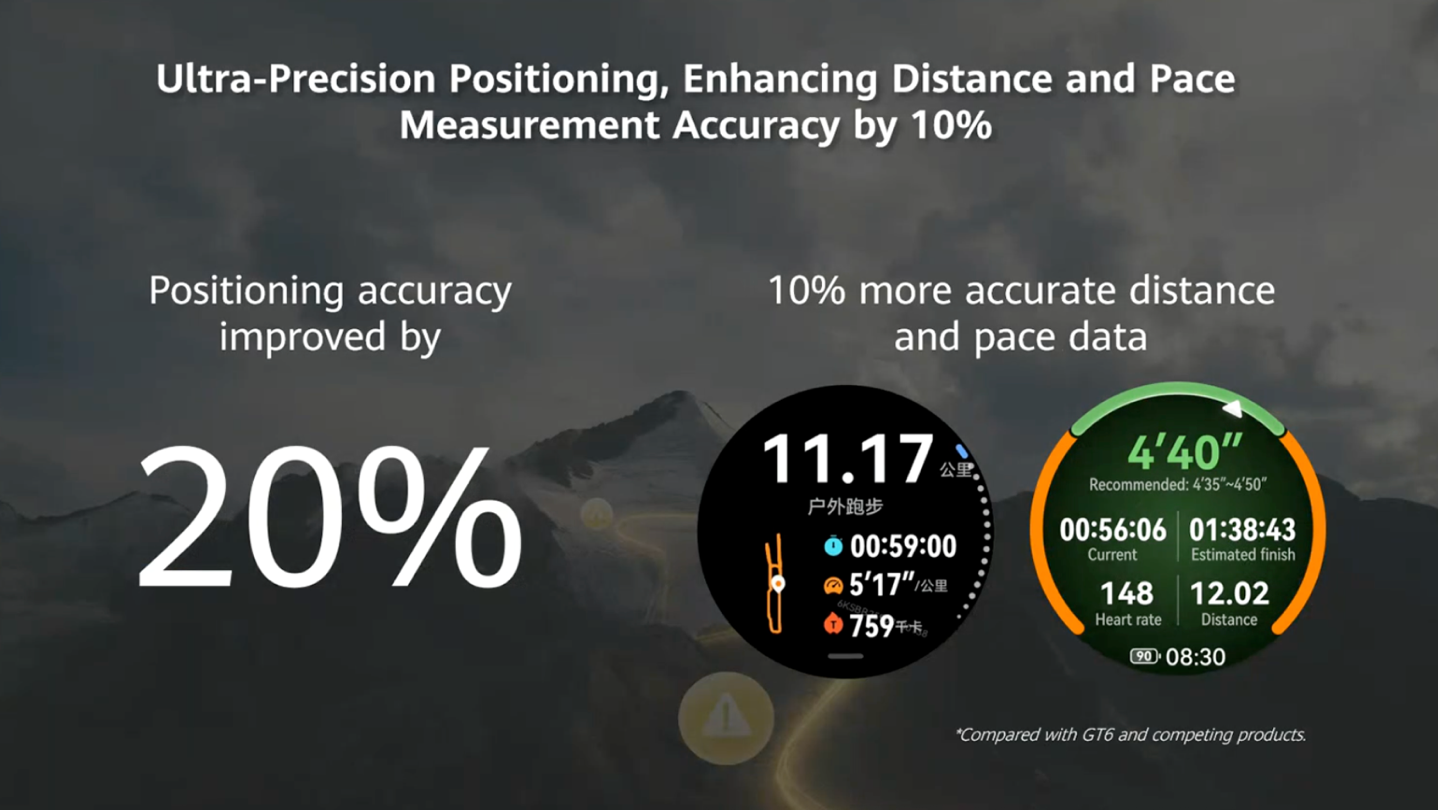
All of which gets us to their claims about being incredibly precise, and substantial improvements over past devices:
And doing so while having really solid battery numbers…at least with a gesture-based display. Here’s a comparison chart they did:
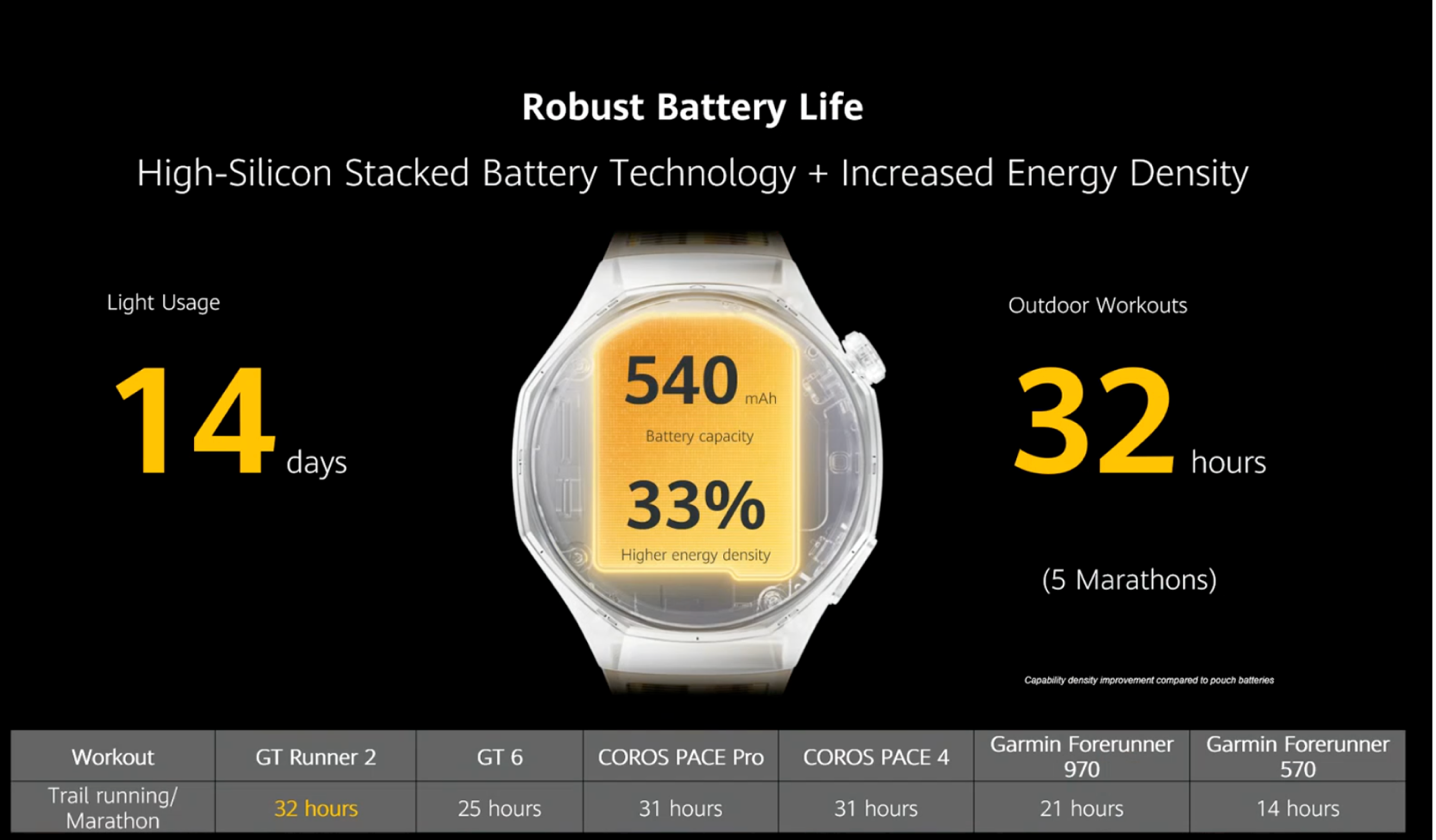
For some real-world data, though, on my 2hr 30min run yesterday, devices in always-on configuration burned as follows in *always-on* display mode (no route loaded on either):
Garmin Forerunner 970 (forced multi-band on): From 94% to 83% (thus an estimate of 23.5hrs battery life)
Huawei GT Runner 2 (multi-band on): From 85% to 70% (thus an estimate of 16.7hrs of battery life)
These Huawei battery burn numbers are consistent with all my other runs.
Is It Actually Accurate?
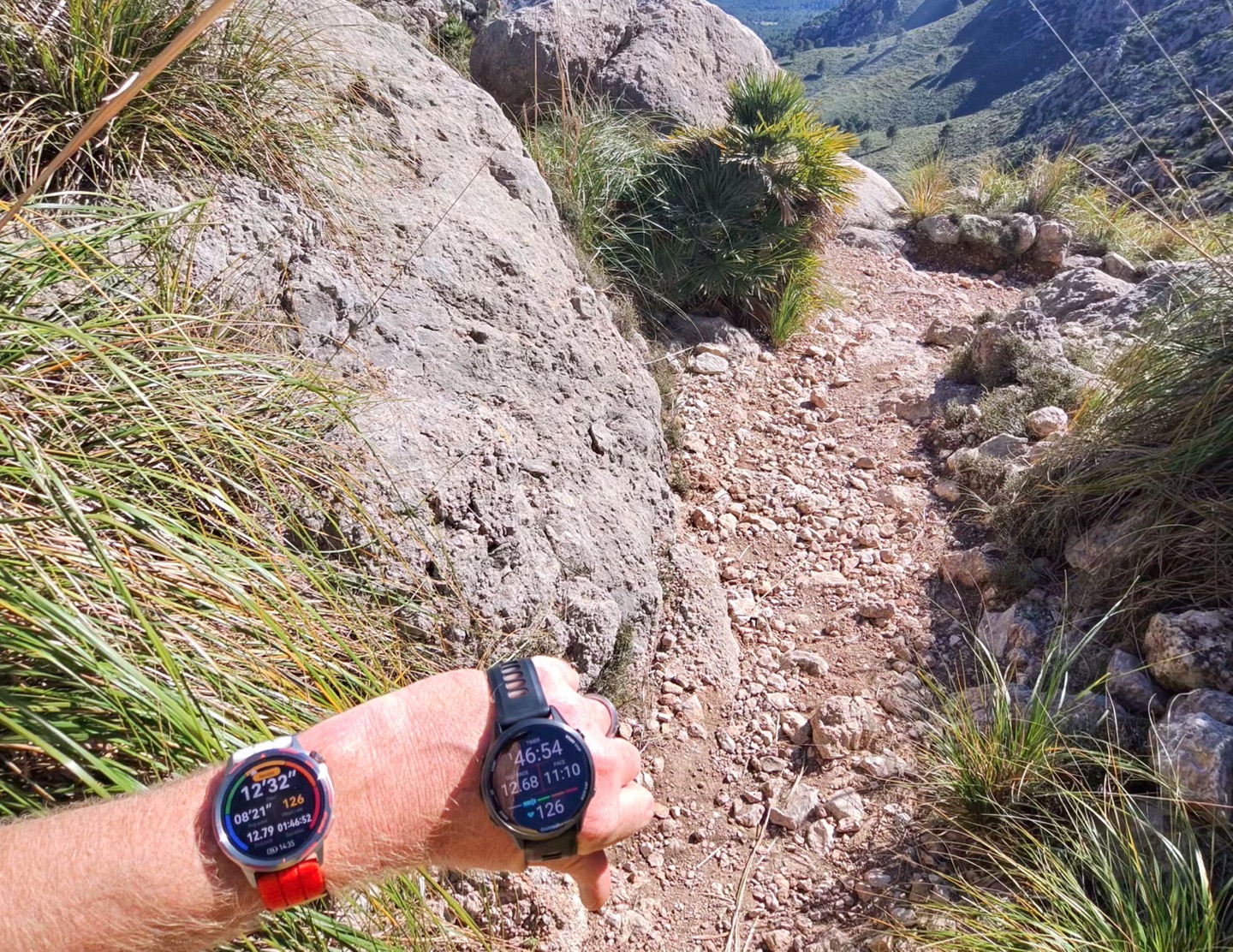
In short, no, it’s not.
At least not in my testing, and I think other reviewers as well. To be clear, there are some brief spots, but more critically, it struggled in both relatively easy and moderate scenarios alike. In my tests, I compared against multiple other units from Garmin, Amazfit, Suunto, and Apple.
Here’s a 2.5 hour run from yesterday, on the final-release firmware. This starts on easy roads/dirt roads, and then eventually works its say up into the mountains. Though none of this is very hard mountain terrain from a GPS standpoint. It’s largely wide open skies, with no overhangs on any section I was in:
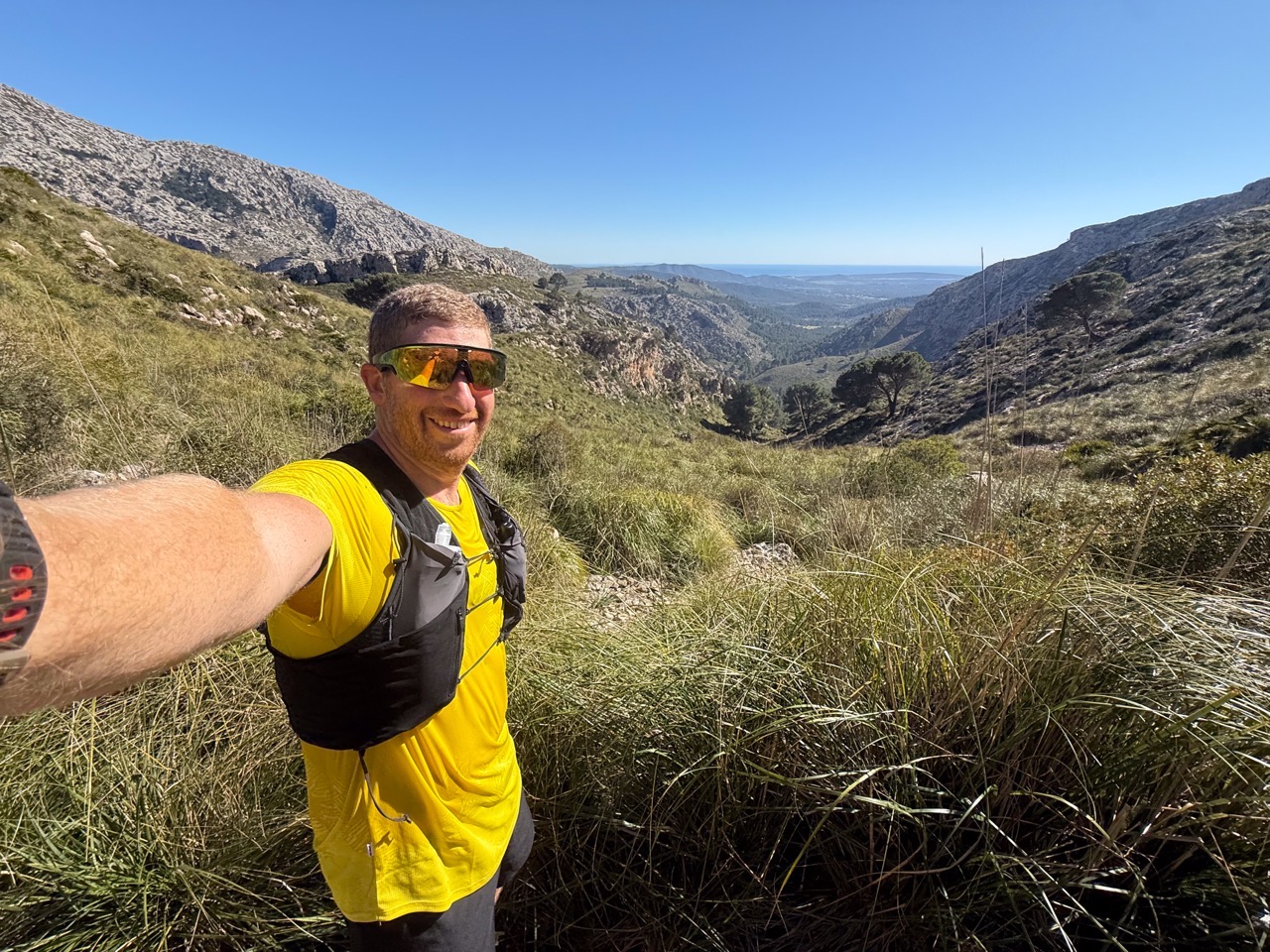
Here’s my configuration (Huawei said it performs best on left wrist, so I gave it its best shot):
Left wrist: Huawei GT Runner 2
Left hand: Garmin Forerunner 970
Right wrist: Amazfit T-Rex Ultra 2
Right hand: Garmin Fenix 8 Pro
Here’s the actual DCR Analyzer set, if you want to look at it online, or, the high-level first everything looks close-ish:
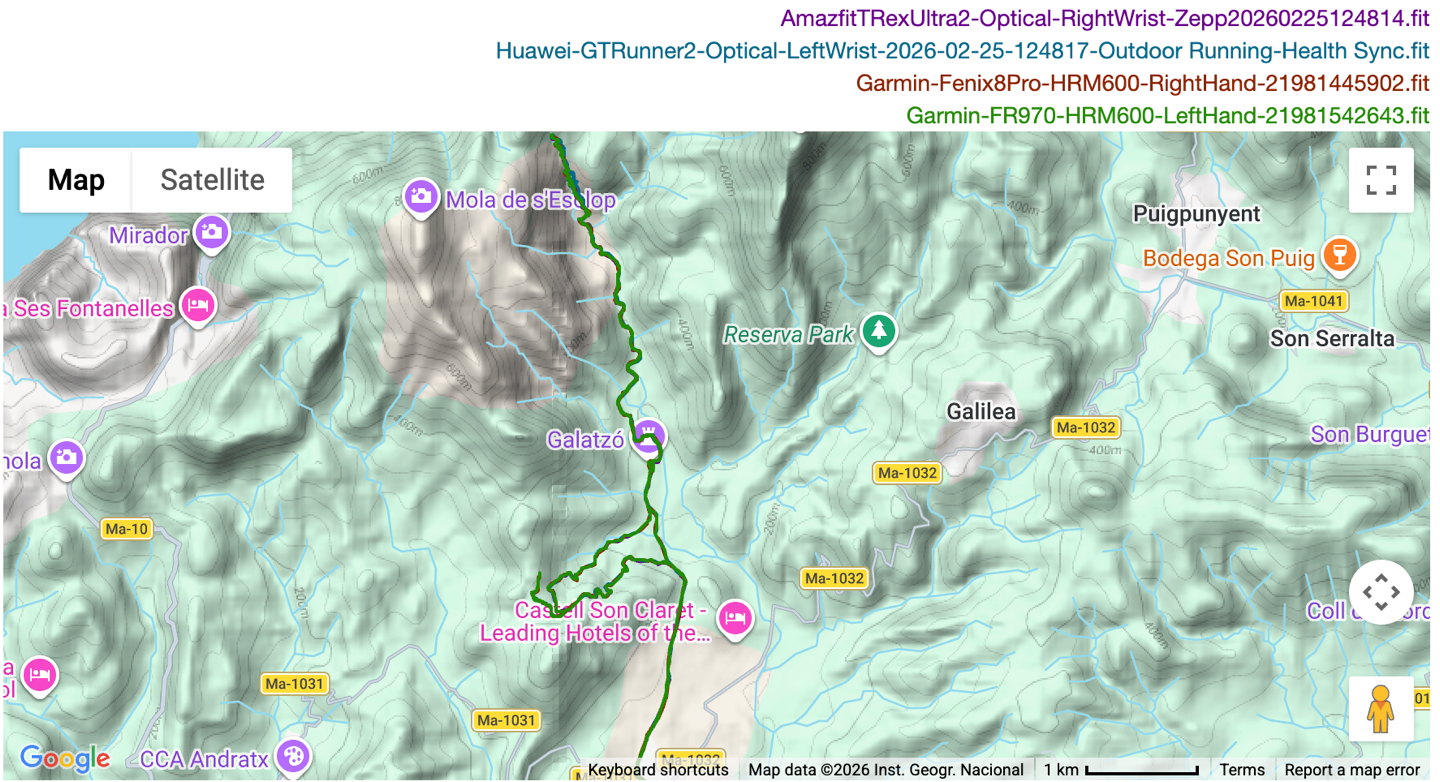
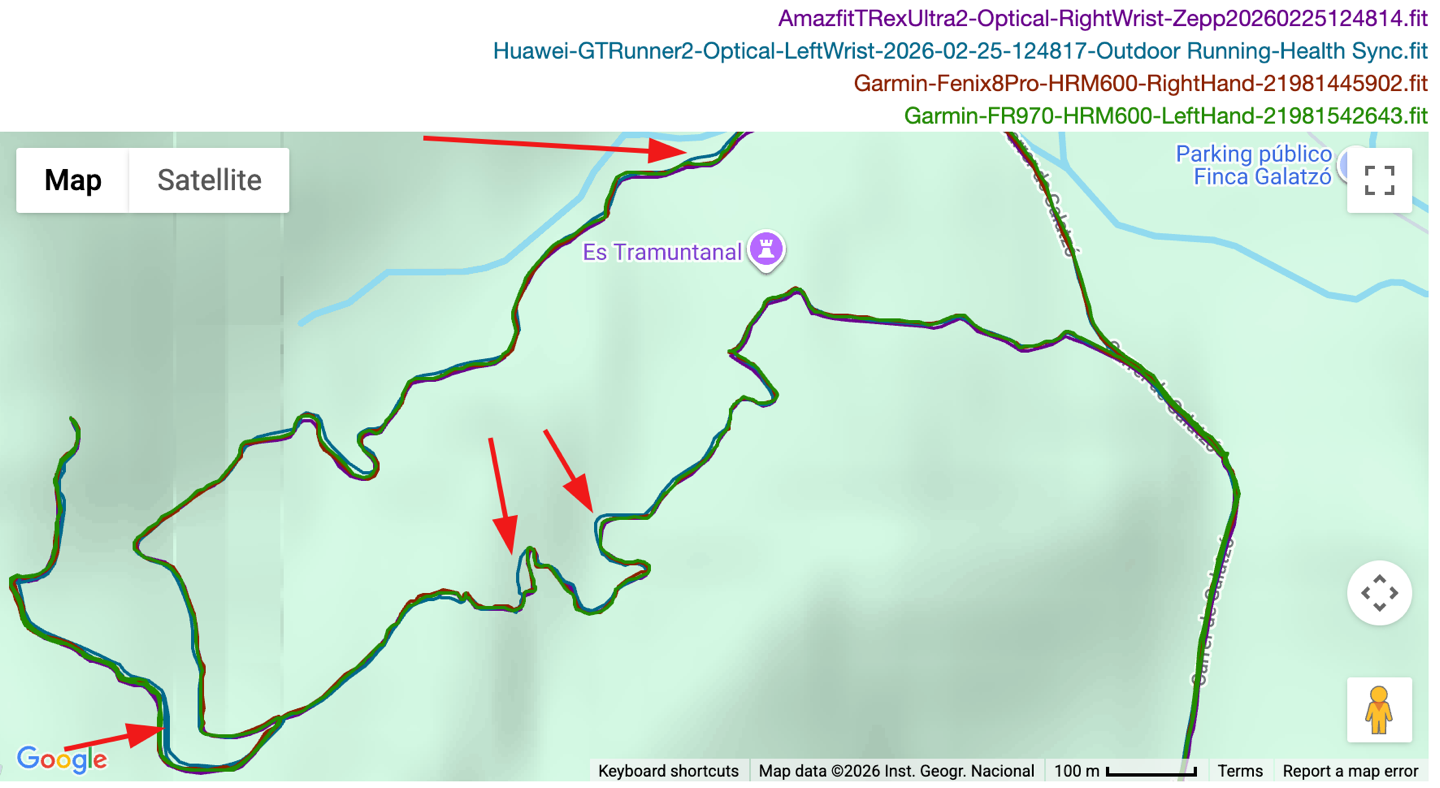
But as we zoom in on a mostly easy section as I translate from flats to a short sucker-punch of an initial climb, you can see slight variations from the Huawei watch. Nothing crazy, but just minor errors initially.
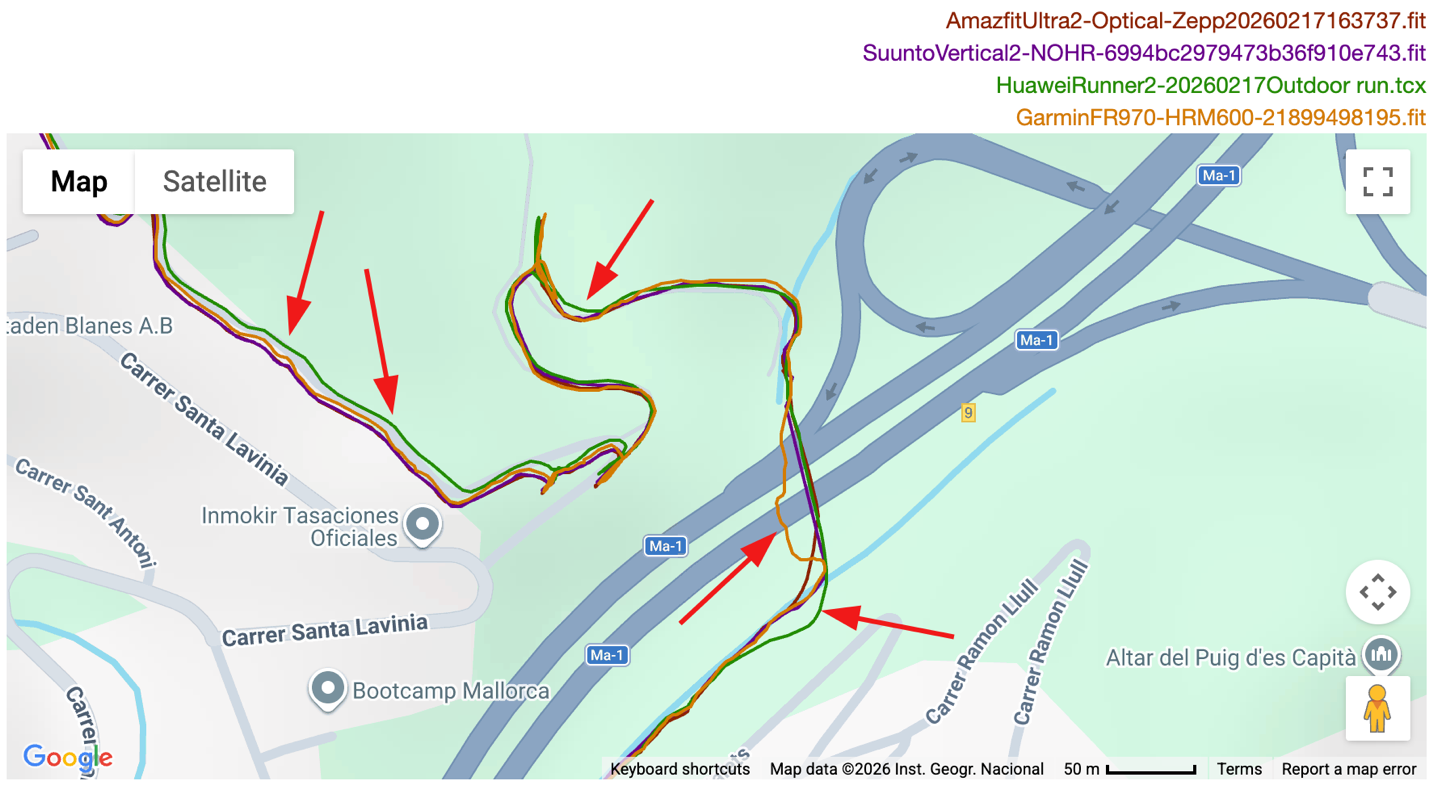
These minor errors continue throughout the run, so I’ll get to the main climb. Again, this is totally open skies, just lots of switch-backs back and forth (and steep, 20%+). But it entirely falls apart here:
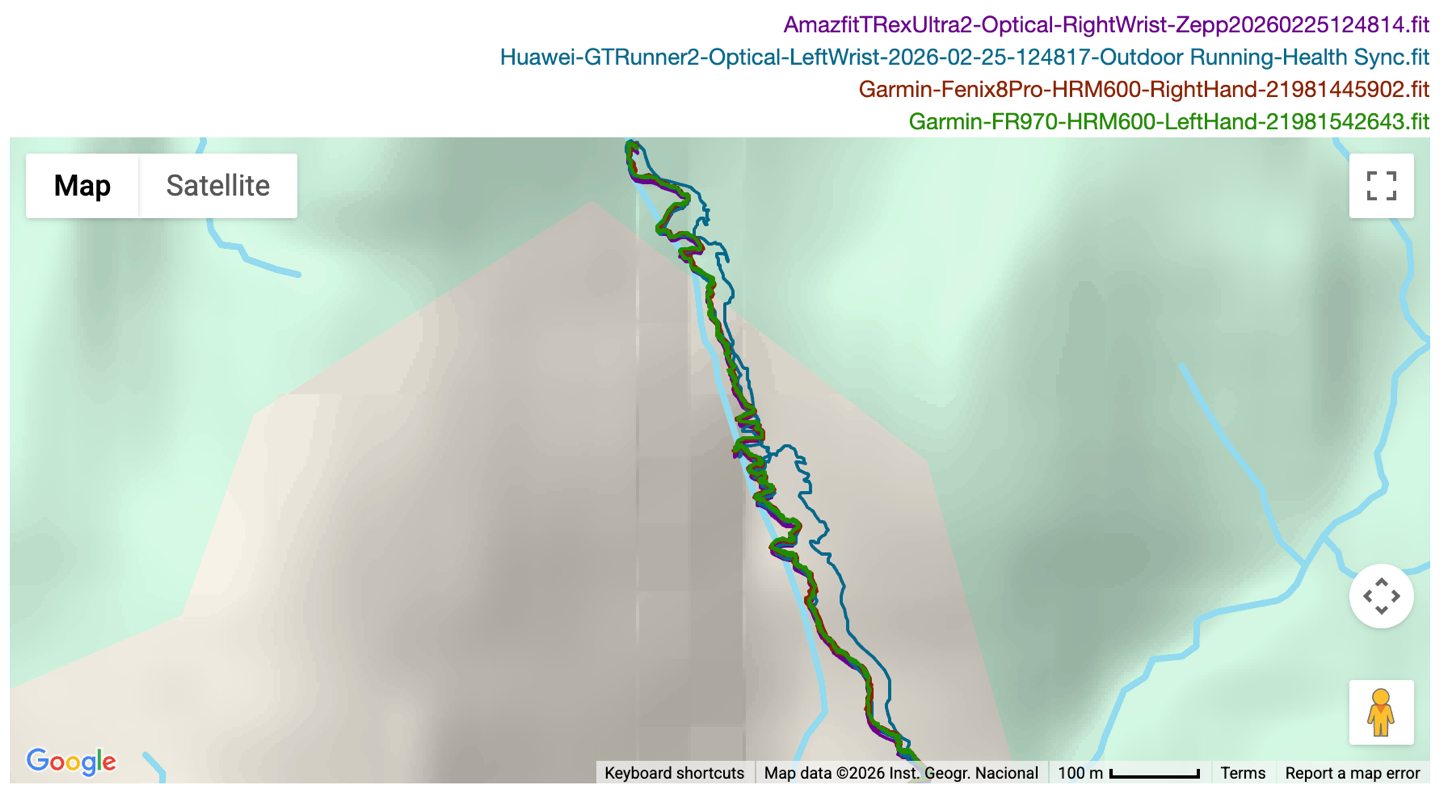
This is bad-bad. Sure, it’s sorta-mirrored off to the side, but also not in some cases. Again, we’re talking upwards of 50m offset from the track here, which is a long-long ways away.
So, let’s try another run, this time three hours. Similar configuration, except now I’ve got a Suunto Vertical 2 instead of a Garmin Fenix 8 with me. Note, colors have changed:
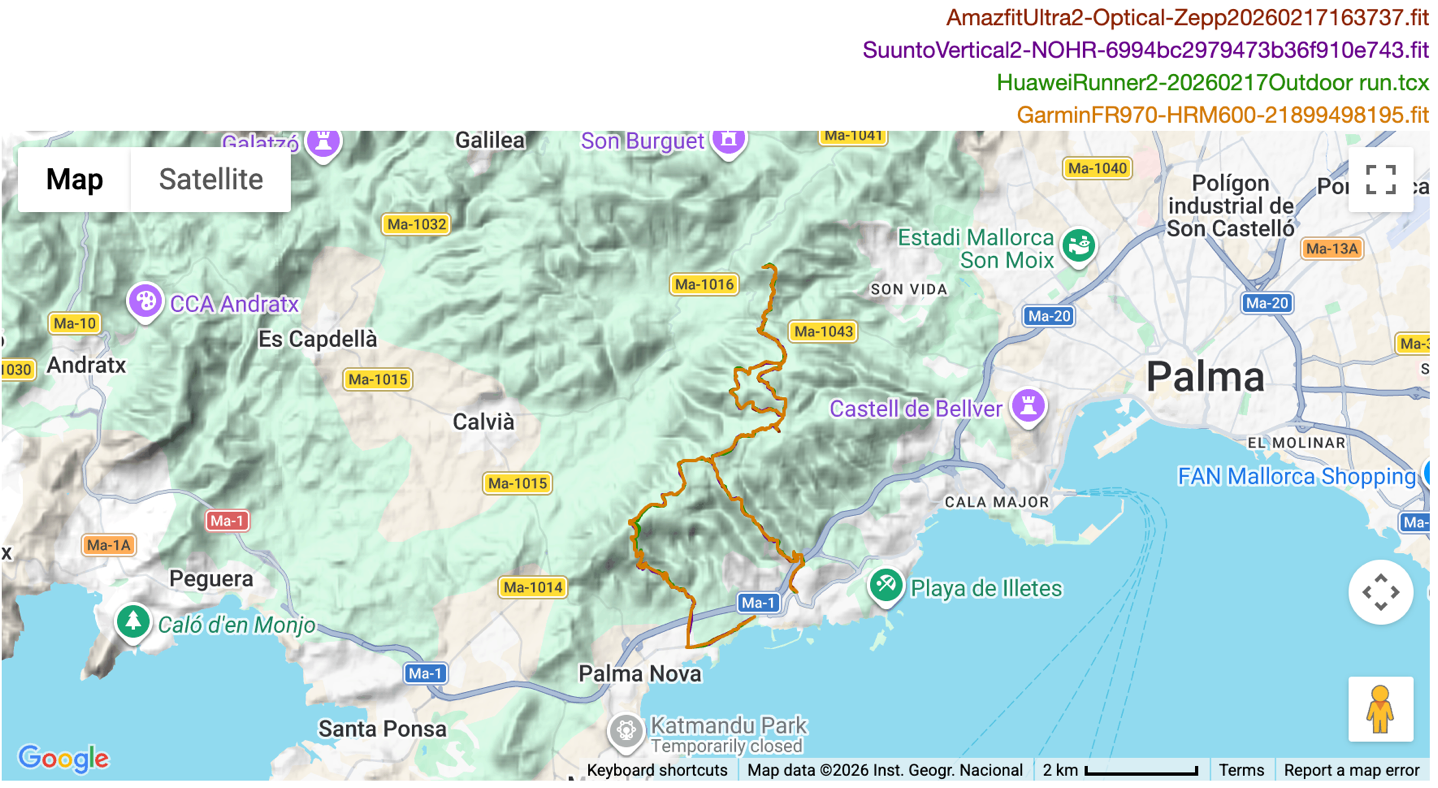
Here, I start off on roads which are fine, but as I begin my climb, it starts to fall apart, slowly separating out from the pack. While there are some minor GPS blockages here, it’s still pretty darn open. As you can see, one of these tracks sticks out:
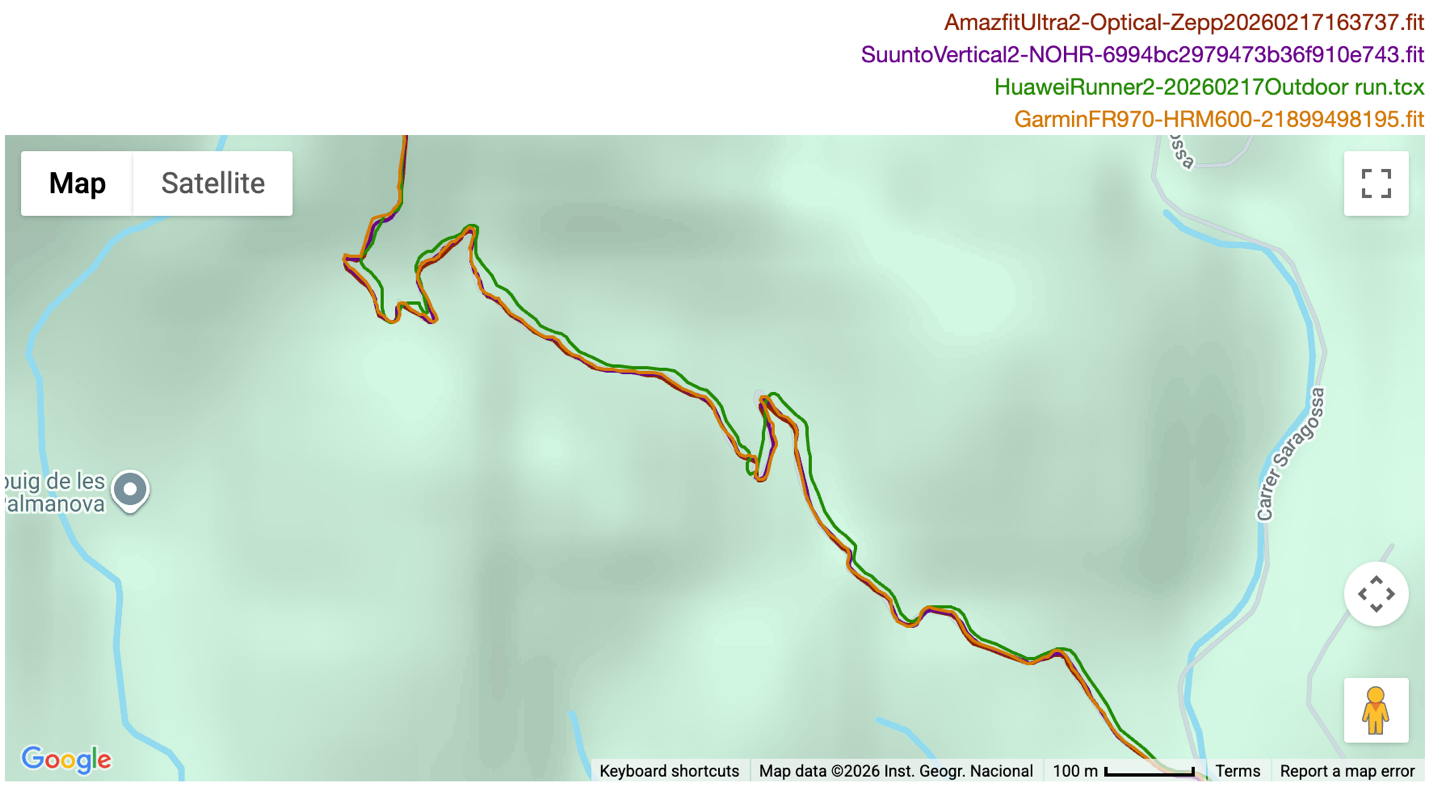
And it gets worse as I go along:
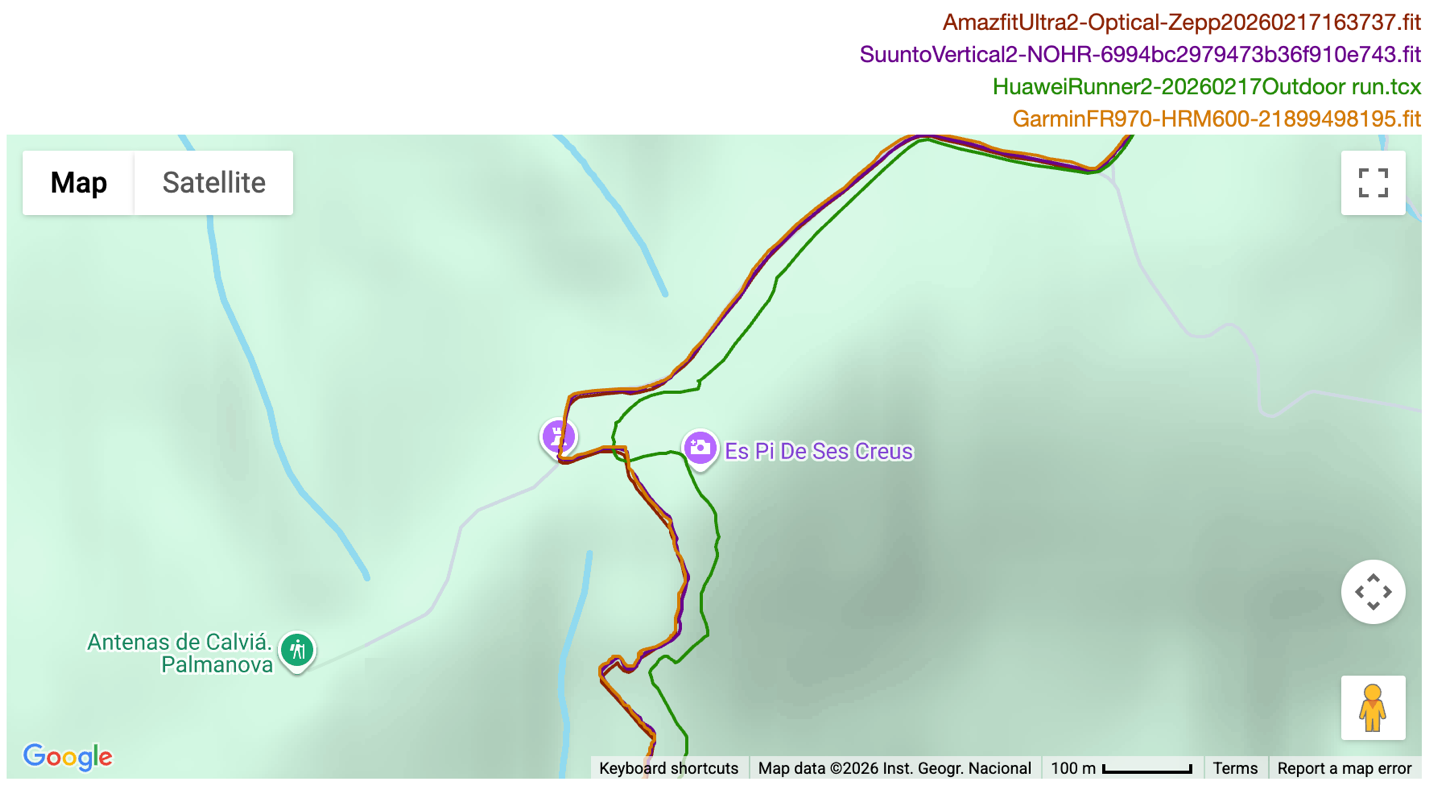
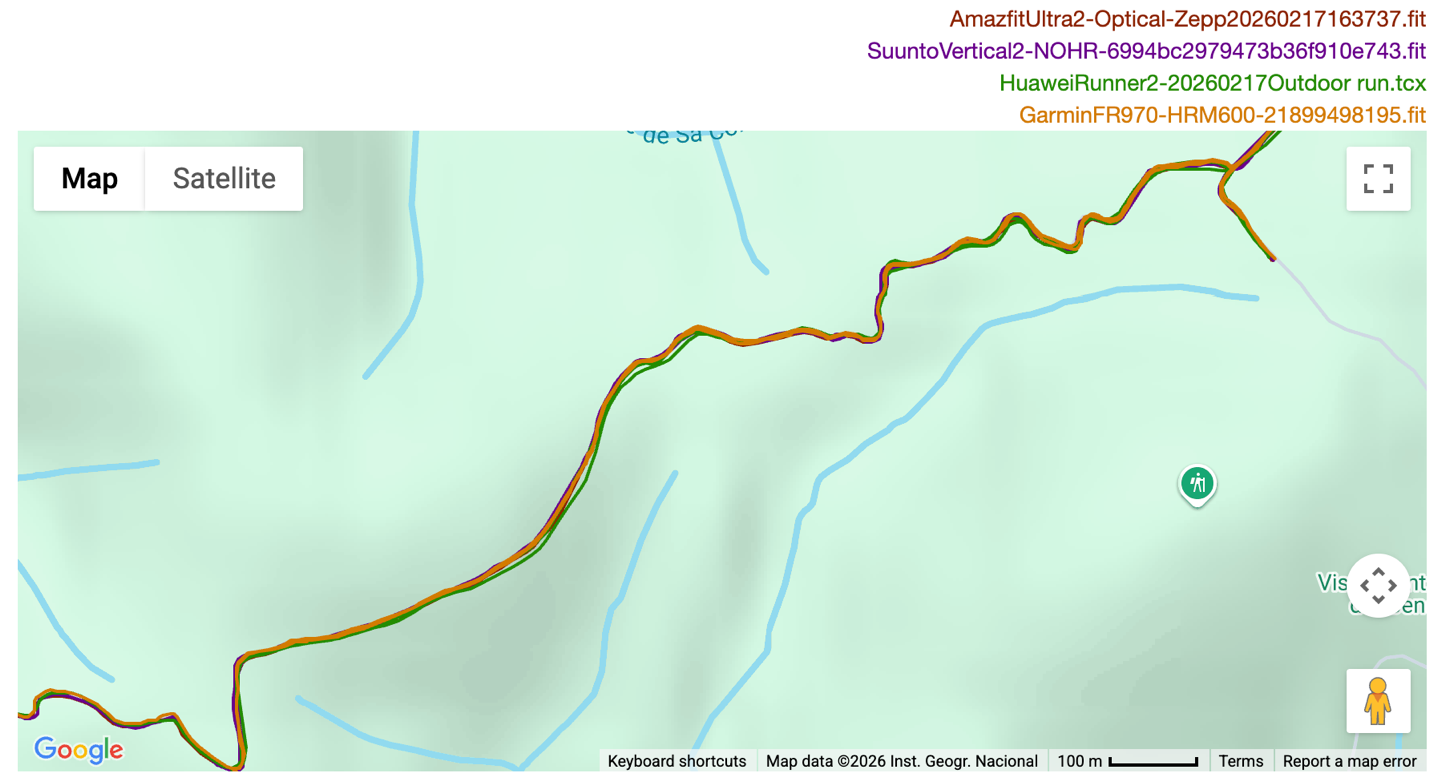
Even along the upper ridgeline (wide open skies), when in seems to get better, it’s still clearly the odd-man out, often slightly offset to the rest:
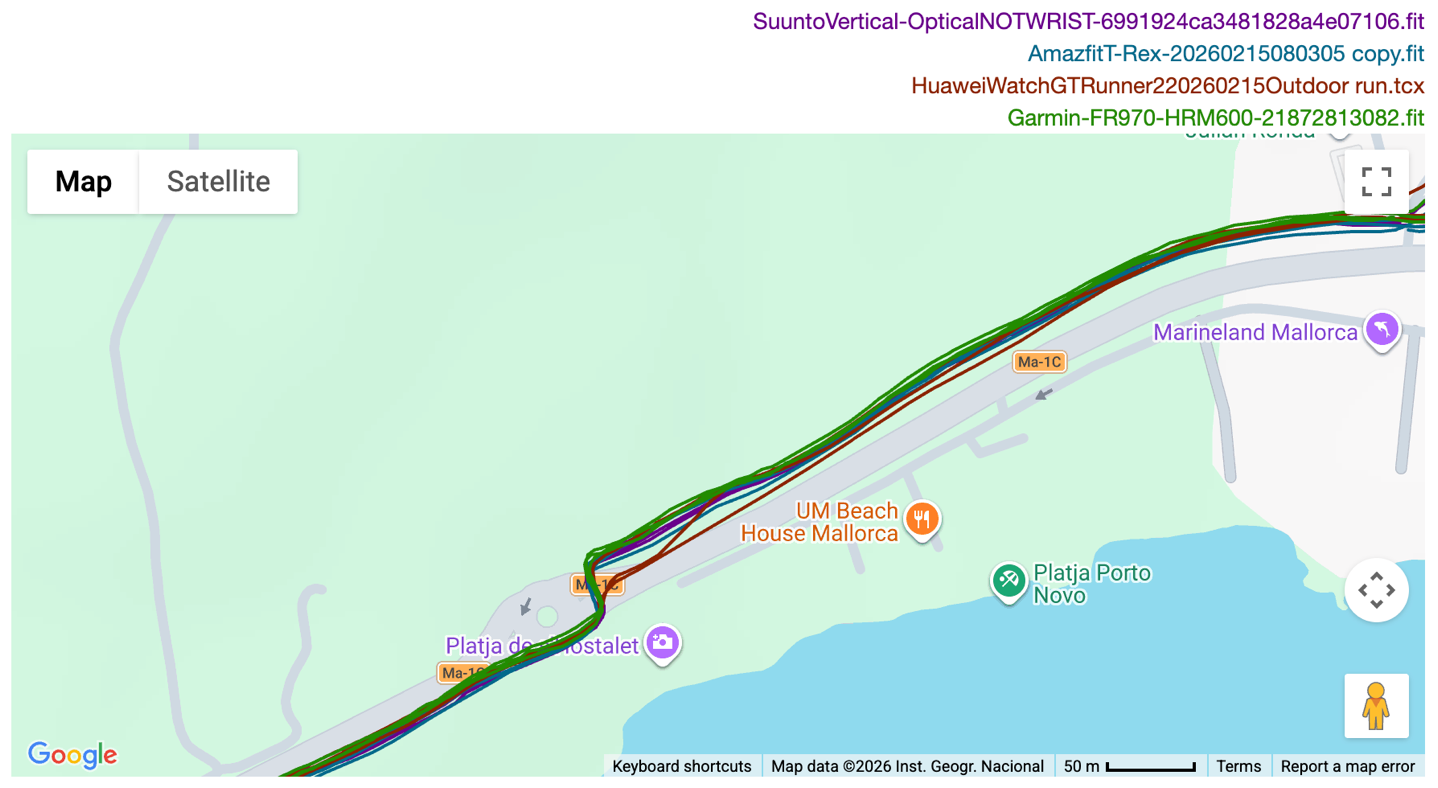
Now I’ll save you another full run on this route, as the results were similar (you can look at them here), though notably on this one, it got confused with a simple road crossing (colors have changed again):
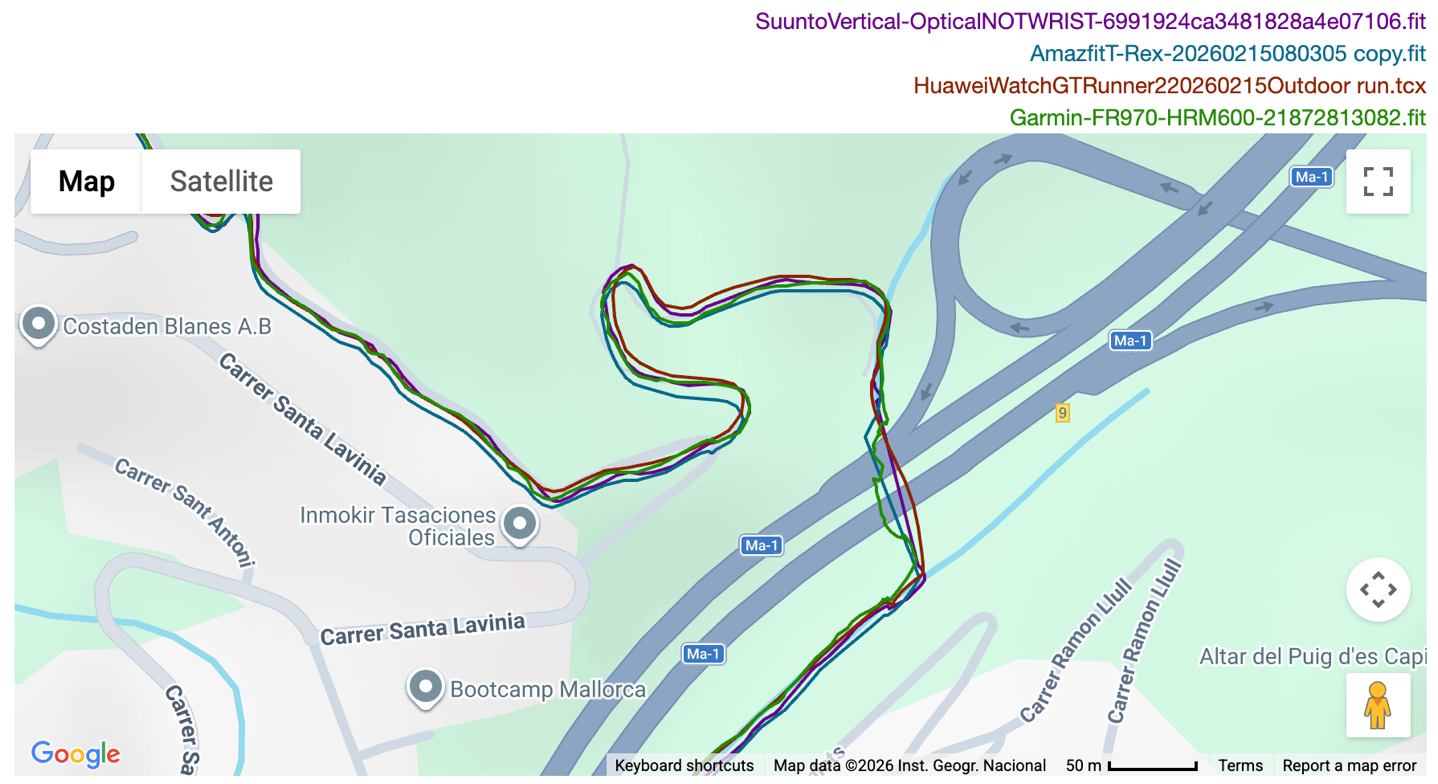
Now, there were a few cases that did handle well. For example, this section here in a long tunnel I did. You can see it did exactly as Huawei specified it’d do: Go straight. It did indeed perform better than the Garmin Forerunner 970 at that point (though, the Huawei watch made errors before/after the tunnel itself):
It should be noted that the Garmin Forerunner 970 was in so-called SatIQ mode (aka AutoSelect), which means it saves battery by changing GPS modes dynamically, scaling up to multi-band as needed if conditions are more challenging (e.g. buildings). Whereas the Huawei watch is always in multi-band. Generally speaking Garmin’s SatIQ mode is one of the best things they’ve done in recent years, though, it would make this test slightly unequal. Still, I’d argue that if SatIQ can’t handle this correctly, then that’s on Garmin.
Here’s that same tunnel on a different day, with more or less the same result from all parties (Huawei better than Garmin):
So what about city running? Unfortunately, again, this fell short. I went out this morning (just hours before the watch announces) with again, the final production firmware, for a quick up/down circuit of the tall hotel buildings in this area.
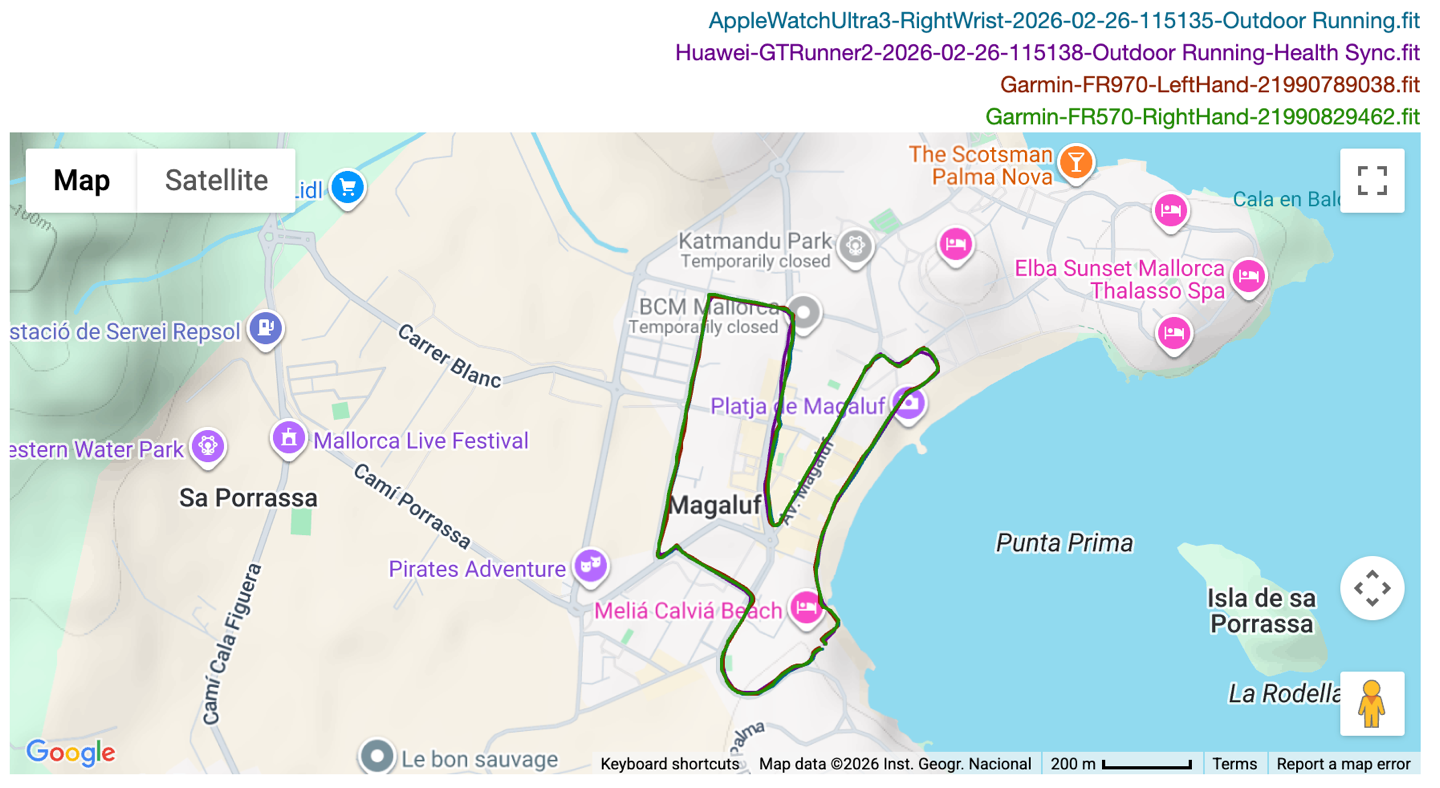
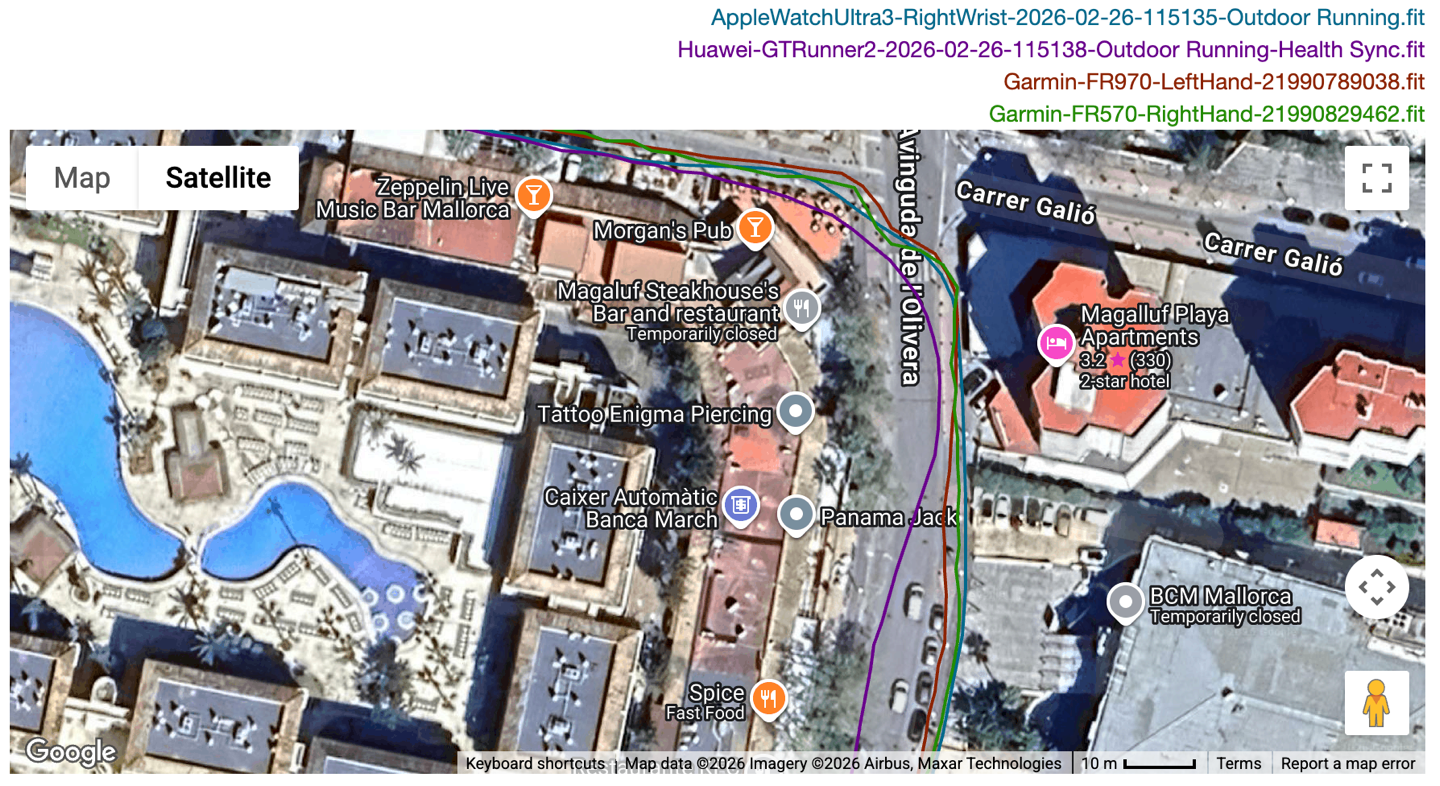
But as you can see, in purple below, the Huawei GT Runner 2 was simply inaccurate quite a bit. Below you can see see a turn I did around this block, where the GT Runner 2 appeared to lock onto the road, versus the sidewalk area I was on (and note how I go around the palm trees with the sidewalk, whereas the watch seems to lock to the road itself):
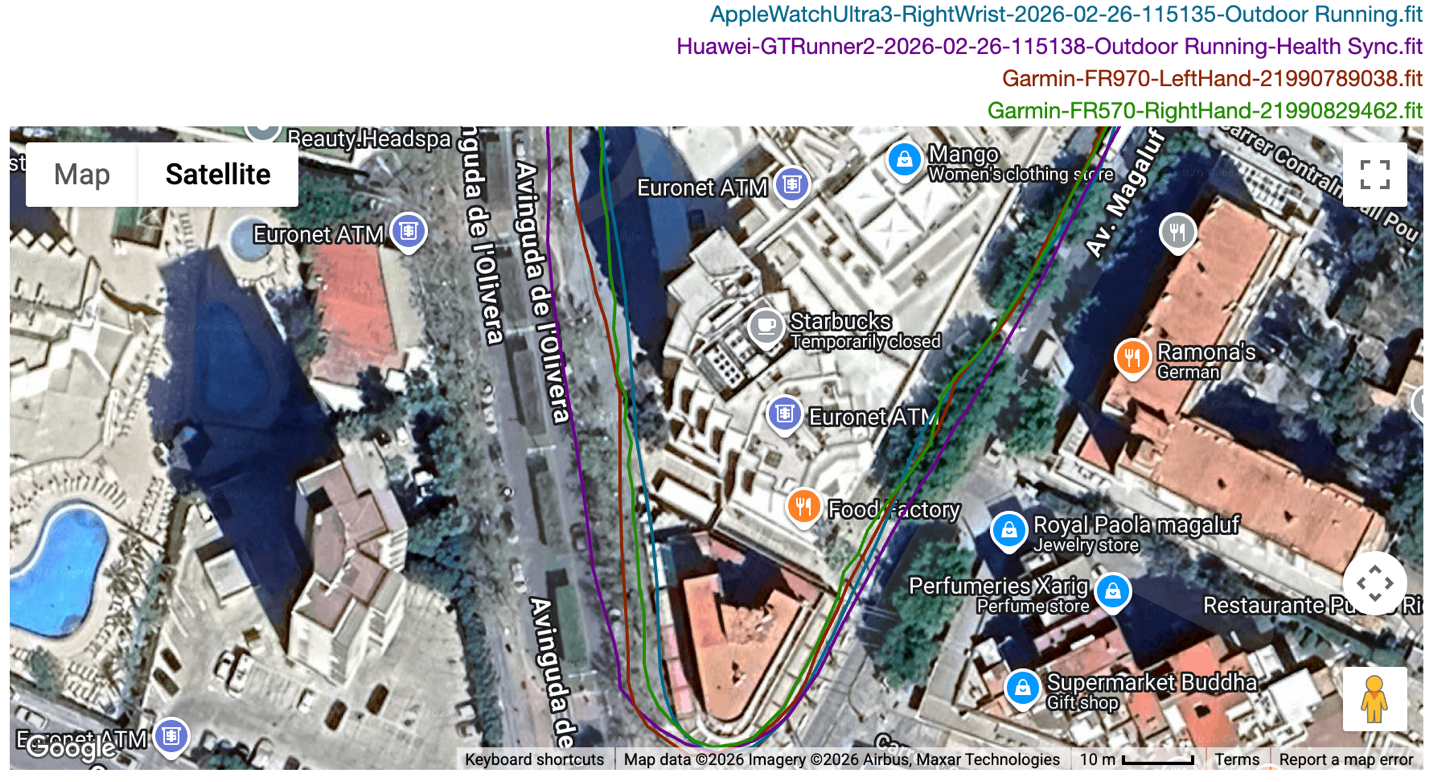
Or arguably the best single example possible, right here, where I follow the sidewalk and crosswalk, yet the watch stays on the road:
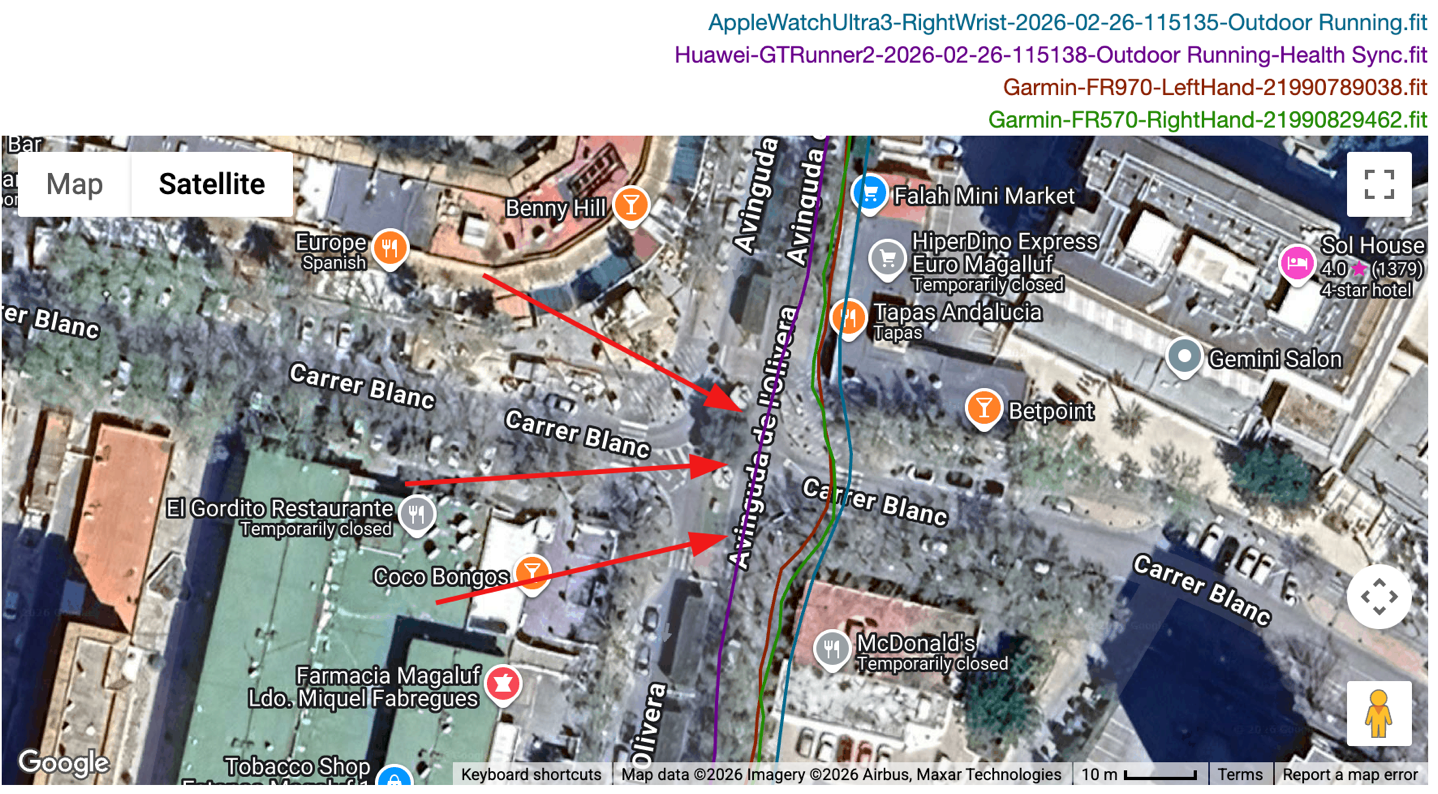
This is fundamentally why most companies *don’t* use a “lock to road” concept. Because ultimately, that’s not where runners run. And again here, it has me playing in traffic on the wrong side of the street:
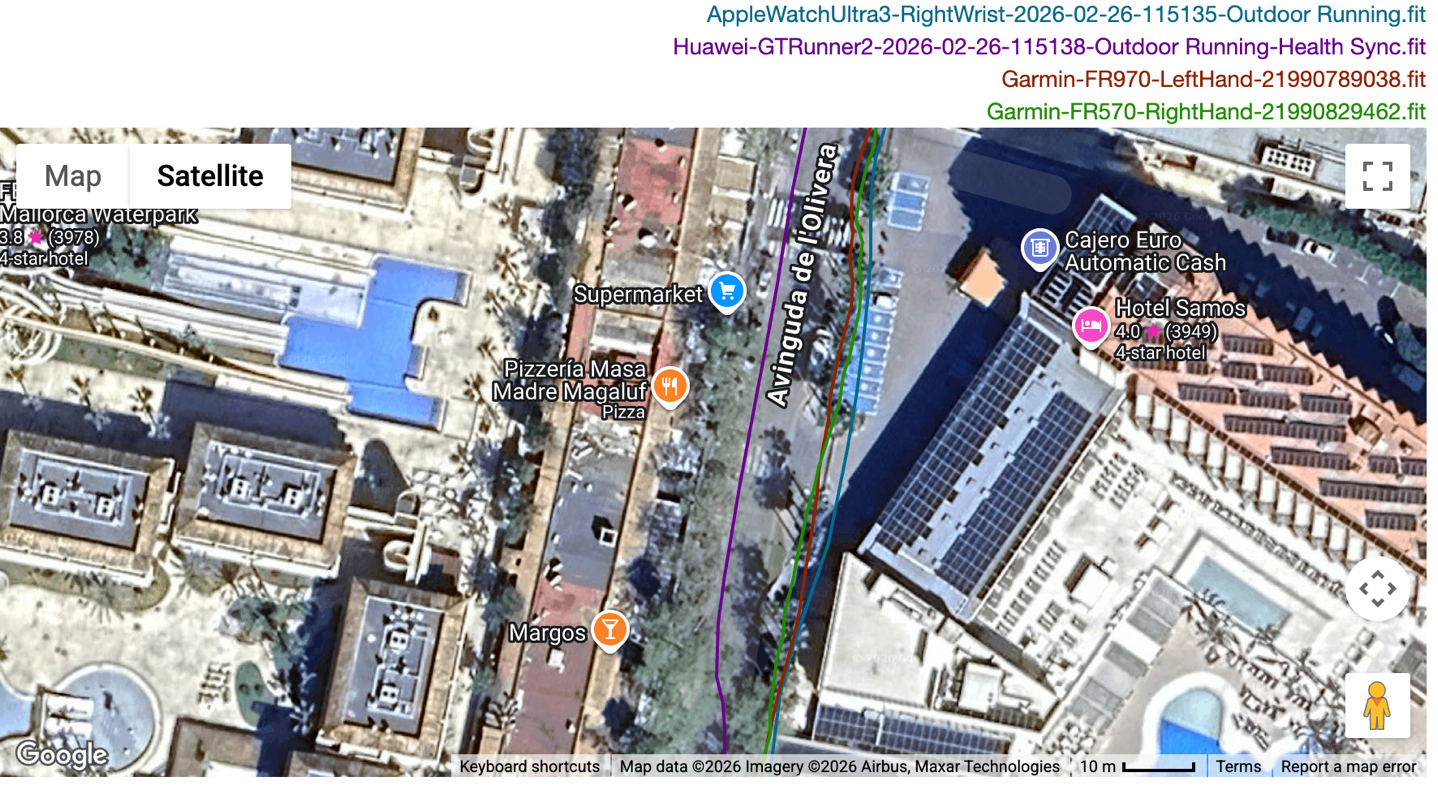
Look, I only play in traffic at night on empty roads. Not here in broad daylight, swerving in front of buses (in Magaluf, that’s served for drunk British tourists).
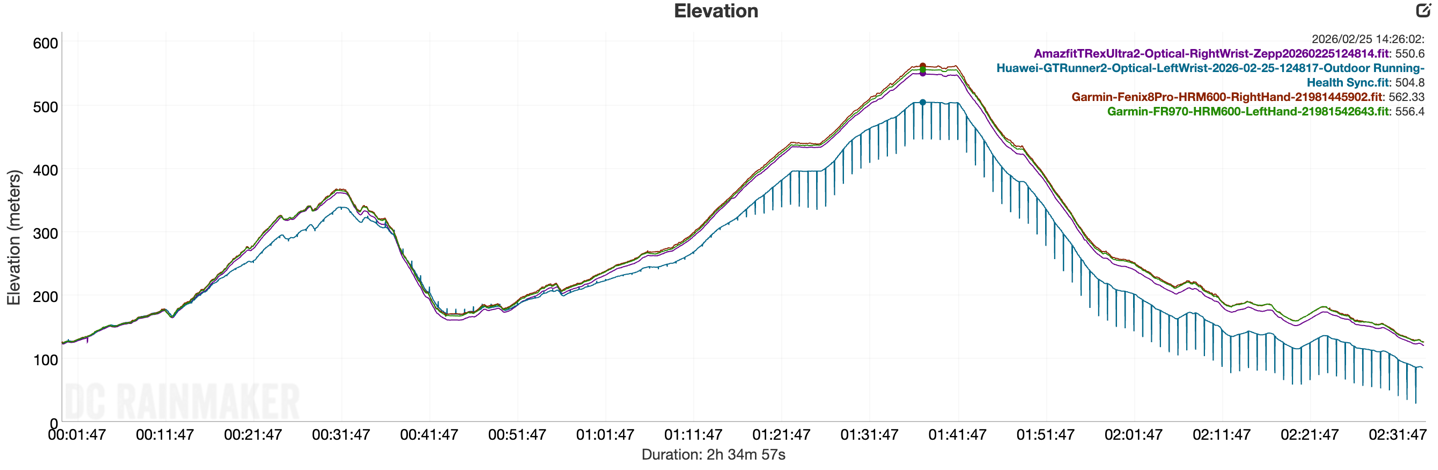
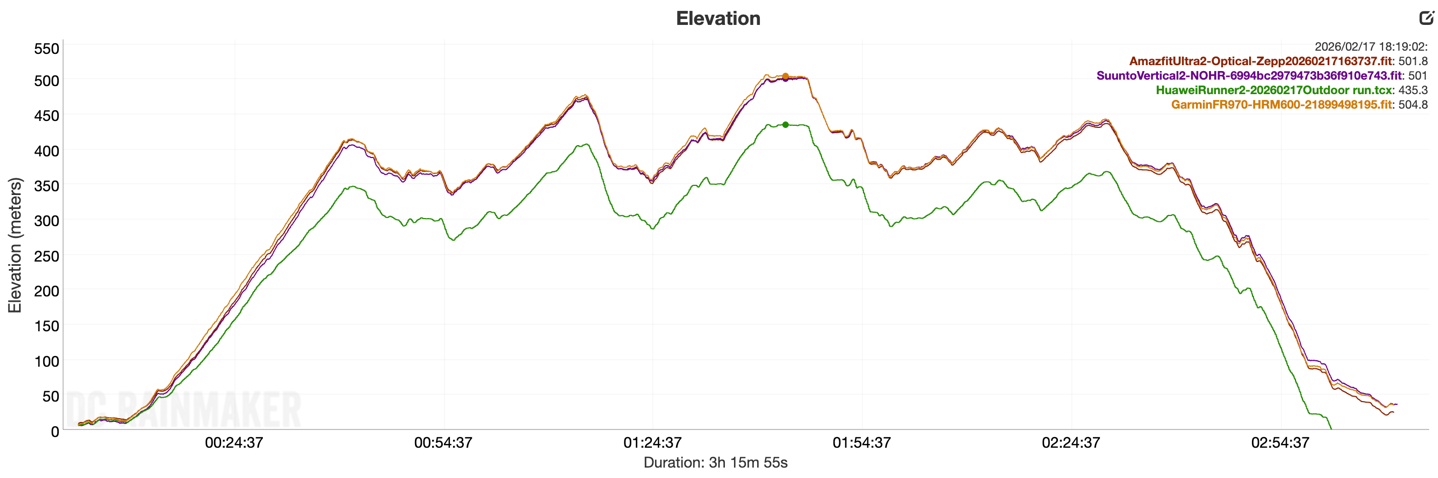
Finally, as for elevation accuracy, things weren’t great there either. On all of my runs it drifted notably. For example, yesterday’s run on the final firmware (ignore the weird drop thing, that’s just an artifact of the export process):
Or, a run from last week, where you can see the elevation deviation slowly drift, so much so that when I got back down closer to the ocean, it went negative elevation, despite not yet being at the end of the run.
Though I did have one run from about 10 days ago where it was reasonably OK:
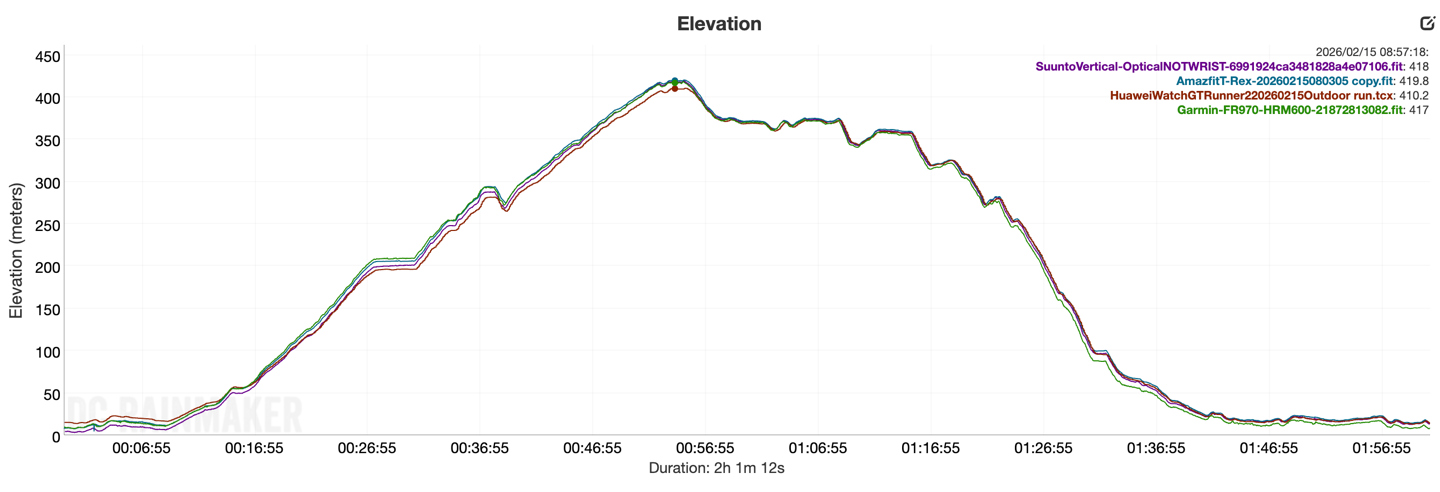
About the only difference here is that Huawei said GPS would be better on my left wrist, so that’s mostly where I wore it on recent runs, whereas on this older run it was on my right wrist. I’m not sure I should have to choose between accurate elevation or accurate GPS based on wrist preference. That sounds like some Fitbit Charge 6 GPS vs HR accuracy logic.
In any case, overall, as you can see, this is falling pretty far short of what I’d expect from a world-class leading device. While Huawei may have added a bunch of other features, and perhaps in certain city environments it’d work better, here, it’s just not working for me on what I’d describe as easy to mildly challenging scenarios. I’d hate to see what more complicated mountain/cliff (or even city) environments look like.
Though, I will say, good job on heart rate. Here’s a run and you can see it did quite well there (the bad one there is the Amazfit):
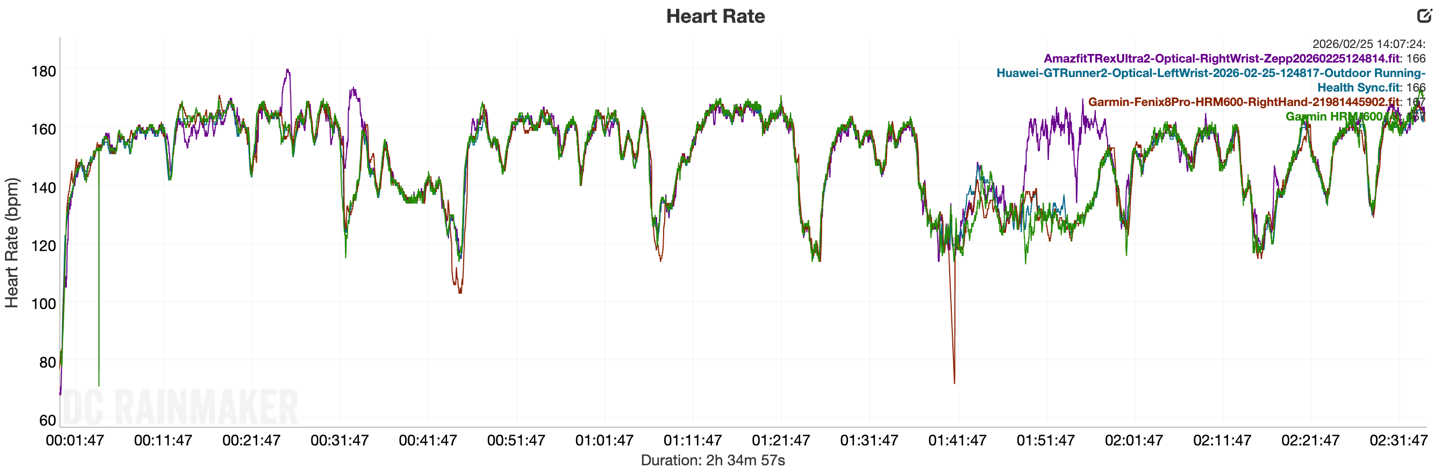
Ok, let’s get into the wrap-up.
(Note: All of the charts in these accuracy portions were created using the DCR Analyzer tool. It allows you to compare power meters/trainers, heart rate, cadence, speed/pace, running power, GPS tracks, and plenty more. You can use it as well for your own gadget comparisons, more details here.)
Wrap-Up:
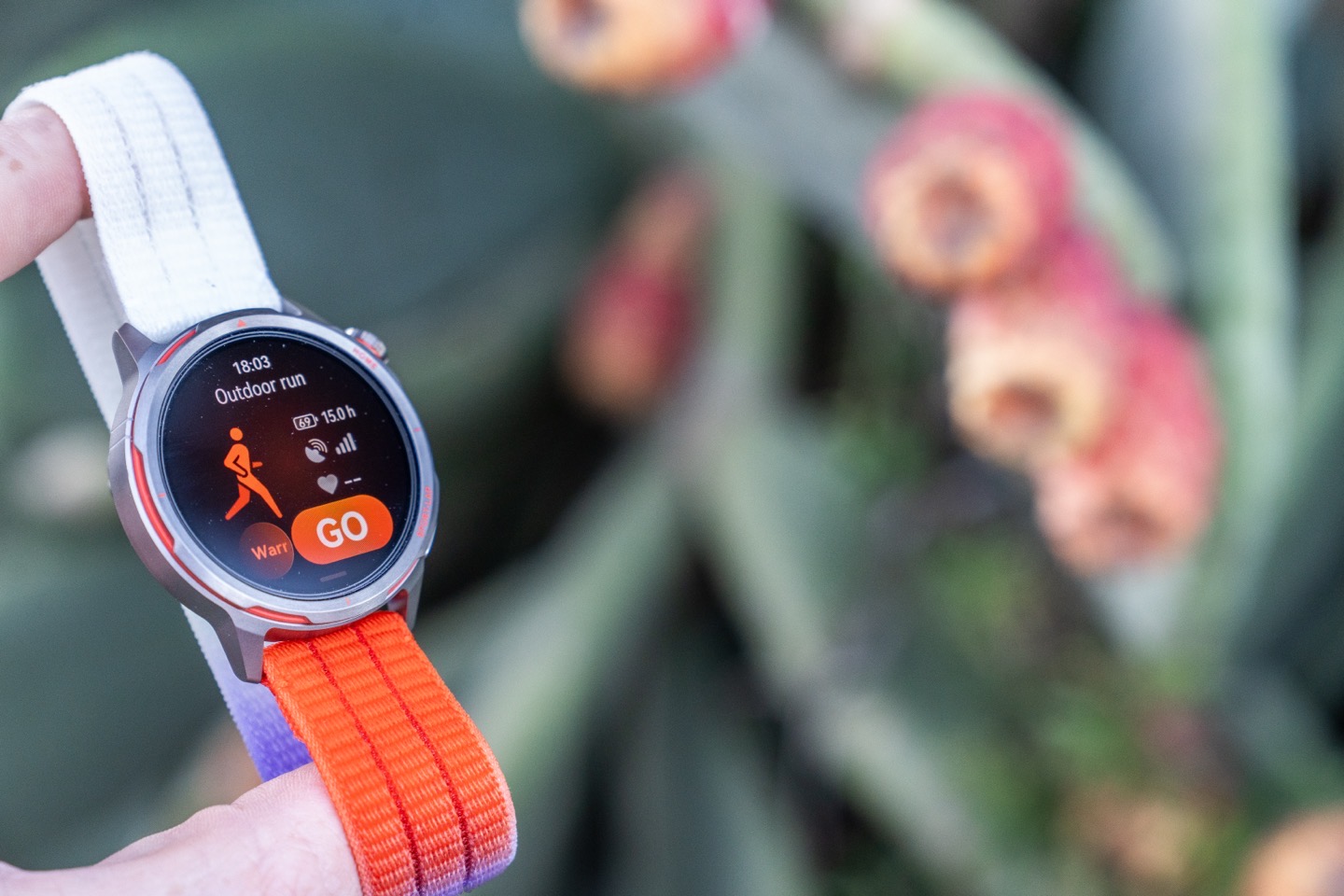
Huawei has put a lot of work into this watch, in a lot of areas – be it software, hardware design, and seemingly the much-praised GNSS antenna design. But ultimately, that key GPS accuracy feature just doesn’t seem to work well. It falls short of all of the competitor watches I compared it against, in both easy and moderate conditions. In other words, it claimed to do one thing really really well, and it didn’t do that thing even so-so.
In bringing up these results to Huawei, they noted this morning that they’ll continue to dig into them, but said that “while the hardware is universal, we have optimized the algorithms for road running (hence the focus on Marathon features) – nevertheless I’d still expect the performance to be competitive.”
I can certainly understand algorithms being optimized for one scenario or another, but nearly 20 years of GPS accuracy testing tells me that something more is amiss here. This almost seems more related to turns and inclines, than pure road vs trail. As for whether it’s fixable? Well again, looking back at those 20 years of testing, very rarely are early GPS accuracy issues fixable in software. The vast majority of the time, it’s antenna design, or other underlying pieces that are hard to fix. Certainly, there are exceptions – but they are just that, very rare exceptions, no matter the company (Apple, Garmin, COROS, Polar, Samsung, Suunto, etc…). All of those are companies that have produced initially bad GPS watch models, and been unable to fix it in software.
Which isn’t to say the whole watch is bad. I actually really do like the styling on this unit (the band is great, and does indeed dry quicker than most fabric-like bands I have). The watch case feels far more premium to me than a Forerunner 570 does (or even a Forerunner 970 for that matter), despite being cheaper. Plus, it’s got free/downloadable onboard maps, a host of training features (albeit ones most of their competitors already have), and the screen has been really solid for me even in bright sunlight conditions. Also, if you like lots of audible alerts, the watch is constantly talking to you with a very easy-to-hear speaker.
With that – thank for reading!
FOUND THIS POST USEFUL? SUPPORT THE SITE!
Hopefully, you found this post useful. The website is really a labor of love, so please consider becoming a DC RAINMAKER Supporter. This gets you an ad-free experience, and access to our (mostly) bi-monthly behind-the-scenes video series of “Shed Talkin’”.
Support DCRainMaker - Shop on Amazon
Otherwise, perhaps consider using the below link if shopping on Amazon. As an Amazon Associate, I earn from qualifying purchases. It doesn’t cost you anything extra, but your purchases help support this website a lot. It could simply be buying toilet paper, or this pizza oven we use and love.










Well, you certainly got different results than me with the GPS testing! I did find moderately parallel tracks (other of my test devices did the same, but not as much), and the switchback thing was also more pronounced with Runner 2. I did about 40 sharp turns off-road, under trees, and 6 or 8 of those from Huawel cut the corner before it happened. IDK why, but I speculate the algorithm postprocessed that based on what the accelerometer said.
Fun fact. It has a tri-band GPS chip (Beidou… no one should get excited!)
I wonder if you just have a defective unit. It just seems implausible that they’d make such a huge deal about being the best at something where they are actually just about the worst.
Also, for what it’s worth, I have definitely noticed that the AWU3 sometimes struggles with tunnels. Not all the time, but occasionally I’ll come out of a tunnel or out from under an overpass, and suddenly I’ll have picked up a ton of extra distance. 99% of the time it’s super accurate; my tracks are super clean, and it even knows which side of a fairly narrow bike path I was on, or it can tell when I deviate a few meters to toss something into a trash can. But every now and then, it just does something kinda crazy, and I’ll end up with a total distance that’s several percent off a known route. Not something that ever happened when I was using Garmin.
It’s a shame it’s not better but I can’t say I’m surprised. I have the HUAWEI GT6 Pro which seems so allergic to any sort of tree cover it’s unusable for where I run- I was really hoping they’d smash it with this one.
That being said it’s funny how the 2 guys I go to for reviews on new watches got such different results!